Why we automated email-to-Salesforce for a PE client and why it matters

Industrial Opportunity Partners (IOP), a Chicago-based private equity firm, reviews between 700 and 800 potential transactions each year. It closes only three or four. That is not just a sales pipeline. It is a high-volume screening funnel.
And when you’re processing that many opportunities, a basic problem starts to show up: the actual work happens in email, while the systems that need to track that work expect structured data.
Investment bankers send deal teasers, CIMs, financials and updates through email. For IOP’s business development team, these conversations are sourcing opportunities. Salesforce needs that information as records, fields and activities.
Manual translation kills productivity. At IOP, the Salesforce system hadn’t been meaningfully updated in years. The modernization goal was simple: build a stronger data foundation that reduces admin work and enables future capabilities.
As IOP’s business development lead put it:
“We are much more efficient and much more automated. Most importantly, we have time to work on the more value-added parts of our jobs.”
And that leads to a bigger question: What if the system could capture the work where it already happens instead of asking people to recreate it somewhere else?
The intelligence gap: why vs. what
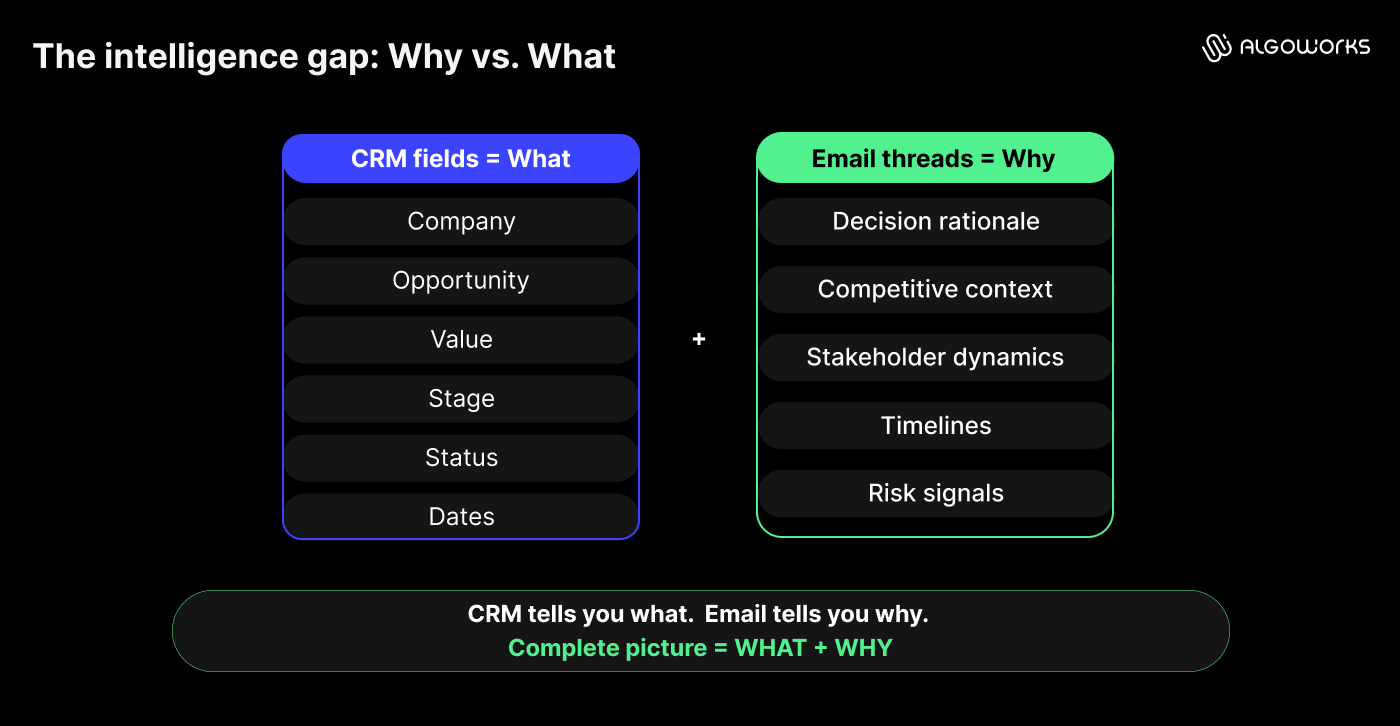
A CRM record and an email thread tell you very different things.
| Source | What it typically contains |
| CRM fields | Company, opportunity, value, stage, status and dates |
| Email threads | Decision rationale, competitive context, stakeholder dynamics, timelines and risk signals |
The distinction is simple: Email contains the “why.” CRM fields contain the “what.” This is why CRM workflow automation matters; it bridges the gap.
An opportunity record shows company stage and value. The email shows the CFO’s timeline, competing firms, supply chain concerns and process acceleration signals. This context is what shapes real decisions:
- Timeline urgency (“CFO pushing for Q4”)
- Competitive pressure (“Another sponsor bidding”)
- Risk factors (“Supply chain concerns”)
- Stakeholder dynamics (“Management wants different terms”)
- Process signals (“Preliminary LOI in 45 days”)
Without capturing this in your data foundation, your CRM tells only half the story. Manually pulling this information doesn’t scale. For IOP, the goal wasn’t better data entry; it was eliminating it. The business development team could spend time on what matters: relationships, evaluation and sourcing.
Building the data foundation: The four core questions
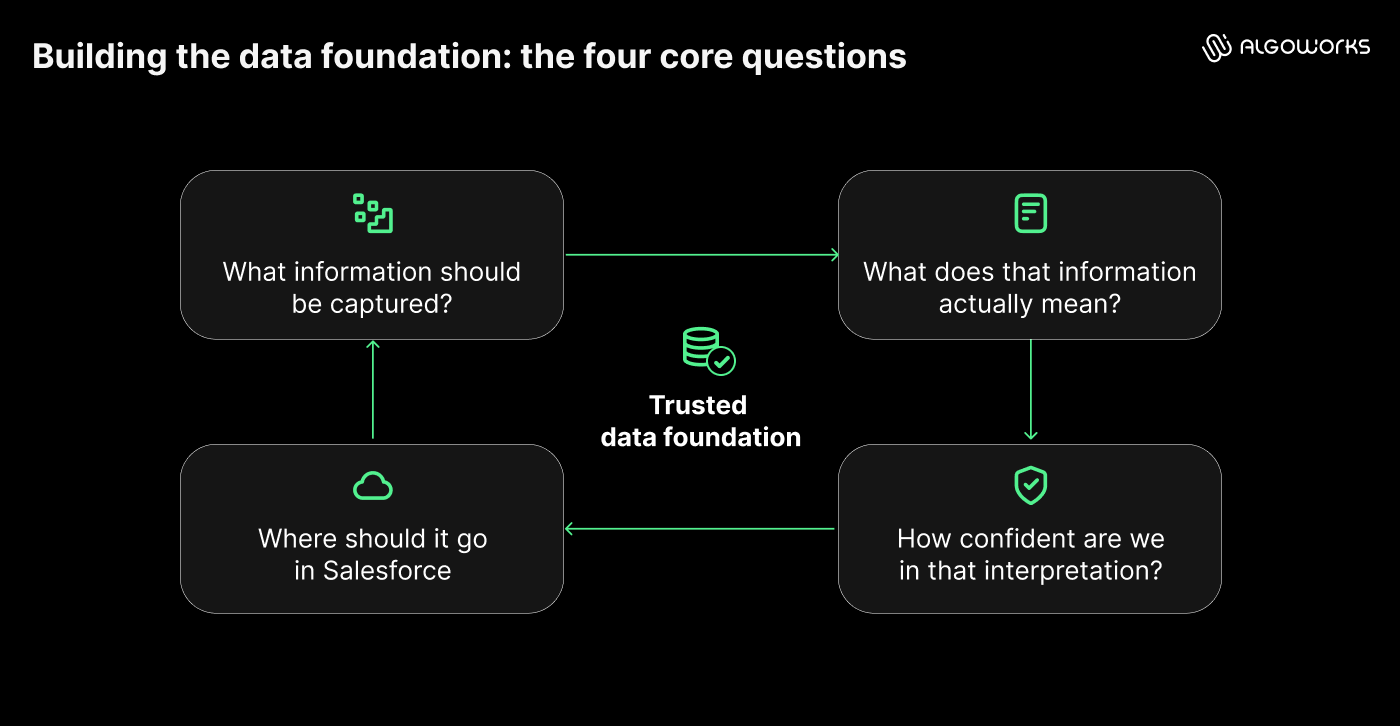
A scalable approach has to answer four basic questions. First, you need data preparation for AI before building automation:
Question 1: What information should be captured?
Deal-related communication needs to flow into the system; via email forwarding, API integration or middleware. The principle: don’t let important information stay trapped in individual inboxes. Attachments matter because emails often reference documents with critical deal context.
Question 2: What does that information actually mean?
The system should extract:
- Companies and accounts (existing vs. new)
- Contacts and decision-makers
- Deal values and transaction sizing
- Timelines and closing signals
- Competitive context (who else is bidding?)
- Risk signals (supply chain, legal, structural)
- Follow-up requirements (next steps, actions)
For example: “The CFO wants to close by Q4” signals urgency. “Another sponsor is also bidding” is competitive context. The goal is to turn unstructured communication into information Salesforce and downstream processes can use; building a reliable data foundation.
Question 3: How confident are we in that interpretation?
The system needs to figure out what information belongs to. Is the company already in Salesforce? Is there an existing Opportunity? Wrong answers create duplicates and pollute your data foundation.
| Confidence level | Extraction quality | Automatic action | Timeline |
| High (>85%) | Exact match, clear value, known contact | Auto-create | Immediate |
| Medium (50-85%) | Partial match, fuzzy name, new contact | Flag for review | 24-48 hours |
| Low (<50%) | Ambiguous, conflicting signals | Manual queue | Assessment |
This tiered routing protects your data foundation by separating routine automation from judgment.
Question 4: Where should it go in Salesforce?
A practical approach separates straightforward cases from ambiguous ones: high-confidence → automate, ambiguous → flag for review, low-confidence → manual queue. Critical distinction: Remove people from routine processing. Keep them for judgment calls. This matters in private equity; wrong information affects opportunity evaluation. Automation handles routine cases. Humans handle decisions.
Why this is more than email automation
Traditional email-to-CRM solves logging. The bigger opportunity is extracting business context from unstructured communication. Before: Email = administrative work Now: Email = structured, searchable context Next: Context supports intelligent workflows
Salesforce is bringing emails and documents into the data foundation used by Agentforce. CRM picks up signals from where work happens; not just recording what happened.
Why the data foundation matters right now
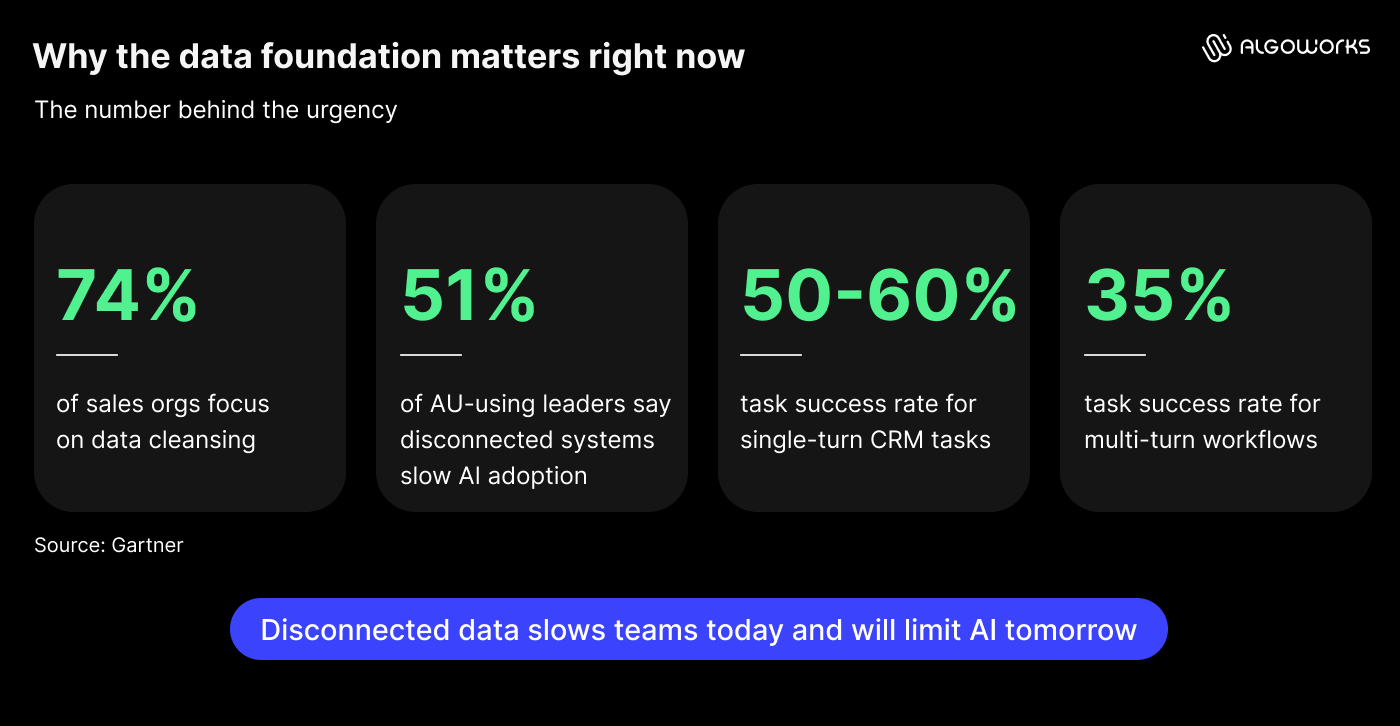
The enterprise data reality
| Metric | Finding | Implication |
| Data Cleansing Priority | 74% of sales organizations focusing on data cleansing | Data quality is now THE competitive issue |
| System Disconnection | 51% of AI-using leaders say disconnected systems slow AI initiatives | Integration problems block modernization |
| Agent Single-Turn Success | 50-60% success rate on CRM tasks | Agents need complete, trusted context |
| Agent Multi-Turn Success | 35% success on multi-turn workflows | Current agents struggle with workflow complexity |
Your data foundation must be in place BEFORE agents arrive. This is why Agentforce readiness requires clean, structured data. Recent research shows reliability gaps in complex workflows. The answer isn’t more technology; it’s reliable data + context + governance. Email-to-Salesforce automation builds the data foundation for intelligent processes.
The architectural tradeoffs matter
Automation vs. verification: the fundamental tradeoff:
| Approach | Speed | Data quality | Scalability | Challenge |
| Manual review everything | ✗ Slow | ✓ Perfect | ✗ Bottleneck | Defeats automation purpose |
| Auto-create everything | ✓ Fast | ✗ Variable | ✓ Scales | Pollutes data foundation |
| Confidence-based routing | ✓✓ Good | ✓✓ Good | ✓✓ Scales | Requires explicit governance |
Tiered confidence routing: automate high-confidence cases, flag ambiguous ones. This protects your data foundation while scaling.
Other key decisions:
- BCC forwarding: fast to implement, user-dependent
- API integration: more scalable, more implementation effort
- Entity matching: fuzzy with confirmation gates balances accuracy and coverage
What changed for IOP: building a stronger data foundation
The before/after: creating foundation for growth
| Dimension | Before modernization | After building data foundation | Business impact |
| System status | Years without meaningful updates | Modern, governance-controlled data foundation | Ready for next-phase automation |
| Admin work | Manual CRM entry + email processing | Auto-extraction + human verification | 60-70% time recapture |
| Data visibility | Deal context scattered across email | Structured, searchable Salesforce context | Better decision-making |
| Team focus | Divided (email + CRM work) | Unified (relationships + evaluation) | More time on value-added work |
The biggest outcome: more time for value-adding work. As IOP’s business development lead put it:
“The really fun part is I get to talk to investment bankers and interesting companies all day long. But there’s a big part of my job that’s been administrative.”
The automation freed time for relationships and evaluation instead of CRM updates. The solution was tailored to IOP’s specific processes not a pre-built pattern.
“They’ve really excelled and been helpful in listening to our business needs and the frustrations and pain points that we had and really translating that into a technical solution.”
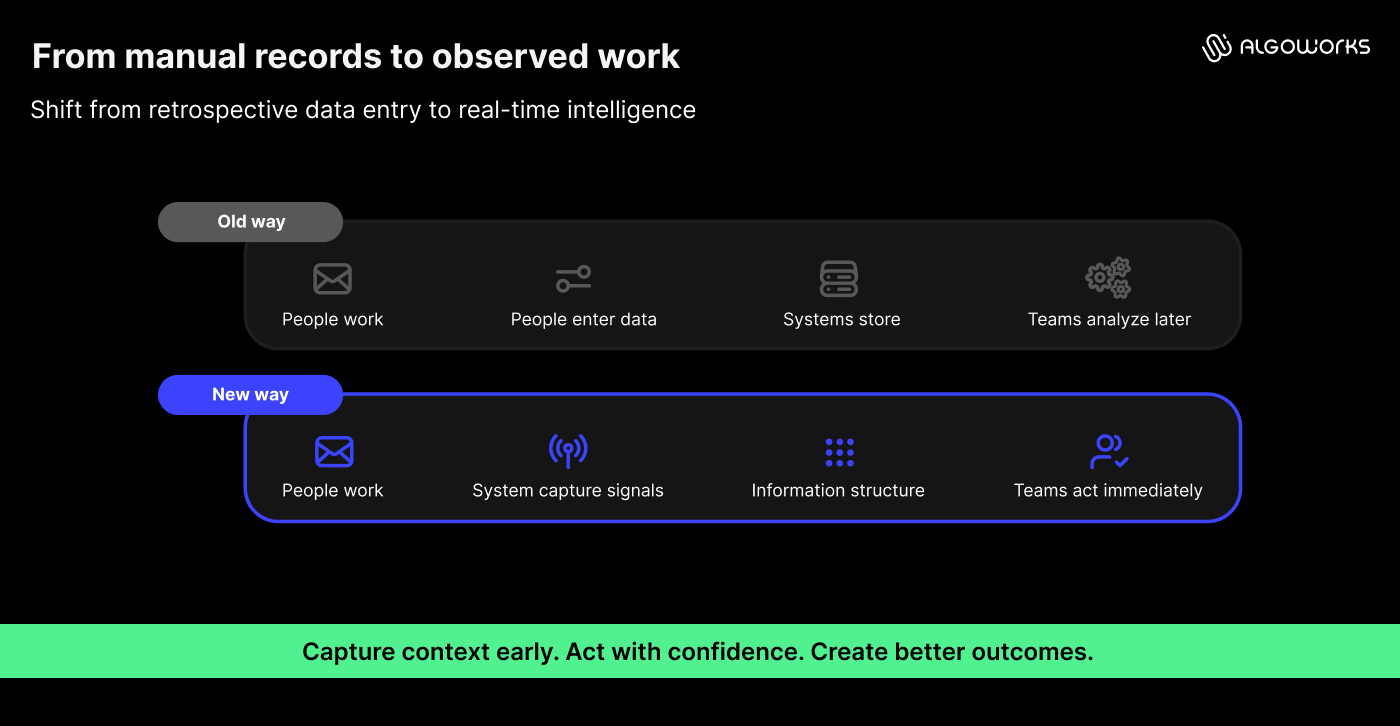
From manual records to observed work
The model evolution is critical. Moving from manual entry to Salesforce modernization means systems capture work instead of people recreating it.
- Old approach: People do work → People enter data → Systems store → Teams analyze later
- Better approach: People do work → Systems capture signals → Information is structured → Teams act immediately
For PE firms, this shift is critical: bankers won’t stop using email. The solution connects systems so deal communication automatically feeds Salesforce, building a data foundation that adapts to where work already happens.
The foundation for what comes next
Email-to-Salesforce automation is not the end state. It is a data foundation. Today, the immediate value comes from reducing manual work, improving information flow and giving teams more time for high-value activities. The next opportunity is to use that structured context for increasingly intelligent workflows.
Two different CRM records
- Traditional: Opportunity: $50M manufacturing, Stage: Early
- With captured context: CFO driving timeline, Q4 close, competitor bidding, supply chain concern
The second gives richer decision context. This context can’t be reconstructed from CRM fields; it must be captured from the work itself. That’s why the data foundation comes first: Complete data + trusted context + governance = foundation for intelligent automation.
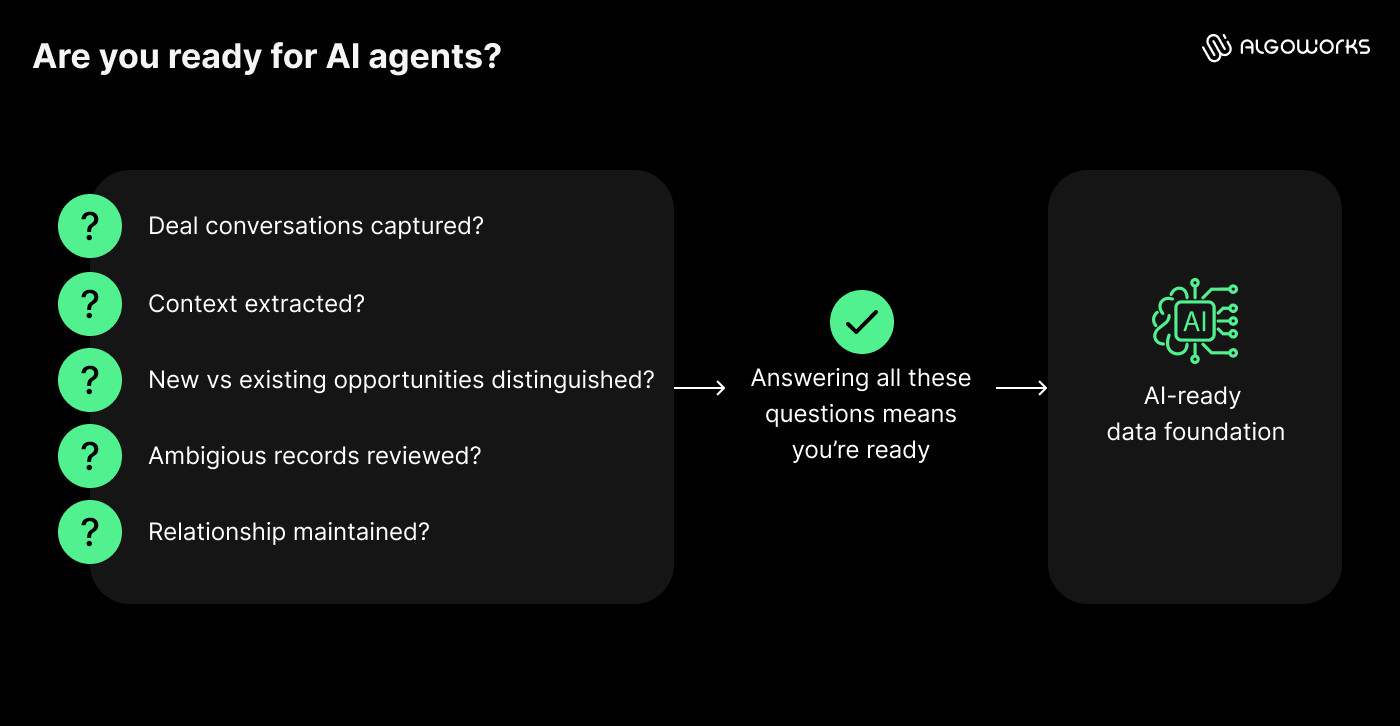
The 2027 question: are you ready for AI agents?
The more important question for enterprises isn’t “When will AI agents arrive?” but “Will our data foundation be ready when they do?” That’s the foundation for Agentforce at scale. For a PE firm:
- Are deal conversations captured?
- Is context extracted?
- Can the system distinguish new from existing opportunities?
- Are ambiguous records reviewed?
- Are relationships maintained?
IOP started with a practical problem: too much administrative work. The solution addressed that while building a stronger data foundation for what comes next. That’s why this story matters. It isn’t about automating email. It’s about connecting where work happens with where business information needs to live. As systems become more intelligent, that connection becomes critical. Build the data foundation first. Then make the technology work harder for people.
Connect your systems. Modernize your operations.
Manual data entry is often a symptom of a larger problem: business processes and systems aren’t working together as well as they could. At Algoworks, we help organizations modernize Salesforce, connect business systems and automate repetitive workflows around the way their teams actually work.
Want to identify where Salesforce automation could take work off your team’s plate? Talk to Algoworks about your Salesforce modernization and automation goals.