The hidden cost of manual CRM work in deal sourcing

Most private equity firms evaluate 80 investment opportunities [Axial] to close just one deal. That’s a 1.48% conversion rate [Axial].
The math seems simple. The reality is painful: your sourcing team spends massive amounts of time processing opportunities that will never close. When that process is manual, CRM administration becomes the biggest bottleneck in your pipeline.
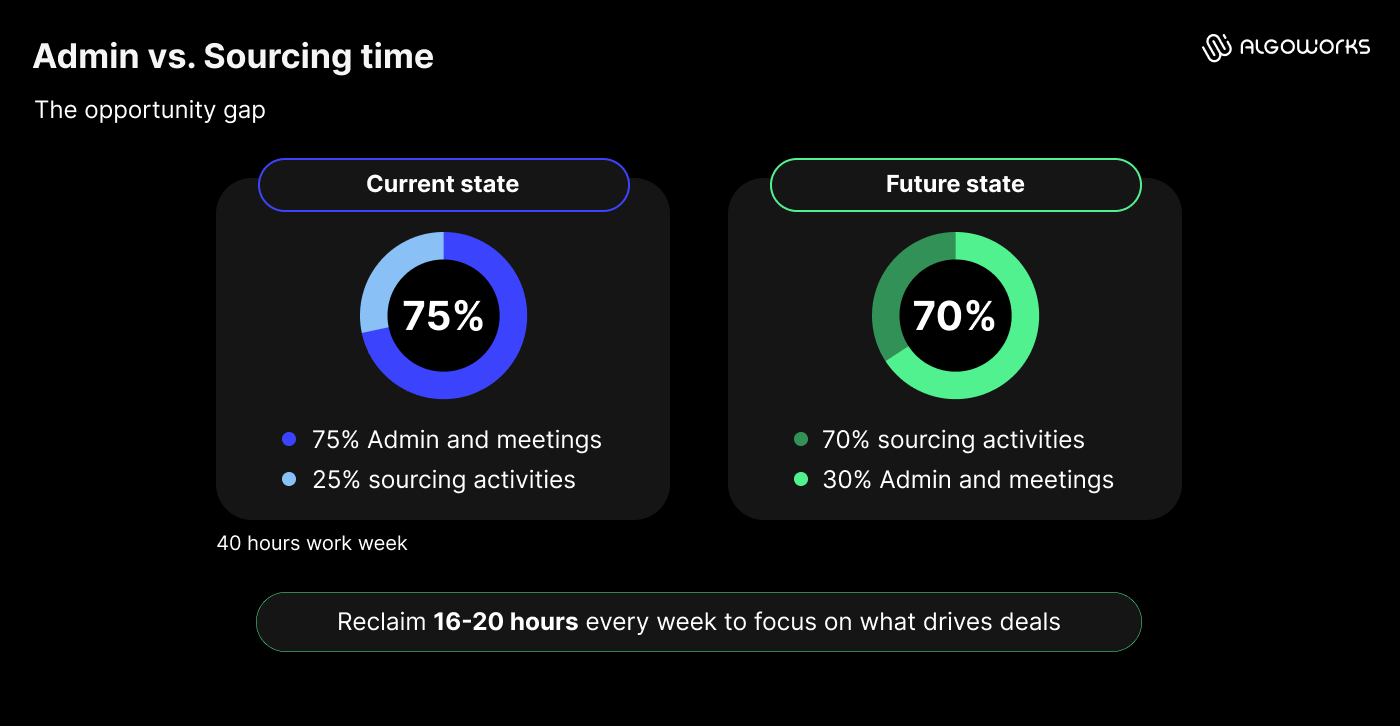
Here’s what’s happening across PE firms right now: business development professionals spend 60% of their workweek [Salesforce State of Sales 2026] on administrative tasks instead of sourcing. For a sourcing professional, that means roughly 24 hours per week on data entry, pipeline updates and CRM corrections.
This isn’t a productivity problem. It’s an economics problem.
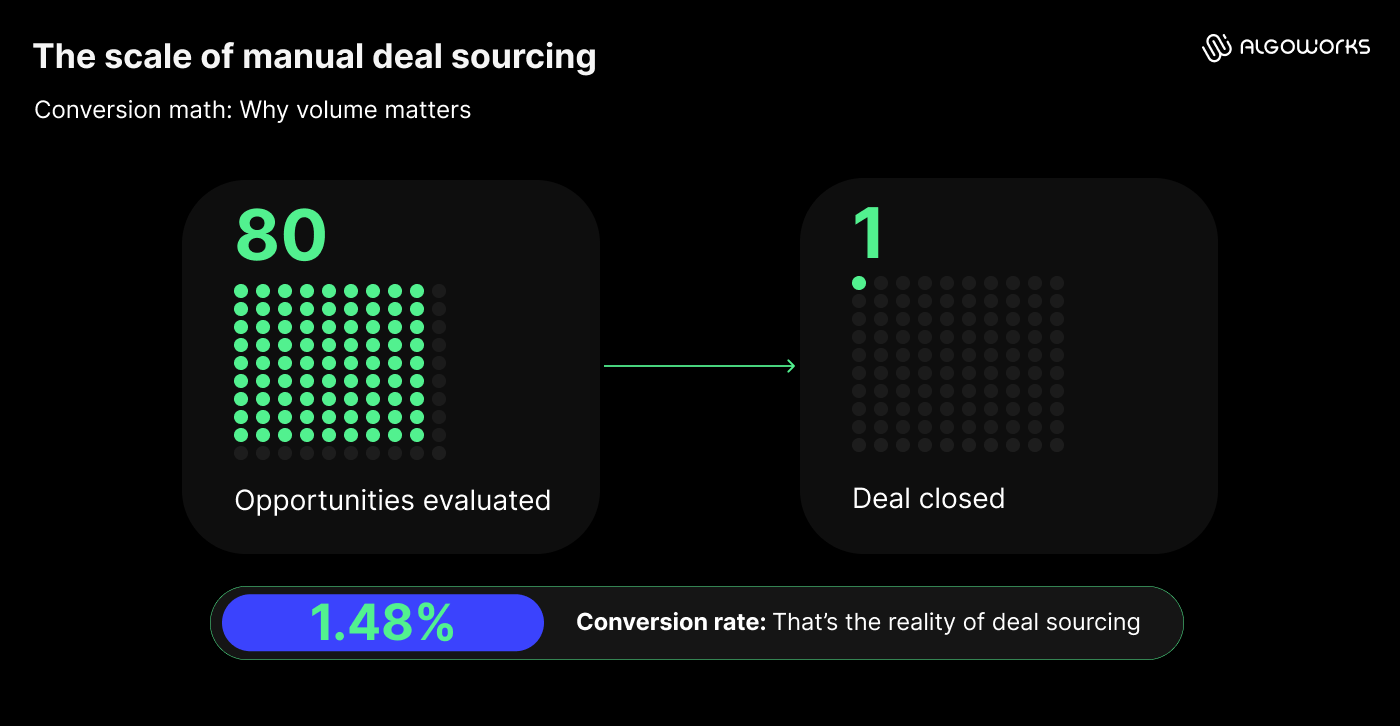
The scale of manual deal sourcing work
A typical mid-market PE firm must process hundreds of deals annually to identify a small number worth pursuing.
According to Axial’s research on PE deal sourcing: the average firm evaluates 80 opportunities [Axial] before closing a single deal. This 1.48% conversion rate [Axial] is structural. It’s not inefficiency. It’s the deal sourcing business model.
This means 99% of transaction volume generates no return. But all of it requires processing, assessment and pipeline tracking.
Where sourcing professionals actually spend their time
Research from Salesforce’s State of Sales 2026 report shows what really happens during a sourcing professional’s workweek:
| Activity | Time per week | Percentage of 40-hour week |
| CRM data entry and note-taking | 6-8 hours [Salesforce] | 15-20% [Salesforce] |
| Administrative tasks (corrections, data cleanup) | 5-8 hours [Salesforce] | 12-20% [Salesforce] |
| Internal meetings and forecasting | 6 hours [Salesforce] | 15% [Salesforce] |
| Email and scheduling | 5 hours [Salesforce] | 12% [Salesforce] |
| Research and information gathering | 5-6 hours [Salesforce] | 12-15% [Salesforce] |
| Actual deal sourcing and banker conversations | 8-10 hours | 20-25% |
Total administrative overhead: 21-32 hours per week. Total sourcing time: 8-10 hours per week. The consequence is direct. Sourcing professionals spend more time on data entry than they spend finding deals.
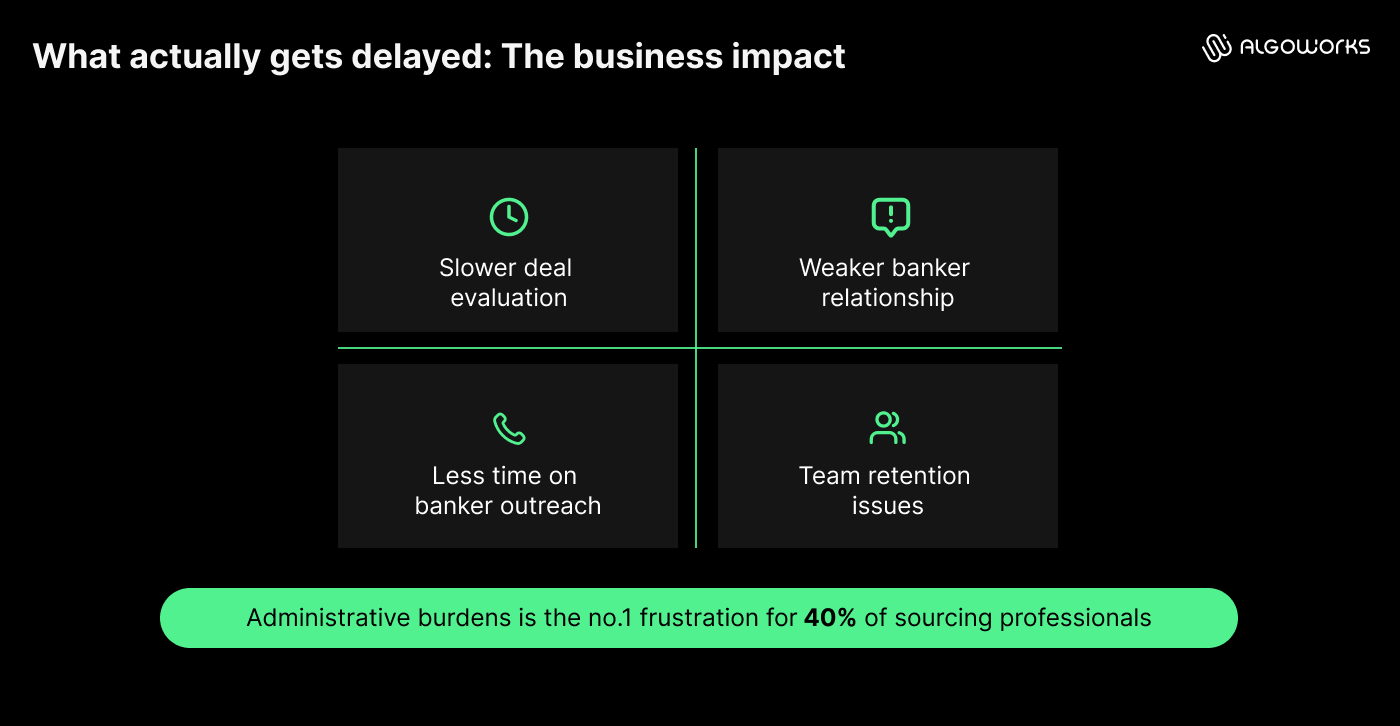
What actually gets delayed: the business impact
A banker sends a deal to your team on Monday morning. Your sourcing professional receives it. Then the work begins: logging the company into Salesforce, creating a record, adding the contact information, writing a summary, setting up a timeline.
Meanwhile, the banker has already sent the same deal to three other PE firms. Those firms are evaluating simultaneously. If your internal process takes two days instead of one, you’re already behind.
According to Salesforce research: 68% of sourcing professionals [Salesforce State of Sales 2026] say note-taking and data input are their most time-consuming tasks. This administrative work directly delays decision speed.
Weaker banker relationships
When a banker calls back with a follow-up question about a deal from two months ago, what happens? Your sourcing professional searches for notes. The insights you captured are scattered across emails and Salesforce records. Critical context is missing because the notes were taken days after the call.
The banker senses incomplete knowledge. The conversation becomes transactional instead of strategic.
Less time on banker outreach
Sourcing professionals have a fixed number of hours. Every hour spent on CRM updates is an hour not spent on banker calls.
This is opportunity cost. You’re not calling bankers to ask about their current deal flow. You’re not building the relationships that surface the best opportunities first.
Team retention issues
Your best sourcing professionals are leaving. The reason isn’t compensation. It’s that 20-30% of their day is data entry, not deal sourcing.
According to HubSpot research: 40% of sales and sourcing professionals [HubSpot 2025] cite administrative burden as their top frustration. When talented people spend a quarter of their day on work that produces zero value, retention suffers.
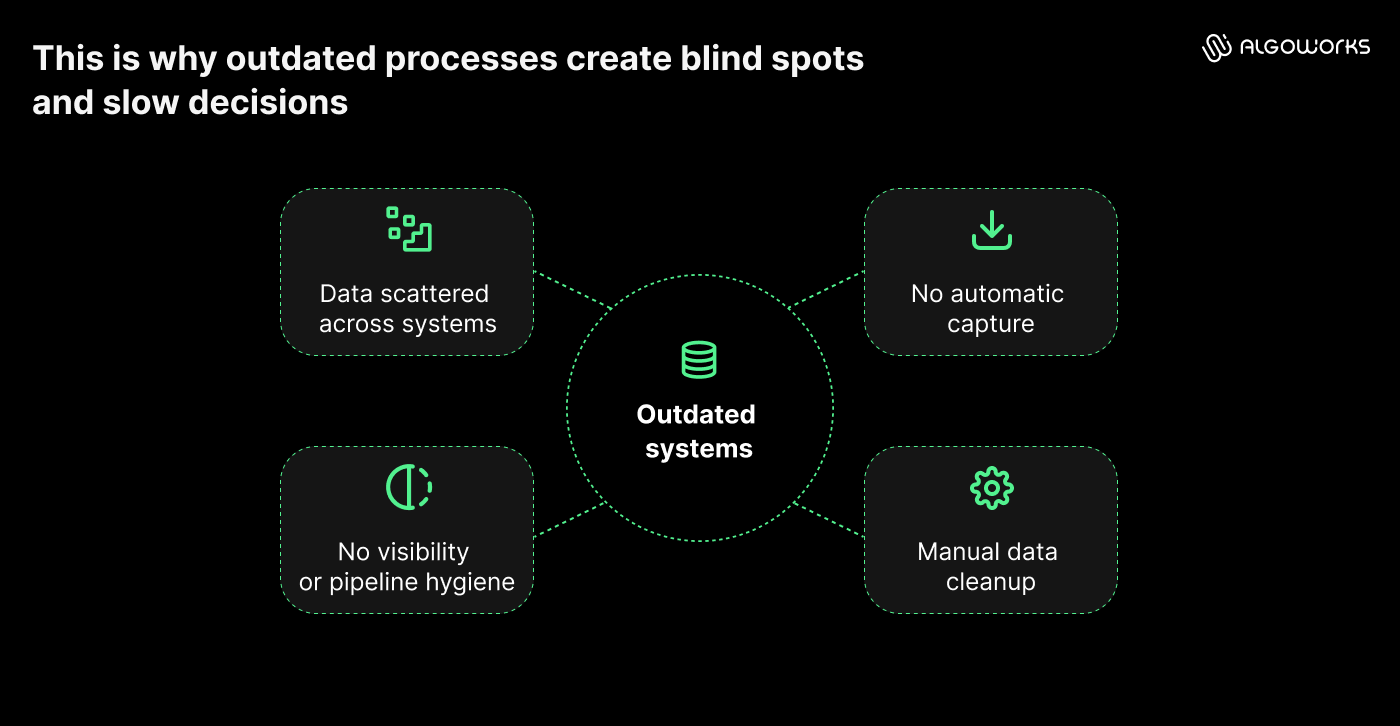
Why outdated systems make this worse
Most PE firms have Salesforce instances that haven’t been updated in years. The structural problems:
Data is scattered across systems
Deal information lives in emails, Slack messages, meeting notes, spreadsheets and Salesforce. A banker mentions a company name. Your sourcing professional searches three different systems just to remember the context. Data lives in multiple places. None are authoritative.
No automatic capture
When a banker emails a term sheet or transaction summary, someone manually copies key information into Salesforce. But what if your system could capture this automatically? Learn how smart PE firms are solving this by automating email-to-Salesforce workflows. The company name, revenue, contact; all extracted in seconds.
Data decay is constant
Because updating CRM records manually is tedious, records become stale. A deal marked “active” is actually dead. The last update was six weeks ago. The contact information is outdated. Your pipeline report shows deals that aren’t real.
Process inconsistency
Your newest sourcing associate updates deals one way. Your senior person updates them differently. There’s no standard for what information goes where. When you search for deals matching specific criteria, you’re not confident you found everything.
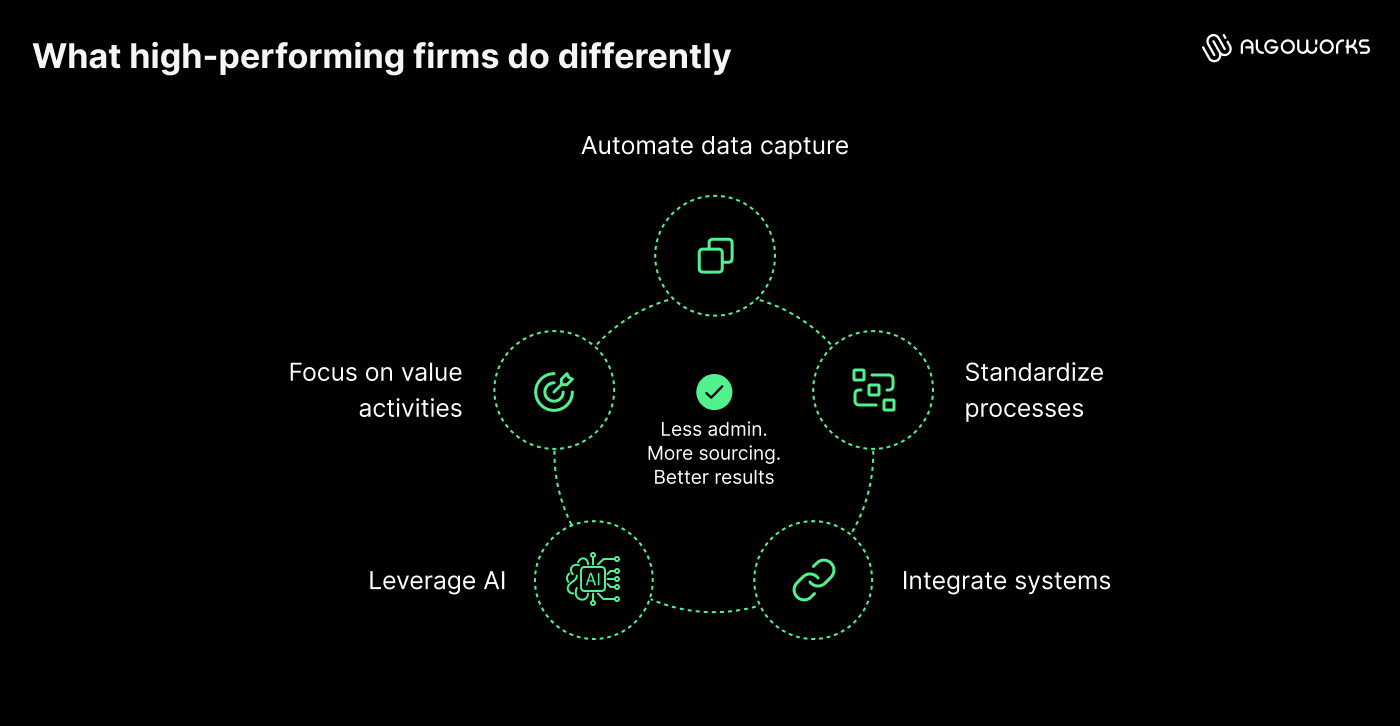
How leading PE firms solve this: Three specific tools
Firms that have modernized their deal sourcing process use these three systems together:
- Automatic data capture from email. A banker emails a term sheet or summary. The system automatically extracts relevant information: company name, industry, revenue, EBITDA, banker contact. No manual typing. The deal appears in Salesforce with complete information.
- Continuous CRM updates without manual entry. When a deal status changes, the system updates automatically. Your sourcing professional talks to a banker. The call is logged. A timeline appears. Deal status moves from “prospect” to “qualified.” Here’s a step-by-step guide to setting up Salesforce workflow automation that does this without anyone clicking anything.
- Intelligent deal routing. New deals are automatically assessed against your investment criteria. Does the company fit your target industry? Is the revenue in your range? The system categorizes by fit and surfaces high-priority opportunities immediately for review. For firms managing massive deal volume, RPA integration with Salesforce takes automation even further handling complex workflows that pure automation alone can’t tackle.
What this actually changes for sourcing teams
Organizations that implement these tools report concrete changes:
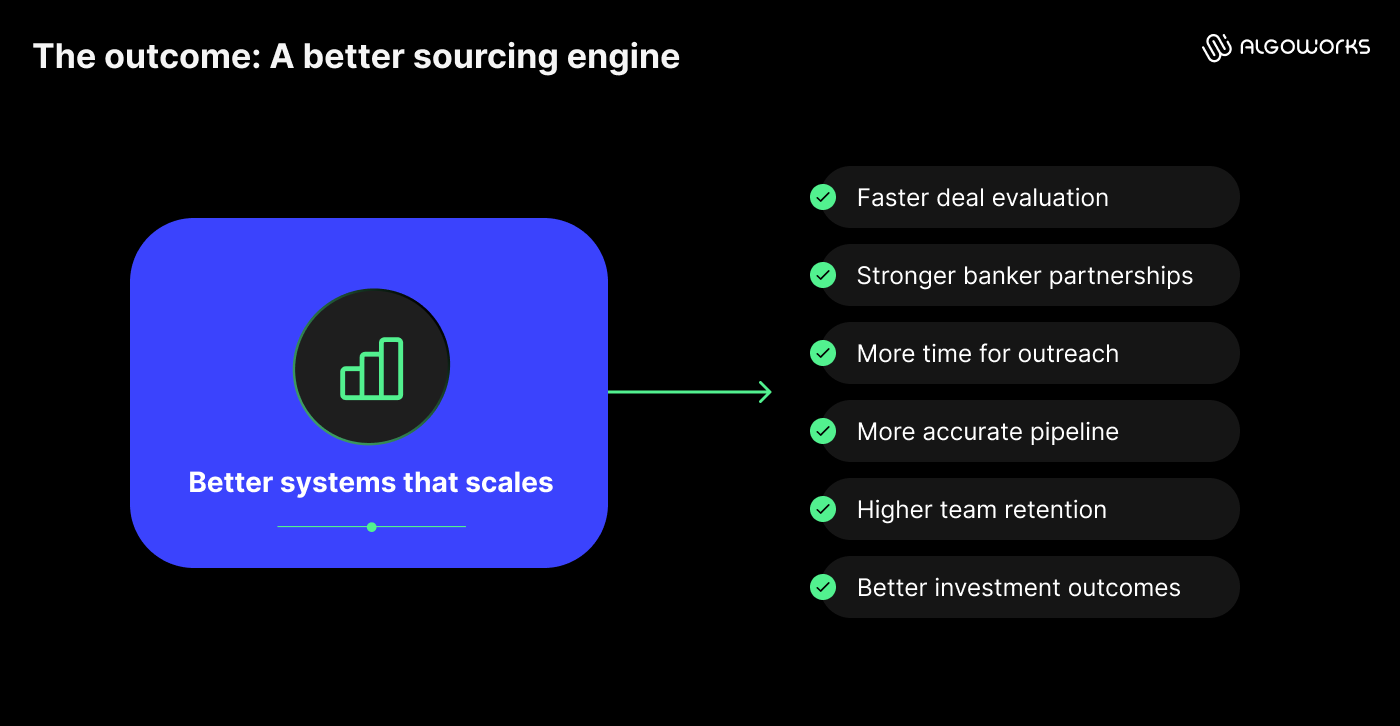
- Sourcing professionals spend their time on banker calls and deal evaluation, not Salesforce updates
- Deal assessment happens faster because information is captured immediately
- More bankers can be contacted because sourcing time is freed from administrative work
- Better retention because team members do the job they were hired for
- Portfolio quality improves because your team evaluates more opportunities thoroughly
A real example: deal sourcing transformation at a mid-market PE firm
One Chicago-based PE firm had exactly the problem described above. They process hundreds of transactions annually to identify 3-4 closed deals per year. Here’s how they modernized their Salesforce workflow from notebooks to full automation.
The situation before modernization
- Aging Salesforce instance, not updated in many years
- Business development team working evenings on pipeline data entry
- Deal sourcing updates happening in hotel rooms at night
- Multiple hours per day spent on CRM administration
- No automation, everything manual
- Data quality issues from manual entry and scattered notes
The business development team was stuck. Their actual job, sourcing new transactions and evaluating opportunities, was being crowded out by administrative work.
The solution they implemented
They partnered with a technical team to modernize their Salesforce instance and add three specific capabilities:
- Auto-capture from banker emails: transaction data extracted automatically
- Automatic CRM updates: no manual entry when deal status or information changes
- Intelligent flagging: new deals automatically categorized by fit to investment strategy
The results they achieved
- Sourcing professionals freed from 15-20 hours per week of administrative work
- Average time from deal receipt to decision dropped from 5-7 days to 1-2 days
- The team evaluated 30% more transactions in the same calendar year
- No turnover in the sourcing team over the following year (previously lost one professional every 18 months)
- Team now spends time on banker calls and deal analysis, not spreadsheet updates
The economics question: can you afford not to modernize?
The visible cost
For a typical business development team of 3-5 professionals managing deal sourcing; using Salesforce data on average professional compensation and time spent on admin work:
- 3-5 professionals × 20-30 hours admin per week × 52 weeks per year = significant annual cost
This is pure administrative overhead that produces zero deal value
The hidden cost
According to Axial’s research: the median PE firm captures roughly 18% [Axial] of relevant deals in its target market. This means 82% of available opportunities never reach your desk at all.
Slower evaluation cycles mean you’re competing with other PE firms for the same deal. If your competitor evaluates in 2 days and you evaluate in 5 days, you’re slower. First movers get better entry prices. Better entry prices drive better returns.
The firms that modernized 2-3 years ago have a significant advantage right now. They have faster sourcing, happier teams and lower sourcing costs. The advantage compounds over time.
The business case
Modernization changes what your sourcing team spends time on:
Before: Data entry, email searching, spreadsheet updates, CRM corrections After: Banker calls, deal analysis, building relationships, identifying strategy fit
Speed matters in deal sourcing. The question isn’t whether you can afford to modernize. The question is how quickly you can catch up to firms that already have. Most Salesforce transformations fail at execution. Understanding why transformations stall and how to prevent it is critical before you start.
What to do next
If your sourcing team is still doing manual CRM work, the economics are clear: you’re paying for administrative overhead instead of deal sourcing. Before you pick a vendor, understand what PE firms should look for in a Salesforce vendor. The right vendor makes the difference between transformation and costly mistakes.
Algoworks helps PE firms automate deal processing and sourcing workflows. They focus on Salesforce modernization and implementing the three systems above: automatic data capture, automatic updates and intelligent deal flagging.
If you want to understand what modernization looks like for your specific situation, a conversation with their team is worth your time. They can tell you the implementation timeline and what changes for your sourcing process.