From notebooks to automation: How one PE firm modernized its Salesforce workflow
Private equity firms are under growing pressure to create value during the hold period. PE firm Salesforce automation is one way firms can improve how they operate, reducing manual CRM work while keeping deal intelligence moving through the investment workflow.
Alvarez & Marsal’s 2026 report found that margin improvement accounted for 51% of EBITDA growth in portfolio companies exited in 2025. For companies exited before 2023, it accounted for 21.5%.
Operational value creation is becoming a bigger part of the PE playbook.
Yet many everyday workflows behind deal sourcing remain manual. Important deal information can sit across emails, notebooks, spreadsheets and conversations before it reaches the CRM.
The issue is not always the CRM itself. For a PE firm, Salesforce automation can address the work that has to happen before information reaches the system. For investment teams managing hundreds of opportunities, removing that friction can free up one of their most valuable resources: time.
The hidden cost of manual CRM in private equity
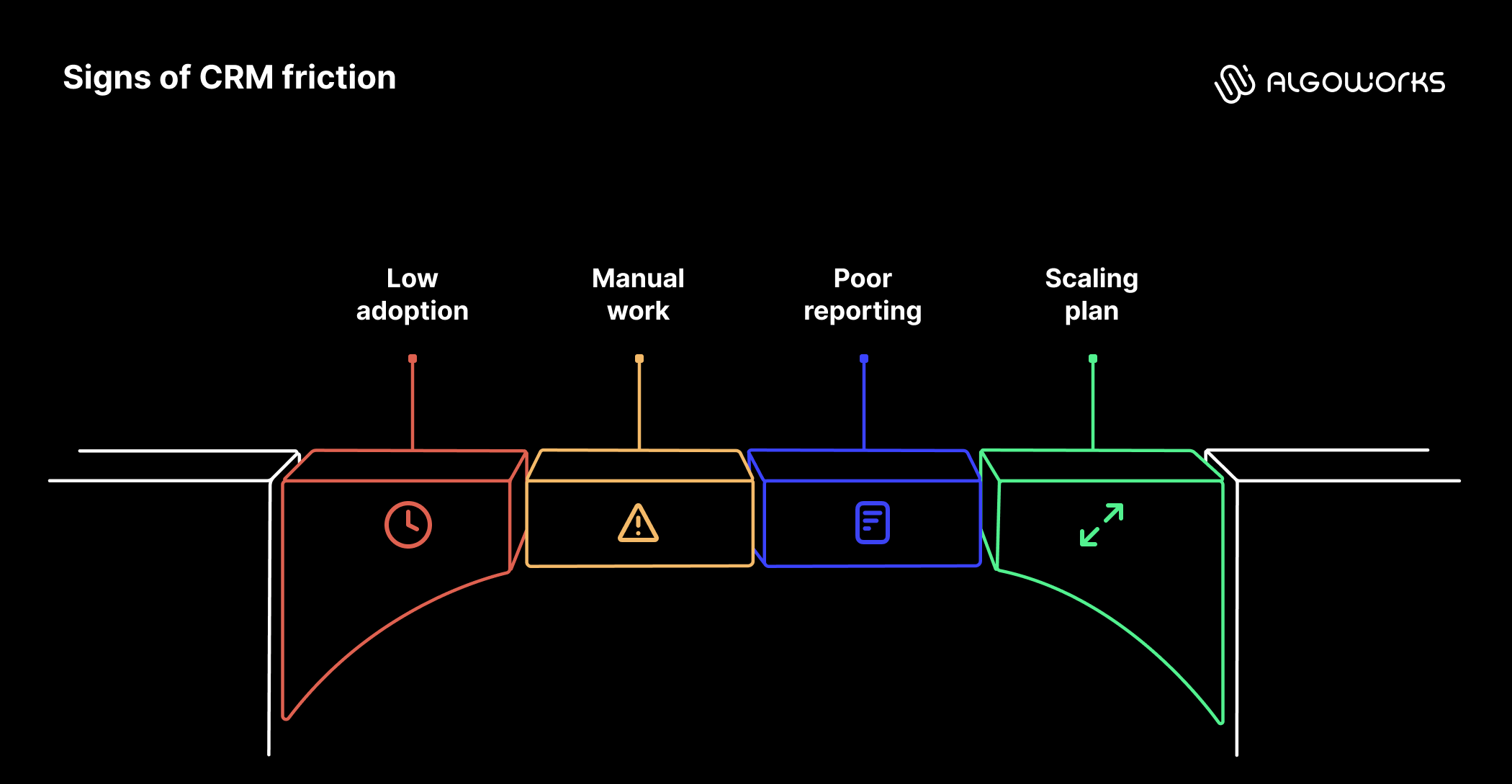
Manual CRM work does more than consume a few minutes. It can slow pipeline updates, scatter deal intelligence and pull investment professionals into repetitive administrative work. The impact typically appears in common CRM challenges.
<h3?Pipeline lag
Deals move quickly. CRM records do not always keep up. A conversation happens at a conference. A founder follows up by email. New information arrives while an investment professional is travelling. If someone has to update Salesforce later, there is a gap between what is happening with the opportunity and what the CRM shows.
Fragmented deal intelligence
Deal information rarely starts in Salesforce. It can begin in an email, meeting, notebook or spreadsheet. When moving that information into the CRM depends on manual entry, important context can remain scattered across tools and people. The firm may have the information. It just may not be available where the team needs it.
Administrative drag
Manual CRM updates are simple but repetitive. Open Salesforce. Find the opportunity. Transfer the information. Update the fields. Save the record. At low volumes, that may seem manageable. Across hundreds of opportunities, the workload adds up. For PE teams, that time has a clear opportunity cost. Time spent maintaining CRM records is time not spent sourcing deals or supporting portfolio companies.
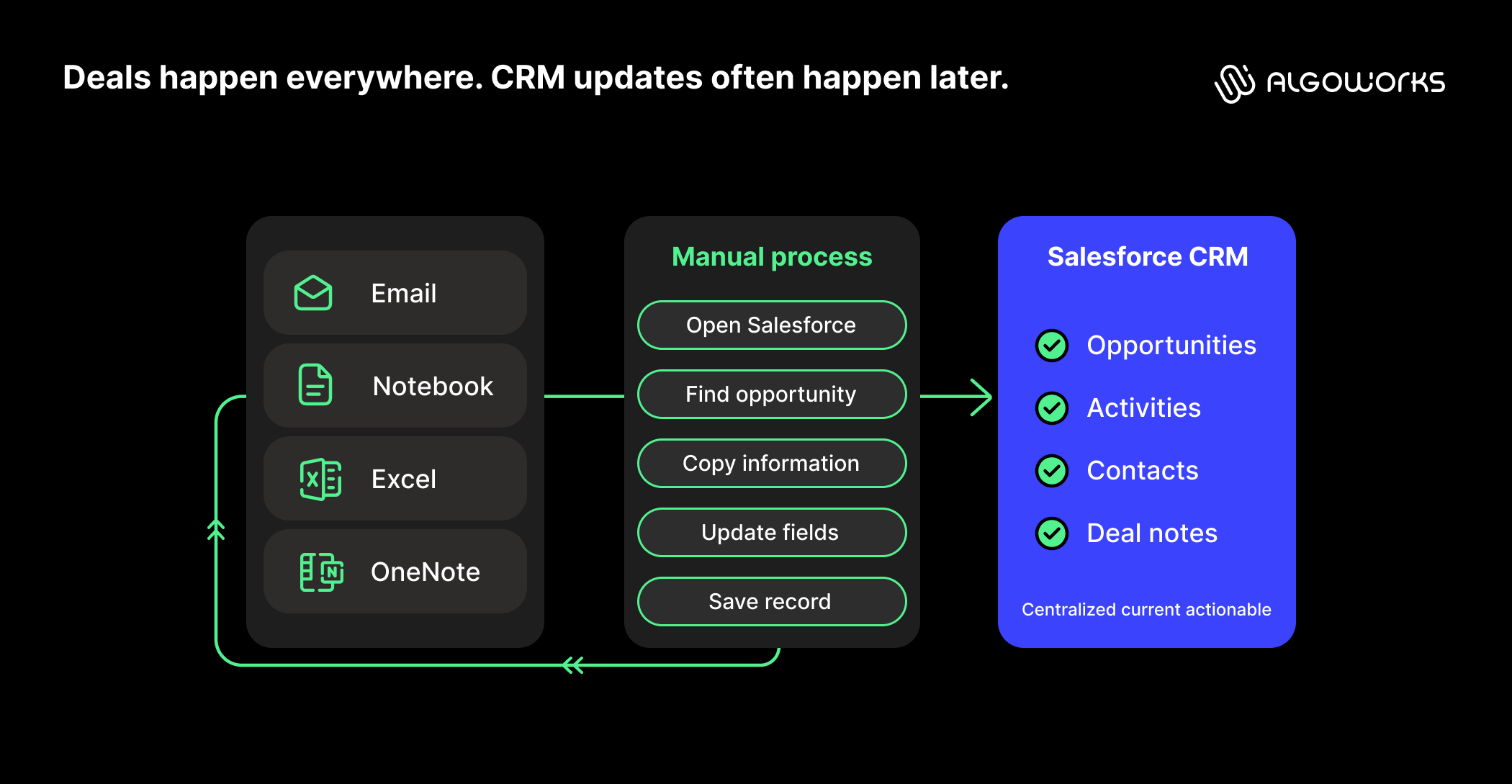
Deals happen everywhere. CRM updates often don’t.
Private equity professionals work across conferences, founder meetings, management discussions, calls and portfolio visits. Deal intelligence is created wherever those conversations happen.
But traditional CRM workflows often require people to stop, open a system and document what they just learned. That was the challenge facing one private equity firm working with Algoworks. Salesforce was already its central CRM. The firm did not need another system. It needed a better approach to Salesforce automation for private equity, moving information into the system it already had without adding more work for the investment team.
When 700–800 opportunities meet a two-person team
The firm’s two-person team was processing around 700–800 opportunities every year. Information was spread across notebooks, OneNote, emails and Excel. Salesforce remained central to pipeline management, but keeping it updated required manual work.
Travel made the problem more visible. At conferences, team members could quickly capture notes in a notebook. Those notes still had to make their way into Salesforce later. Email created similar friction. When new information arrived, someone had to open Salesforce, find the right opportunity and update the record. At this volume, Salesforce workflow automation became a practical way to reduce the team’s administrative burden.
A simpler approach to Salesforce automation for private equity
Algoworks worked with the firm to modernize its Salesforce environment through Salesforce workflow automation, using automation and AI capabilities including Agentforce implementation. One change captures the transformation particularly well: email-to-Salesforce automation. Previously, an email update could require several steps:
Email received → Open Salesforce → Find opportunity → Transfer information → Update fields → Save
The new Salesforce workflow automation was much simpler: Email received → Forward email → Salesforce updated through automation
The value was not just fewer clicks. The workflow changed who was responsible for moving the information. Instead of asking the investment professional to stop and update Salesforce, automation handled more of that work in the background.
It also worked with a tool the team already used every day: email. That is an important principle for CRM modernization. A new capability creates more value when it removes steps from an existing workflow instead of creating another place for people to work.
From CRM administration back to investment work
The modernized workflows are saving the team multiple hours per day, according to the client. Salesforce updates happen faster and the team spends less time maintaining records. But the bigger impact is what the team can do with the time it gets back.
For this firm, that means more time for sourcing investments and supporting portfolio companies. This is where AI strategy focuses on business outcomes, not just efficiency metrics. Saving time is useful. Returning that time to activities that contribute directly to the firm’s investment strategy is more meaningful.
Private equity is moving beyond AI for productivity
The firm’s transformation reflects a broader change across private equity. Alvarez & Marsal’s 2026 research found that 63% of surveyed PE respondents use AI in value creation, up from 41% a year earlier. It also found that 39% use AI across multiple functions while delivering measurable value.
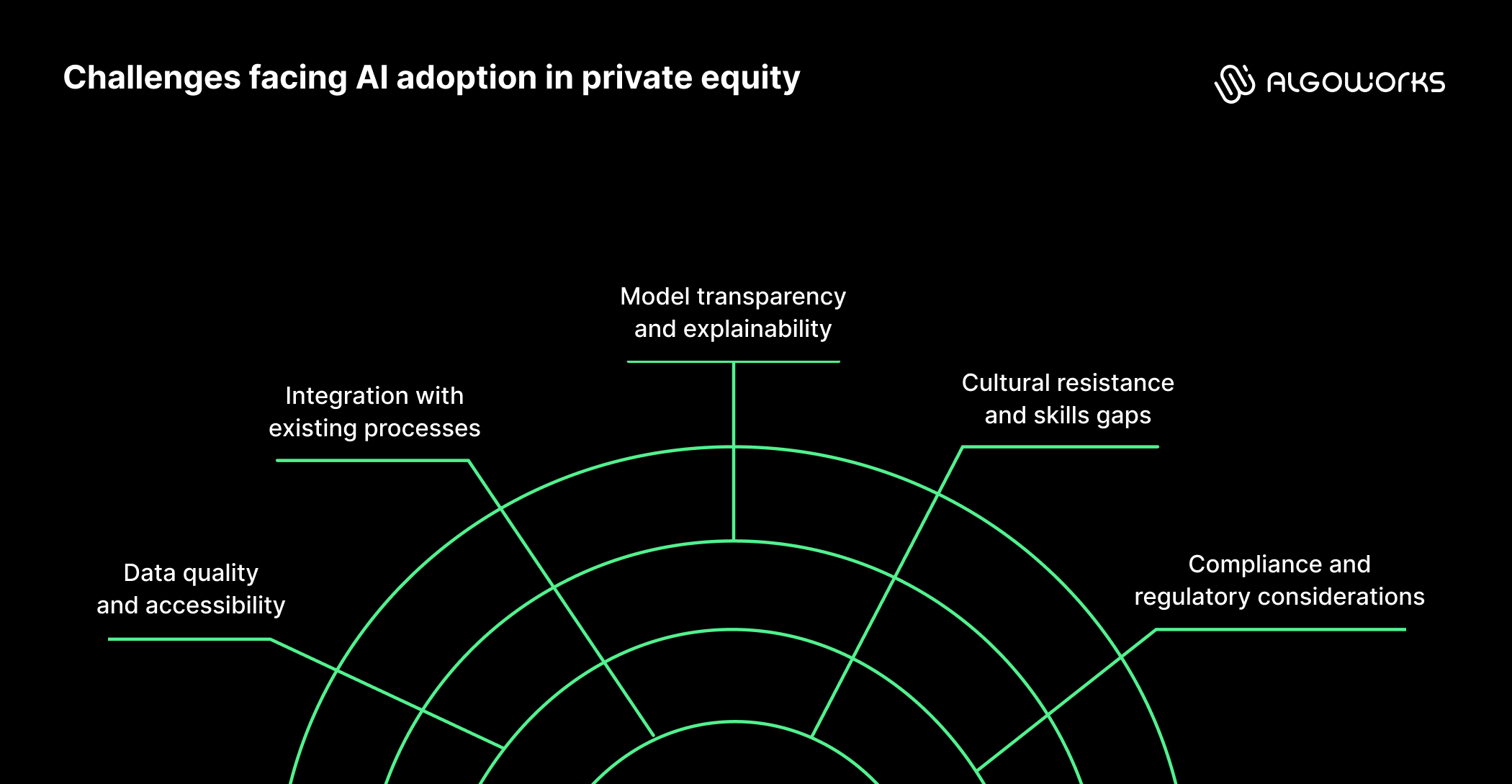
But another finding is just as important: 45% identified data quality and availability as barriers to effective AI deployment—a challenge that requires proper data preparation for AI success. That matters for CRM modernization. AI cannot do much with deal intelligence that never reaches the system. If important context remains in inboxes, notes and spreadsheets, adding AI on top of the CRM does not fix the underlying information gap.
McKinsey’s 2026 research also points toward a broader shift. Its analysis of 471 PE-backed companies describes a progression from using AI for isolated productivity gains toward using it to change operating models, products and business models.
For CRM, the question is therefore changing. It is no longer only: How can AI make CRM work faster? A more useful question is: How much of this work should require manual effort in the first place?
From manual CRM to AI-enabled Salesforce automation
PE firm Salesforce automation can be viewed as a progression across three stages, from manual CRM to automated workflows and AI-enabled CRM.
| CRM model | How it works | Role of the professional |
| Manual CRM | People enter and maintain information | Maintain the system |
| Automated CRM | Workflows capture and structure information | Trigger or review workflows |
| AI-enabled CRM | AI interprets context, surfaces insights and initiates actions | Review, decide and act |
The direction is clear. CRM modernization is not about getting investment professionals to spend more time in Salesforce. It is about requiring less of their time to keep Salesforce useful. As AI capabilities mature, CRM can move from being a system people constantly maintain toward a system that captures more context from the work already happening around it.
Three lessons for PE firms modernizing Salesforce
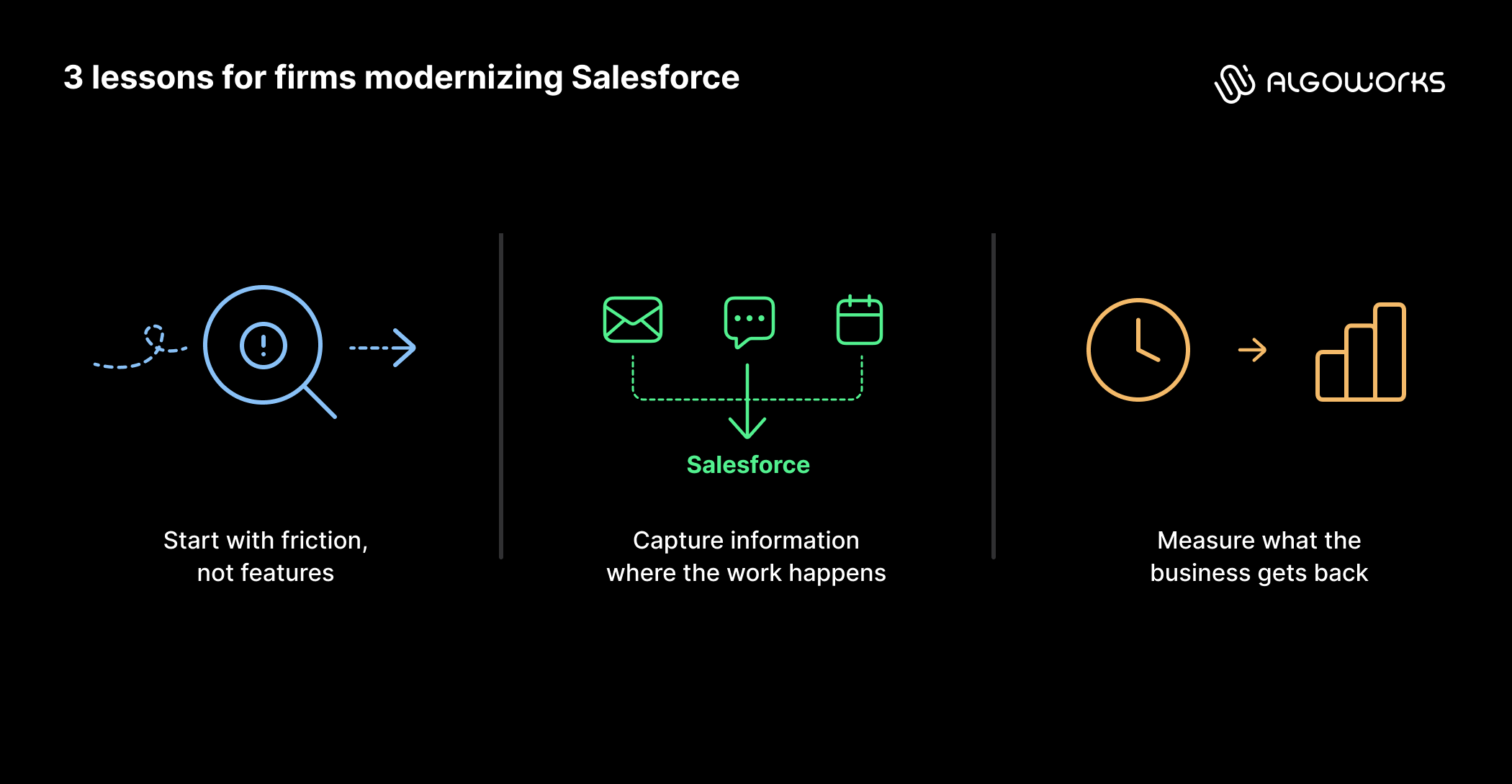
1. Start with friction, not features
Do not begin by asking what a particular AI feature can do. Look at how the investment team works today. Where are people copying information between systems? Where do updates get delayed? Which repetitive tasks take professionals away from investment work? Those friction points are often the best places to start automating.
2. Capture information where the work happens
Deal intelligence already exists across emails, meetings and conversations. The goal of Salesforce automation for private equity should not be to add more technology to the investment process. The email-to-Salesforce workflow worked because it did not ask the team to learn another process. It made an existing process easier.
3. Measure what the business gets back
Hours saved are only one measure of automation. Ask what those hours allow the team to do instead. For a PE firm, the answer might be more time for sourcing, evaluating opportunities, building relationships or supporting portfolio companies. That is when CRM modernization becomes more than an efficiency project.
The best CRM workflow may be the one users barely notice
A modern CRM should not demand more attention from investment professionals. It should make it easier for them to keep deal information current while staying focused on investment work.
For this two-person team, that change was tangible. A workflow that once required several manual Salesforce steps could now begin with something as simple as forwarding an email. The technology became more sophisticated. The work became simpler.
That is a useful benchmark for Salesforce automation in private equity: not how much more technology people use, but how much less effort the technology requires from them. Contact us to know more.