Why AI projects should start with business outcomes, not technology

More than 80 percent of AI projects fail to deliver their intended business value, roughly twice the failure rate of standard IT projects that do not involve AI (RAND, 2024). The model is rarely the reason.
Across failed pilots, the pattern is a framing problem that existed before the first line of code got written: the team asked what the technology could do instead of what had to change in the business first.
That single difference in starting point, more than any AI and data engagement you bring in, is what separates an outcome-first AI strategy that scales from projects that quietly get shelved.
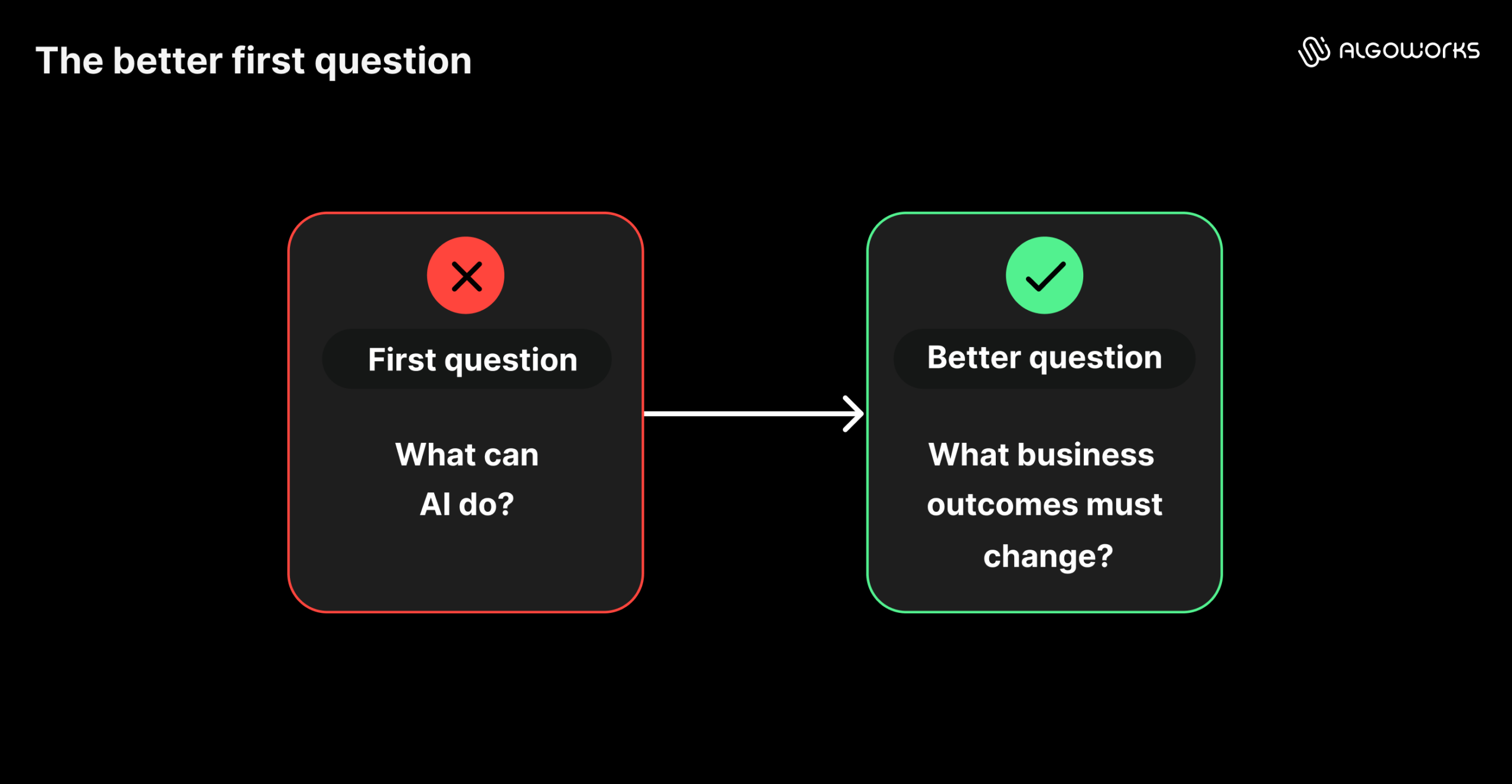
The question every AI project should start with
Walk into most AI kickoff meetings and you will hear some version of the same opening line: we have access to this model or this platform or this vendor tool, what should we build with it? That question feels productive. It gets a team moving fast, produces a demo within weeks, and gives leadership something to look at. But it skips the one question that actually determines whether your project survives past the pilot stage: what business result has to change for this to matter.
That is not a minor sequencing issue. It is the difference between a project that has a reason to exist and one that is looking for a reason after the fact. When you define the outcome first, every decision that follows has something to be measured against. When you let the technology lead, those same decisions get made on instinct, and instinct is a lot easier to justify in a meeting than to defend six months later when someone asks what the project actually delivered.
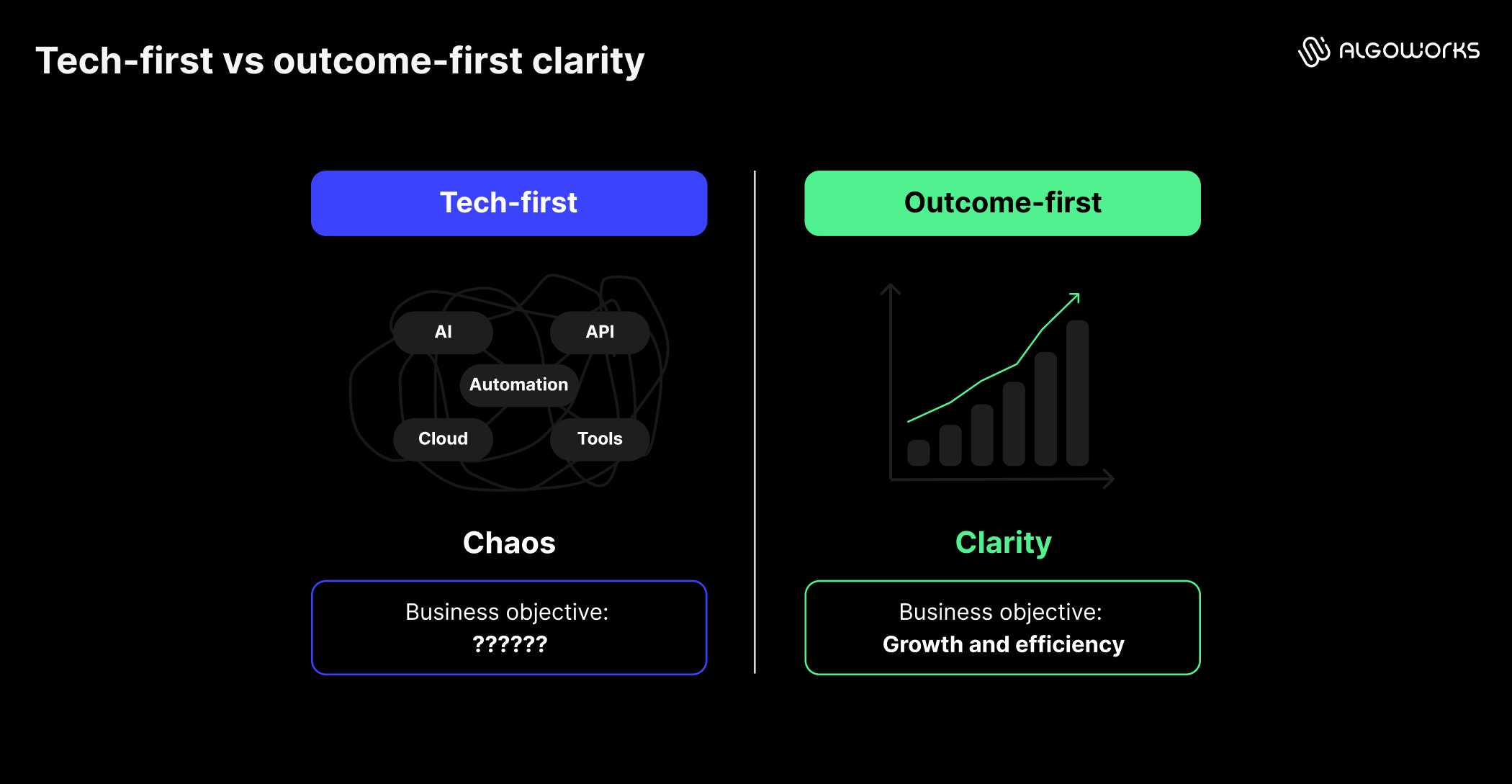
Why business outcomes have to come before technology
This is the direct answer to the question you came here with, and the foundation of an outcome-first AI strategy. Business outcomes need to come first for three specific reasons, and each one shows up as a real decision point on your project, not a theoretical one.
- You get a working definition of success. A model can hit every technical benchmark you set and still fail the business. Without a target metric set in advance, there is no way to tell those two outcomes apart.
- You know what data and integration your work actually needs. The outcome tells you which systems the project has to touch and which ones it can ignore. Start with the technology and you end up building integration you never needed, or missing the one connection the outcome depended on.
- You keep ownership with the people who feel the result. A project measured by a business metric has to be owned by the function that metric belongs to, not by whichever team happened to build it.
There is a fourth reason, walking away from a project that is not working, but that deserves its own section further down, because it is the one teams get wrong most often.
Treat your AI project like a hypothesis, not a build
A deployment has a plan, a timeline, and a launch date. Once it ships, your instinct is to call it done. A hypothesis works differently. It has a specific claim about the business, a way to test that claim, and a clear answer to what would prove it wrong.
That distinction sounds academic until you watch what it does to your team’s behavior: a deployment that is not working gets more budget and another sprint, while a hypothesis that is not working gets rejected. You move on to the next one. That is not a failure. It is the system working exactly as intended.
Two things make this reframe practical instead of philosophical. The first is a specific way to write the outcome down before you write the project brief. The second is a specific point at which you decide the hypothesis failed. The next two sections cover both.
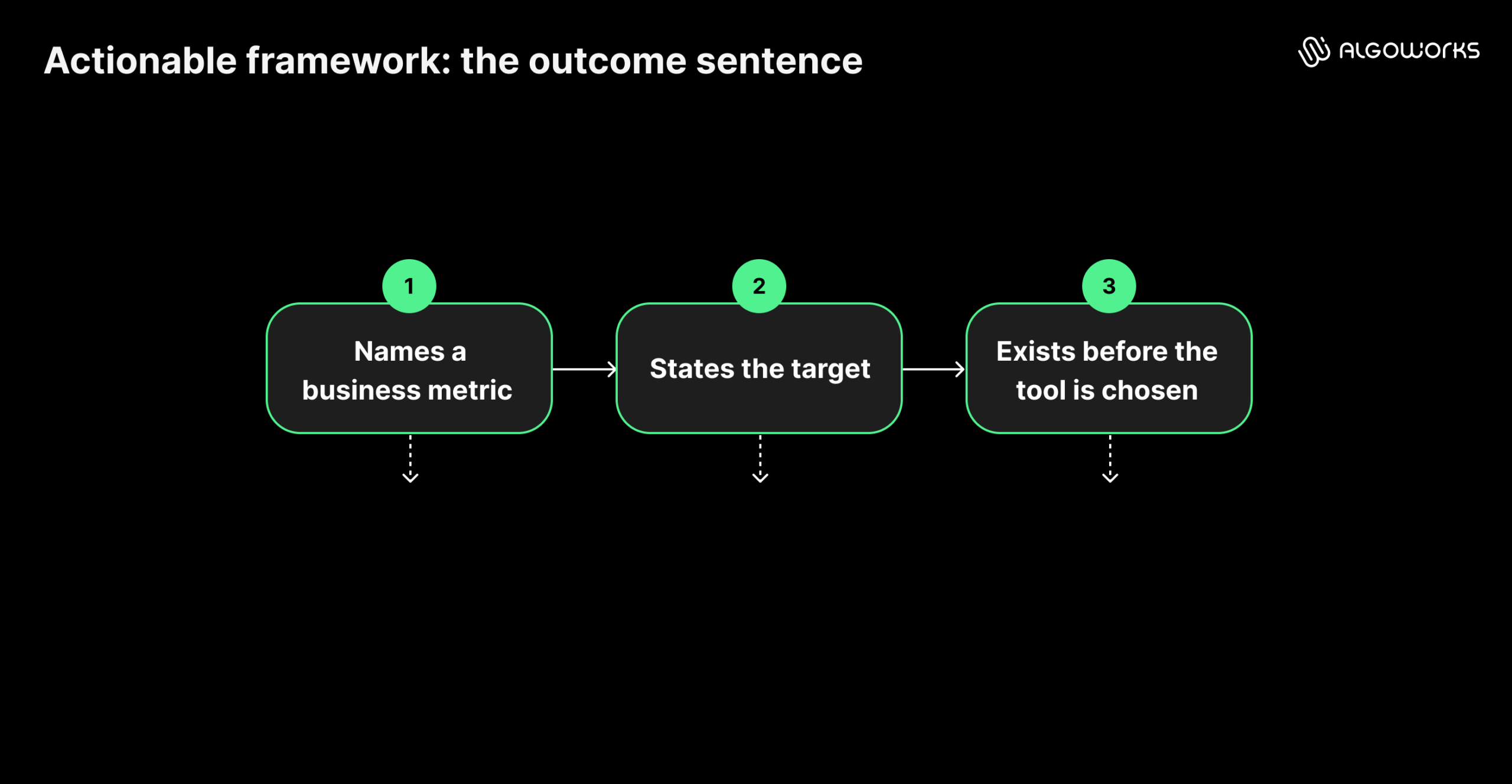
Actionable framework: the outcome sentence
Before you select any tool, write one sentence that states the business result you expect and how you will measure it. This simple exercise is the starting point of an outcome-first AI strategy. Something like, “If we automate first-pass invoice review, we reduce processing time by 30 percent without increasing error rate.”
That sentence has to do three things:
| Requirement | What it looks like |
| Names a business metric | Processing time, error rate, conversion, cost per unit, not “adoption” or “usage” |
| States the target | A number, not a direction. “Reduce by 30 percent,” not “improve” |
| Exists before the tool is chosen | Written into the project brief, not backfilled after a model is picked |
If you cannot write that sentence, your project is not ready to move forward, regardless of how promising the technology looks. This is also the fastest filter for whether a project is outcome-driven or technology-driven: teams that start with the metric tend to pick smaller, outcome-driven AI use cases, while teams that start with the technology tend to pick broad, ambitious ones that look good in a slide deck and are almost impossible to measure cleanly.
Governance: when to walk away
Set your kill criteria at the same time you set the outcome sentence, not after the project is already running into trouble. Define, in writing, what result would tell you the hypothesis failed. If usage does not move the target metric within a defined window, the project ends or gets redesigned.
This matters because of a simple bias every team runs into once money and time have already gone into a build: the sunk cost fallacy. Strong AI governance helps organizations define exit criteria early instead of allowing unsuccessful projects to continue indefinitely.
A project with no outcome attached to it has no natural stopping point, so it keeps absorbing budget on momentum alone, and the longer it runs, the harder it becomes to cancel. A project with a kill criterion set in advance does not have that problem. It either hits the number or it does not, and either answer tells you what to do next without a debate about whether the team has already invested too much to stop.
This is also why a pilot should be run as a test with an expiration date, not a launch. At the end of the test window, you answer one question: did the hypothesis hold? That is a very different conversation than “should we keep this running,” which tends to default to yes regardless of the data.
A structured Define phase, the first stage of a Define, Build, Run approach to AI delivery, earns its place here, because it forces this exact conversation before a single line of implementation work starts.
Ownership and accountability
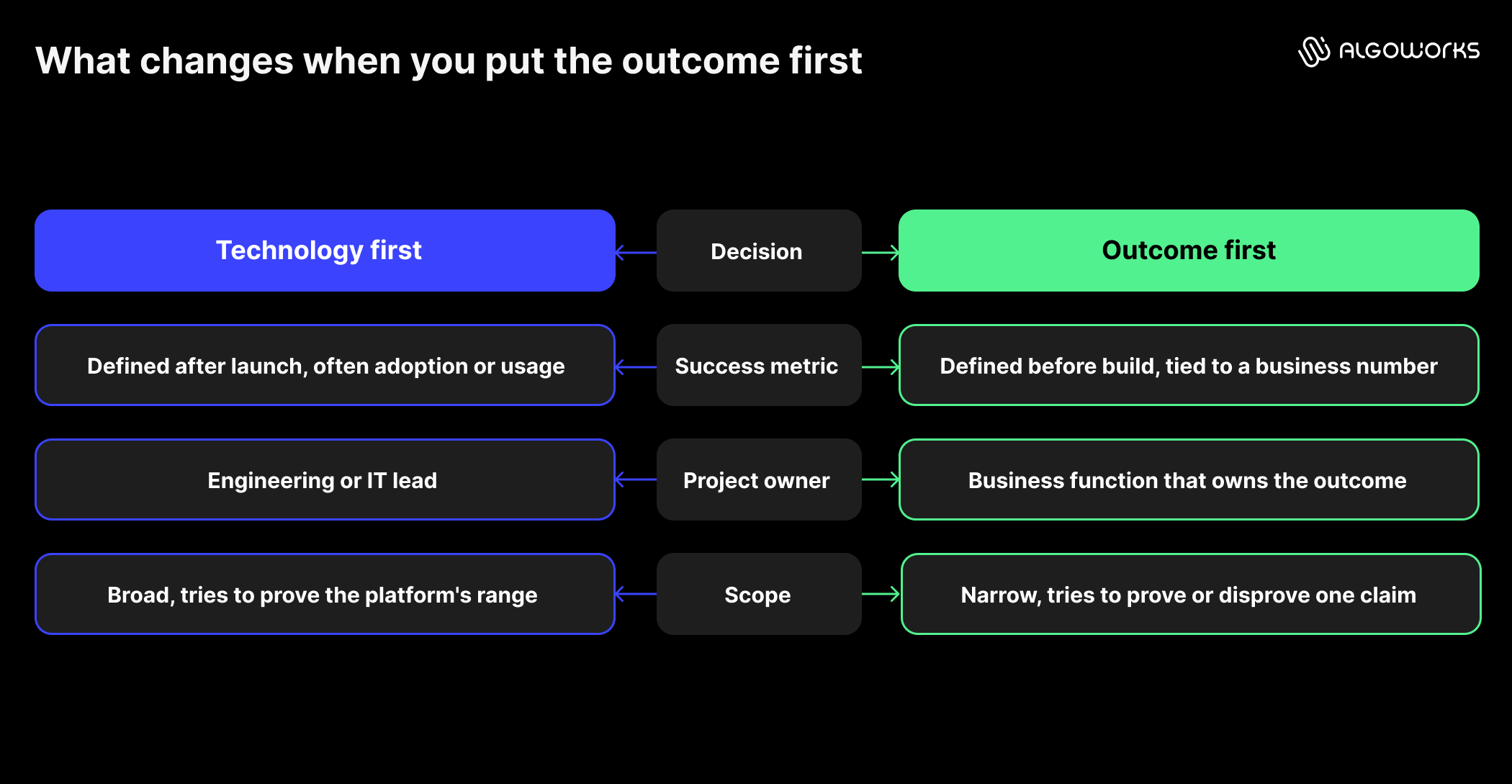
The table below is the fastest way to see what changes when you put the outcome first instead of the technology.
| Decision | Technology first | Outcome first |
| Success metric | Defined after launch, often adoption or usage | Defined before build, tied to a business number |
| Project owner | Engineering or IT lead | Business function that owns the outcome |
| Scope | Broad, tries to prove the platform’s range | Narrow, tries to prove or disprove one claim |
The ownership row matters more than it looks. A project owned entirely by engineering will optimize for technical success, which is not the same thing as business success. A model can perform exactly as designed and still fail to move the number you actually care about, and only a business owner accountable for that number will catch the gap early enough to act on it.
What scaling looks like once the hypothesis holds
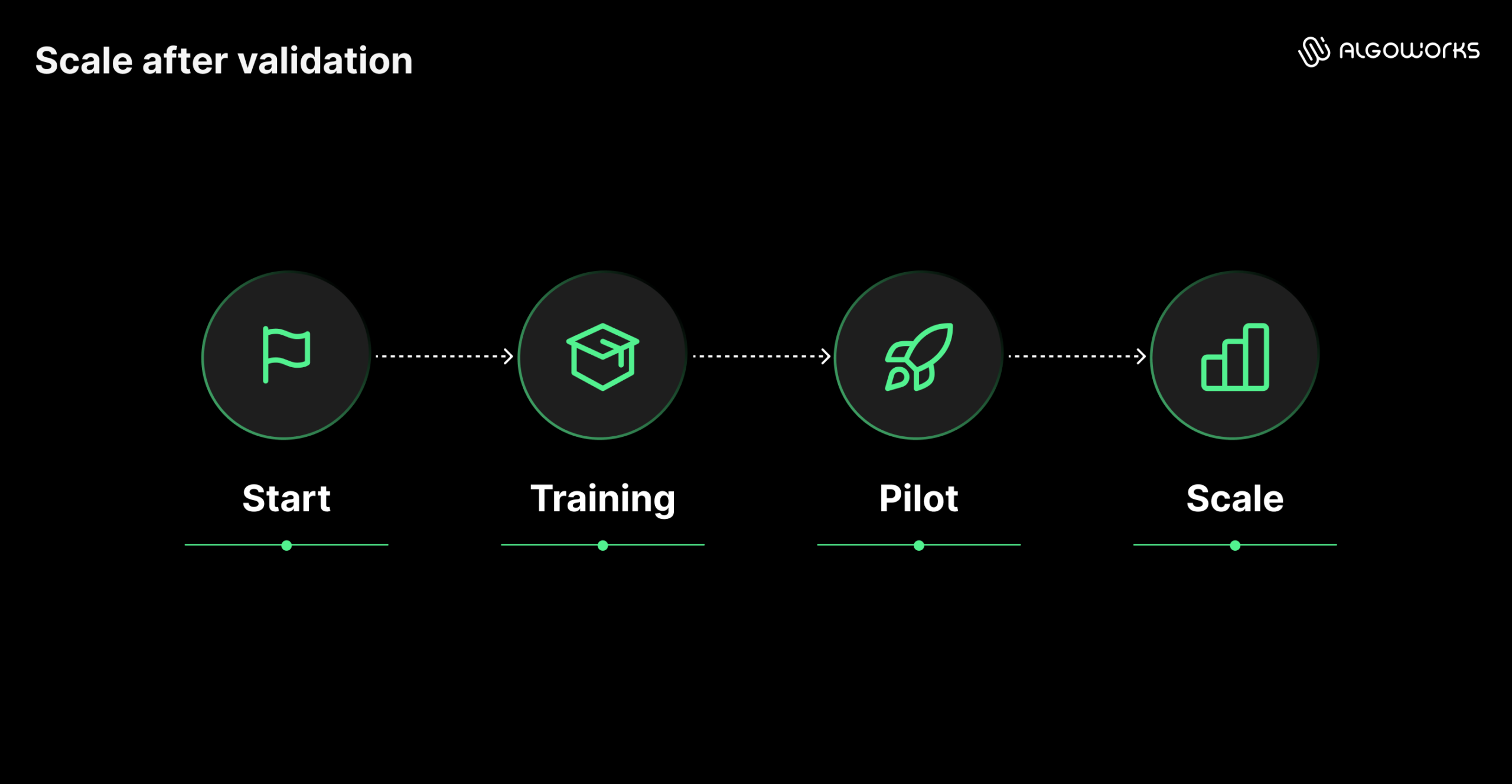
Scaling only makes sense once you have proven the hypothesis at small scale. If your narrow pilot moved the metric it was built to move, scaling means expanding that same tested claim to more of the business, not expanding your technology footprint for its own sake. The Build and Run phases pick up here, turning a validated hypothesis into a system that holds up in production and keeps delivering the result it was built for.
The shift to carry into your next AI conversation
The question worth repeating in every AI meeting you sit in on from here forward is simple: what has to be true for the business, not what can the technology do. That mindset is what defines an outcome-first AI strategy. The metric, the owner, the scope, the point at which you walk away, all of it follows from that one question, and it is the only question that consistently separates pilots that scale from pilots that quietly disappear.
If you are staring down an AI initiative right now and are not sure your team has answered that question yet, that is exactly where to start. Talk to Algoworks about defining the outcome before you define the build, or explore how the Define, Build, Run framework applies to your next use case.