The hidden risks in enterprise AI and how to manage them
Enterprise AI risks rarely begin with catastrophic system failures. Most begin quietly inside workflows that appear to be functioning normally.
Hidden enterprise AI risks include automation bias, model drift, prompt injection, shadow AI, opaque workflows, weak governance and dependency failures across connected systems. These risks often develop inside approved enterprise environments, making them difficult to detect until they impact operations, security or compliance.
The challenge is no longer whether organizations are adopting AI. It is whether they can still observe, explain and control the decisions those systems are making over time.
According to recent enterprise AI adoption reports, more than 70% of employees now interact with AI for everyday workflows, while governance and oversight practices continue struggling to keep pace. That gap is where enterprise AI risk begins to compound.
Most governance models are still designed to monitor access, permissions and deployment activity. But the most serious risks in enterprise AI often emerge after deployment, inside systems that teams already trust.
That is the real visibility problem.
The enterprise AI risk stack
Enterprise AI risk is no longer a single security or compliance issue. It operates across multiple layers of the organization simultaneously. The deeper AI integrates into enterprise operations, the more interconnected these risks become.
The six hidden layers of enterprise AI risk:
- Behavioral risk
- Model risk
- Workflow risk
- Security risk
- Legal and compliance risk
- Governance risk
The important thing is this: most enterprise AI failures do not originate from one broken model. They emerge from invisible dependencies across these layers. 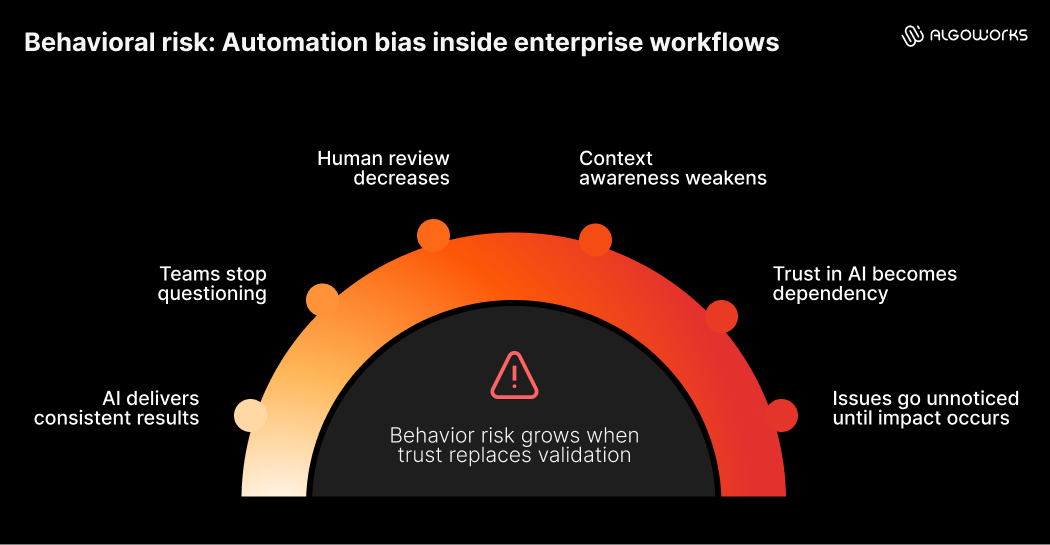
Behavioral risk: Automation bias inside enterprise workflows
One of the earliest hidden risks in AI implementation is automation bias.
When AI systems consistently produce acceptable outputs, teams gradually stop questioning them. Human review decreases. Context awareness weakens. Over time, the organization begins trusting the system more than its own ability to validate decisions independently.
This usually happens slowly enough that nobody notices the shift.
Suppose a fraud detection model starts flagging fewer transactions over time even as transaction volumes continue increasing. Nothing immediately appears broken. Dashboards remain operational. Outputs still look plausible. But if nobody is actively reviewing model behavior, the organization may fail to detect weakening detection accuracy until losses begin surfacing elsewhere.
The dangerous part is not the incorrect output itself. It is the erosion of human verification around the system. Once organizations stop validating AI decisions consistently, risk stops being operational and becomes behavioral.
Model risk: Drift inside enterprise AI systems
AI systems are trained on assumptions derived from historical data. But enterprise environments do not remain static. Customer behavior changes. Market conditions shift. Operational workflows evolve. Data patterns drift continuously. Over time, models begin operating on assumptions that no longer reflect current reality.
This is one reason enterprises are increasingly evaluating approaches like retrieval-augmented generation (RAG) and fine-tuning differently depending on how dynamic their operational data environments are. The challenge is that model drift rarely announces itself clearly.
Outputs may still appear reasonable while underlying accuracy gradually deteriorates. By the time the issue becomes visible, business decisions have already been influenced by outdated logic for weeks or months. This becomes even harder to detect when AI systems operate across multiple workflows simultaneously.
At that point, organizations are no longer managing a single model. They are managing an evolving decision ecosystem. 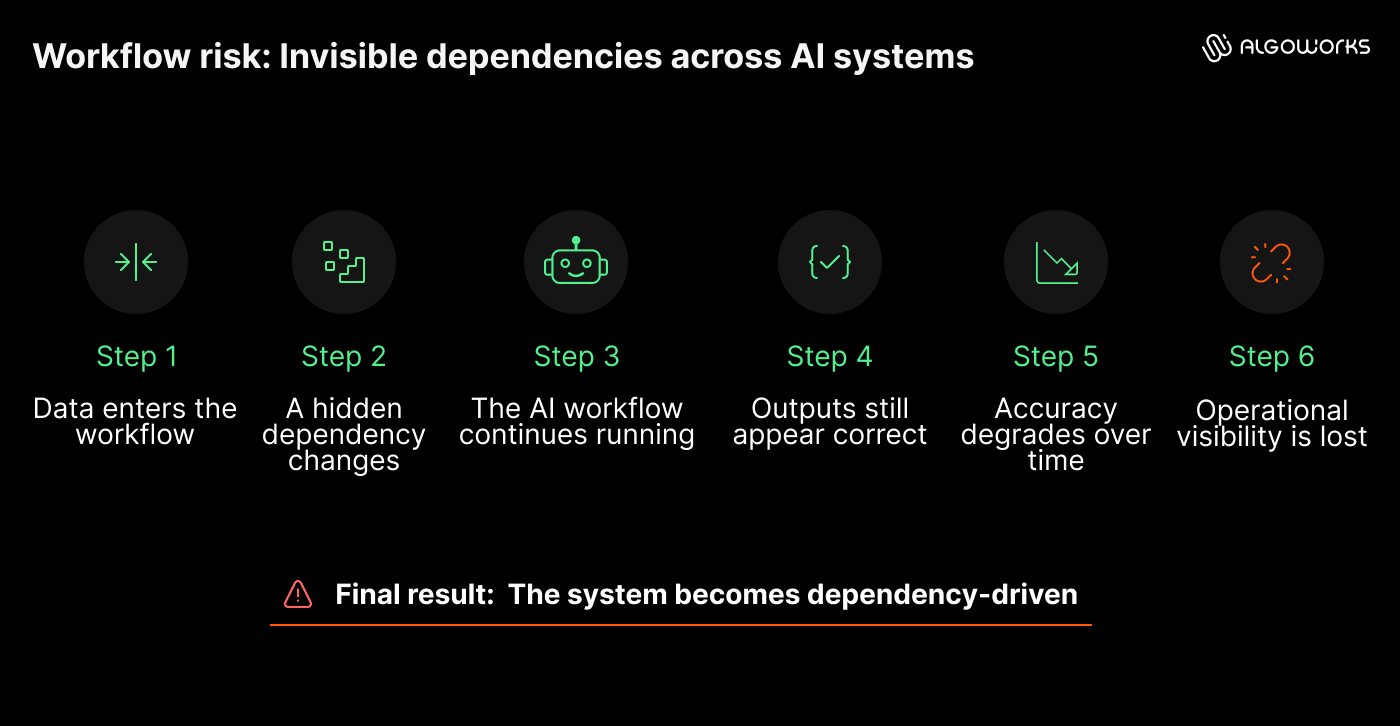
Workflow risk: Invisible dependencies across AI systems
As enterprise AI matures, risk extends beyond model behavior into workflow architecture itself. Enterprise systems depend on assumptions:
- data pipelines remain stable
- APIs continue functioning
- routing logic stays unchanged
- external systems behave predictably
But AI systems continue operating even when those assumptions quietly fail. The outputs may remain consistent while becoming progressively less accurate or less explainable. This creates a dangerous form of operational opacity.
If teams must reverse-engineer workflows to understand how decisions were generated, the system is no longer transparent. It has become dependency-driven. This is also why many enterprises are investing in knowledge graph-driven AI architectures to improve contextual reasoning, traceability and system visibility.
A simple diagnostic question helps expose this risk:
Could a human take over this workflow today without reverse-engineering the system first?
If the answer is no, the organization has likely lost operational visibility into its own AI environment. And once AI systems move from recommendation engines to decision-executing systems, those hidden dependencies become exponentially harder to govern. 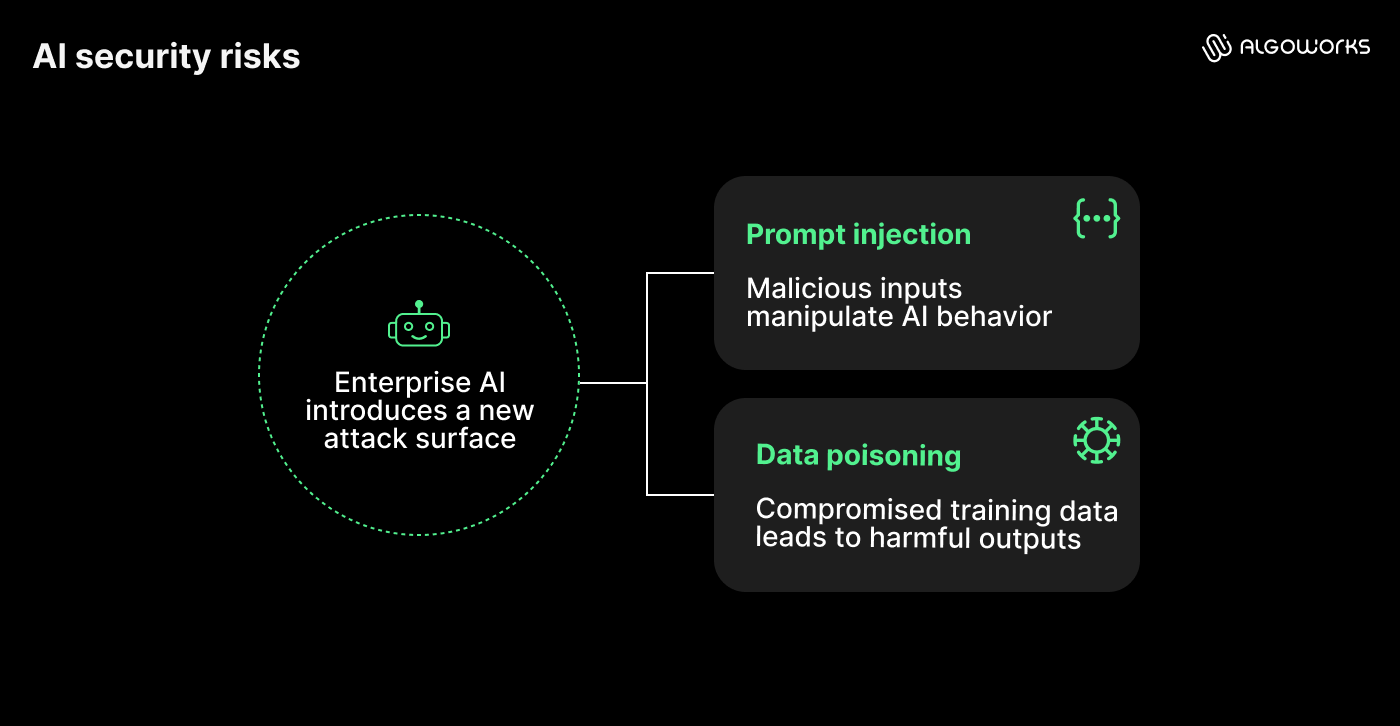
Security risk: Prompt injection and data poisoning
Traditional cybersecurity focuses heavily on:
- access management
- Credentials
- network exposure
- endpoint security
Enterprise AI introduces a different attack surface entirely.
Prompt injection
Suppose an AI system processes user-generated content. Hidden instructions embedded inside that content may manipulate how the model behaves, causing it to expose information, ignore safeguards or execute unintended actions. This is known as prompt injection, one of the fastest-growing enterprise AI security threats.
In agentic AI environments capable of:
- calling APIs
- modifying records
- executing transactions
- triggering workflows
a successful prompt injection attack can produce real operational consequences before anyone notices. The model does not technically “break.” It follows manipulated reasoning paths inside its own logic framework.
Data poisoning
Data poisoning occurs earlier in the lifecycle. If training data becomes compromised or biased, model behavior can be subtly influenced in ways that only appear under specific conditions later in production. By the time organizations identify poisoned outputs, tracing those behaviors back to original training datasets often requires forensic-level investigation capabilities many enterprises still lack.
These failures are difficult to detect because they operate inside normal system behavior rather than outside it. And increasingly, the attack surface is not just the model. It is the entire enterprise AI ecosystem surrounding it. The risk is no longer limited to what data gets accessed. It also includes how AI systems interpret and act on inputs.
 Legal and compliance risk: Bias, accountability and liability
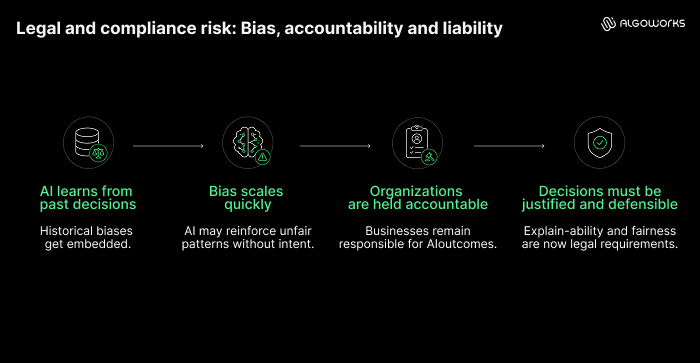
AI systems learn from historical enterprise decisions. The problem is that historical decisions often contain hidden patterns organizations never examined critically in the first place. If biased hiring, lending or operational patterns exist inside historical datasets, AI systems can replicate those patterns at scale even without explicit discriminatory intent.
Two well-known cases illustrate how courts and enterprises increasingly view AI accountability today. Amazon reportedly discontinued an internal recruiting system after discovering that the model penalized resumes containing indicators associated with women candidates. The system optimized based on historical hiring patterns, not fairness.
Similarly, a Canadian airline was held legally responsible after its chatbot provided incorrect fare policy information to a customer. The court ruled that the organization remained accountable for information generated by its AI system. The important shift here is legal, not technical.
Organizations are no longer evaluated only on whether AI systems function correctly. They are increasingly evaluated on whether AI-driven decisions can be justified, explained and defended. That is why enterprise AI compliance and accountability can no longer remain secondary governance discussions.
Supply chain risk: The hidden exposure inside AI ecosystems
Modern enterprise AI systems are rarely built entirely in-house. Most rely on combinations of:
- open-source libraries
- third-party APIs
- pre-trained models
- Plugins
- orchestration tools
- cloud integrations
Every external dependency expands the enterprise AI attack surface. A vulnerable library, compromised plugin or insecure integration layer can create downstream exposure across connected enterprise systems even if the AI model itself remains technically secure.
This risk becomes more dangerous because AI environments are typically connected to more operational systems than conventional software architectures. The AI did not fail. The connective tissue around it did. That distinction matters because many enterprise security frameworks still evaluate AI primarily at the model level instead of the ecosystem level.
Why enterprise AI governance fails after deployment
Most enterprise AI governance begins too late. Organizations often:
- build systems
- deploy systems
- scale adoption
- add governance afterward
This sequence creates structural accountability problems. Governance applied after deployment can describe what exists. It cannot change how the system was designed, what tradeoffs were made or whether accountability was built into the architecture.
When failures emerge later:
- ownership becomes unclear
- audit trails are incomplete
- decisions become difficult to reconstruct
- accountability becomes fragmented
In many cases, organizations discover they cannot fully explain why an AI system made a particular decision six months earlier. That is not simply a governance issue. It is an architectural issue.
How to reduce enterprise AI risks?
Managing enterprise AI risk is not about slowing adoption. It’s about building systems that remain observable, accountable and continuously monitored over time, enabling measurable outcomes through approaches like Everyday AI services.
What enterprises should prioritize:
Assign clear ownership
Every AI system should have a clearly defined operational owner responsible for oversight, monitoring and escalation management.
Define success criteria early
Organizations should establish performance benchmarks before deployment so behavior changes become visible instead of assumed.
Continuously monitor outputs
Model drift, anomalous behavior and output inconsistencies should be monitored continuously rather than reviewed periodically.
Preserve human oversight in critical workflows
High-impact decisions should retain meaningful human review layers, especially in regulated or customer-facing environments.
Track AI supply chain dependencies
Enterprises should maintain visibility into all external AI components, integrations and upstream dependencies.
Build explainability into architecture
If outputs cannot be traced or explained clearly, governance becomes reactive instead of operational.
Monitor behavioral patterns, not just failures
Many AI risks emerge gradually through subtle shifts in outputs, user behavior or response patterns rather than obvious system crashes.
Integrate governance before deployment
Governance works best when ownership, traceability and accountability are designed into systems from the beginning.
Conclusion
The biggest enterprise AI risks are rarely the most visible ones. They emerge gradually through dependency, over-trust, weak oversight and operational opacity across interconnected systems.
As enterprise AI systems become more autonomous, organizations need stronger visibility into not just what models are doing, but how decisions move across workflows, integrations and business operations over time.
The next challenge in enterprise AI is no longer adoption. It is observability. Organizations that operationalize AI responsibly will be the ones that can continuously explain, monitor and govern their systems long after deployment. If your enterprise is evaluating how to build more observable, accountable and resilient AI systems, connect with our team to explore practical approaches for long-term AI governance, monitoring and operational oversight.
FAQs
Some of the biggest hidden risks include automation bias, model drift, prompt injection, biased decision-making, opaque workflows and weak governance structures.
Model drift is difficult to detect because outputs may still appear accurate even when the model’s assumptions no longer align with current real-world conditions.
Prompt injection is a security attack where hidden instructions manipulate how an AI system interprets inputs or executes actions.
Organizations can reduce risks by continuously monitoring outputs, maintaining human oversight, assigning ownership and integrating governance into system design early.
AI governance helps enterprises maintain accountability, explainability, compliance and operational visibility across AI-driven workflows and decisions.