Vibe coding and prompt-driven development: From hype to real engineering practice
You’ve probably seen posts about tools like Claude Code generating working features in minutes. The demos look effortless: prompt in, code out, done.
The reality feels different when you try it yourself.
Getting useful output takes iteration, clear intent and a solid understanding of what you’re building. Without that, results are inconsistent and sometimes unusable. That gap between what AI promises and what teams actually experience is exactly where the conversation around vibe coding and prompt-driven development begins; something many teams are already seeing with agentic AI in enterprises.
Because while both rely on AI, they’re not the same thing. One leans on instinct and speed. The other introduces structure, repeatability and engineering discipline.
This article breaks down what vibe coding actually means in practice, how prompt-driven development changes the way teams build with AI, where each approach works and how to move from ad hoc experimentation to a workflow that holds up in production.
To start, it’s worth understanding what vibe coding means in practice and why it works so well in some scenarios but fails in others. 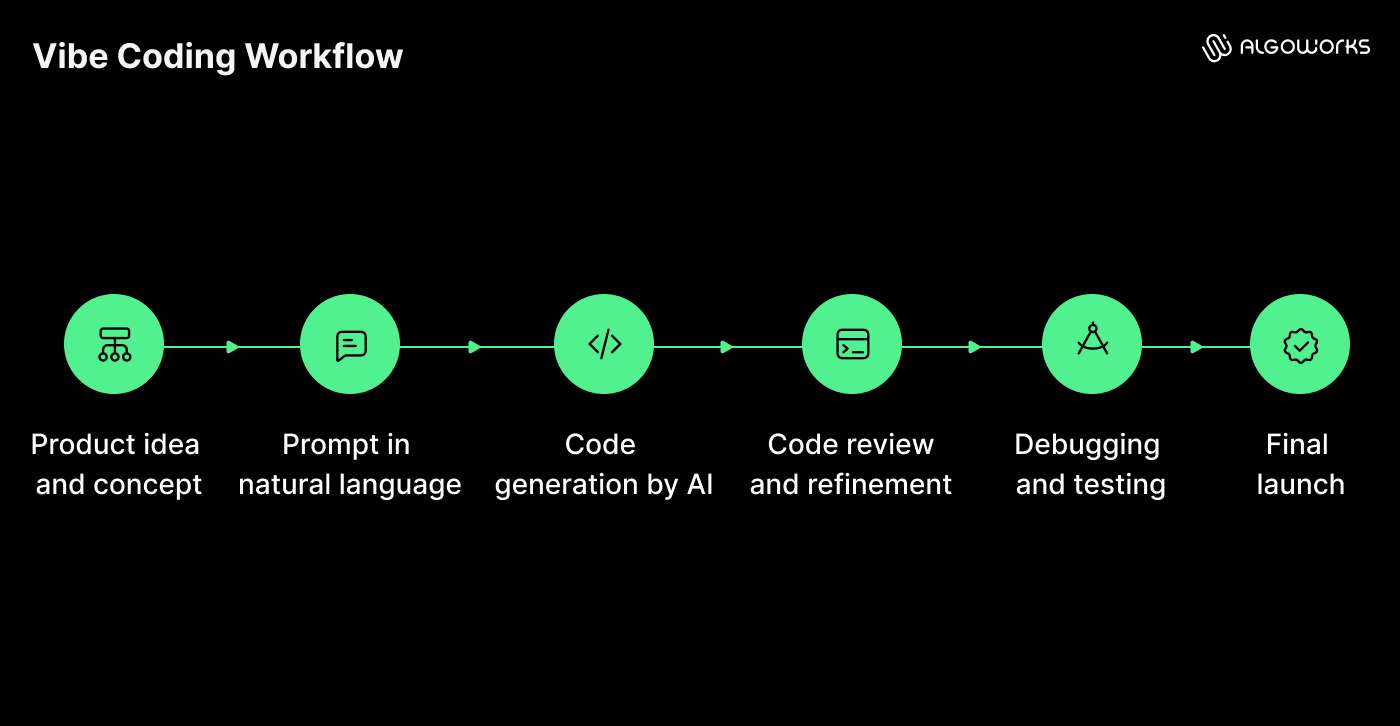
What is vibe coding and what does it actually mean?
Vibe coding is a style of software development where you describe what you want in natural language, accept the AI-generated output with minimal review and keep iterating until the result roughly matches your intent. The emphasis is on speed and intuition over rigor.
The name captures the attitude accurately. There’s no deep focus on architecture or edge cases here. You describe what you want at a high level and let the model handle the implementation; similar to how teams are rapidly experimenting with features in AI-powered mobile apps.
That transition becomes clearer when you compare it to how traditional development works.
Coding through intent instead of explicit logic
In traditional development, a developer translates a requirement into explicit logic. They think about data structures, error handling, edge cases and maintainability before writing a single line. In vibe coding, that translation step is outsourced to the AI. The developer stays at the intent level: “I want a dashboard that shows monthly revenue by region.” The model figures out the how.
This is a real cognitive improvement. It removes the syntactical grind that consumes a large portion of most developers’ time. Moreover, it also removes the layer of deliberate reasoning that catches problems before they become bugs.
Once you clearly understand the difference, the workflow itself starts to make more sense.
How vibe coding works in practice
The workflow is: intent → prompt → generate → tweak. You describe what you want, the model produces code, you eyeball it, you adjust the prompt, you try again. Iteration happens in minutes. You do not need to understand every line of what the model produced to move forward.
Which explains why developers find it so compelling.
Why do developers love vibe coding?
The appeal is real and specific.
- Speed: Tasks that previously took hours happen in minutes. Teams report 51% faster task completion on average.
- Low friction: No boilerplate, no syntax lookups, no context-switching to documentation.
- Intuitive: Describing what you want in plain language matches how most people think about software. The mental model is closer to briefing a colleague than writing a specification.
But those same strengths start to create friction as soon as you move beyond small, isolated tasks.
Where vibe coding starts to break down
The same properties that make vibe coding fast make it fragile at scale.
Inconsistent outputs
The same prompt produces different code on different runs. There is no guarantee the second iteration builds cleanly on the first. Over time, a codebase built this way becomes a patchwork of logically disconnected components.
No repeatability
There is no shared standard for how prompts are written, so two developers working on adjacent features may generate code that conflicts. There is no version history for the intent behind the code, only for the code itself.
Debugging challenges
When AI-generated code fails, the failure is often in logic the developer never fully understood in the first place. CodeRabbit’s analysis of 470 pull requests found that AI-generated code has 1.7x more major issues and 2.74x higher security vulnerability rates compared to human-written code.
Weak architecture ownership
Nobody decided the architecture. It emerged from a series of prompts. That means nobody fully understands it either. When requirements change, there is no clean mental model to update.
And this is usually the point where teams realize speed alone is not enough; they need structure. 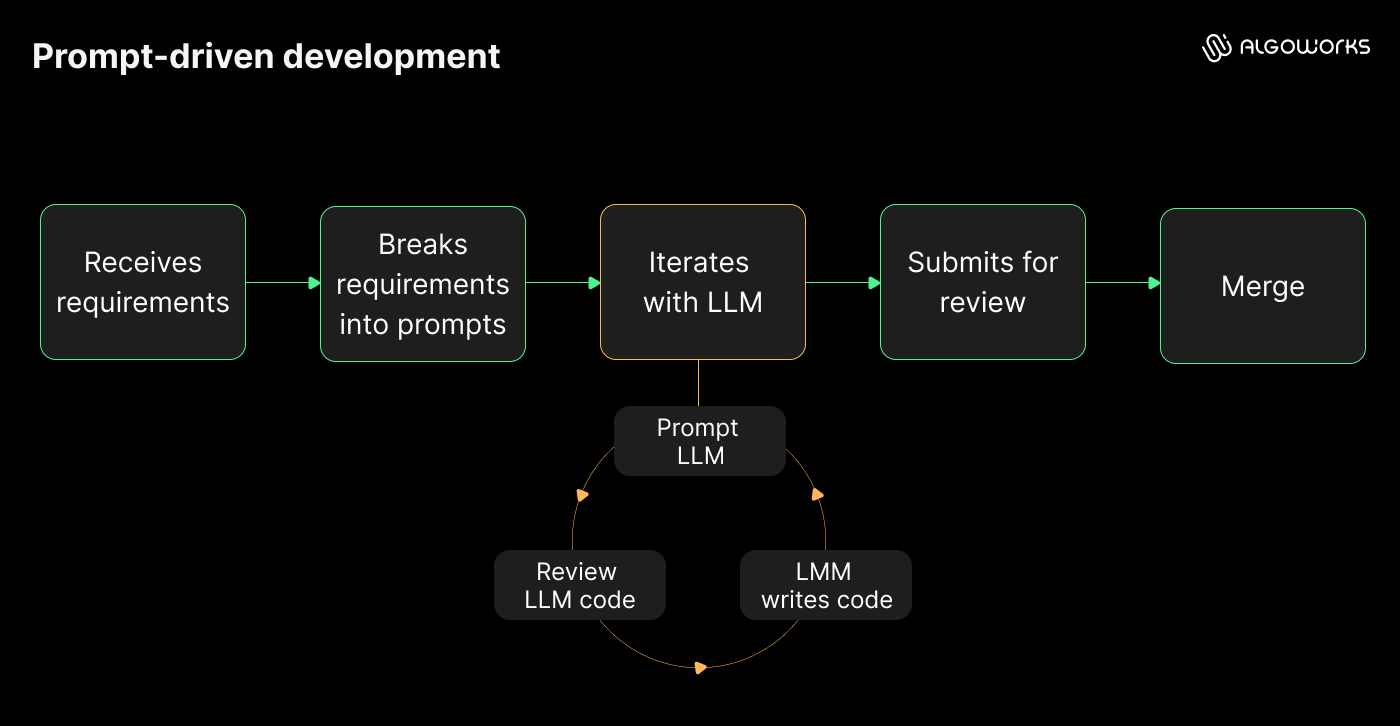
What is prompt-driven development?
Prompt-driven development is a structured engineering approach where natural language prompts are first-class artifacts in the development workflow, designed with intent, versioned like code, reviewed like specifications and reused across a team.
The key difference from vibe coding is not the tools. It is the discipline around how prompts are created and managed, much like the structured workflows enabled by internal developer platforms (IDPs).
In mature engineering workflows, prompts are not treated as chat inputs. They are governed, reusable, versioned team assets that evolve alongside the codebase. When output diverges from intent, the fix starts at the prompt level, not just the generated code.
The easiest way to understand this is to look at how prompts themselves are treated.
Prompts as specifications, not casual inputs
In prompt-driven development, a prompt is not “make me a login form.” It is a structured specification that includes role context, constraints, expected output format, engineering norms, security boundaries and test criteria. The shift is from “generate something” to “build within defined boundaries.”
That directly changes what the AI produces and, more importantly, who owns the output. When prompts include explicit constraints, the developer retains architecture ownership. The AI executes a specification, not invents one. Once prompts are treated this way, the entire workflow becomes more structured.
How prompt-driven development works
Three things distinguish a prompt-driven workflow from vibe coding.
Structured prompts
Every prompt follows a defined format that captures intent, boundaries and context. That includes requirements, assumptions, system context, expected behavior, constraints and safeguards. This gives the model an implementation boundary, not just a goal.
Iteration with guardrails
Changes go through the same review process as code changes. Before a prompt is updated in production, it is tested against evaluation datasets, reviewed for performance impact and documented. Collaborative review catches issues that individual developers miss.
Integration into workflows
Prompts sit in version control alongside code. CI/CD pipelines include prompt regression testing. The same quality gates that apply to code apply to the prompts that generate it.
This structure is what makes this approach viable beyond individual developers.
Why it is more scalable than vibe coding
Three properties make prompt-driven development suitable for production engineering.
- Predictability: Because prompts are structured and versioned, the same prompt reliably produces consistent output. Teams can evaluate changes before deployment.
- Reusability: A prompt template built for one feature can be adapted for similar features. Domain knowledge accumulates in the prompt library rather than being recreated from scratch.
- Team alignment: When prompts are shared assets, the whole team operates from the same intent. There is no ambiguity about what a feature is supposed to do because the specification is written down and reviewed.
At this point, the contrast between the two approaches becomes much clearer.
Vibe coding vs prompt-driven development
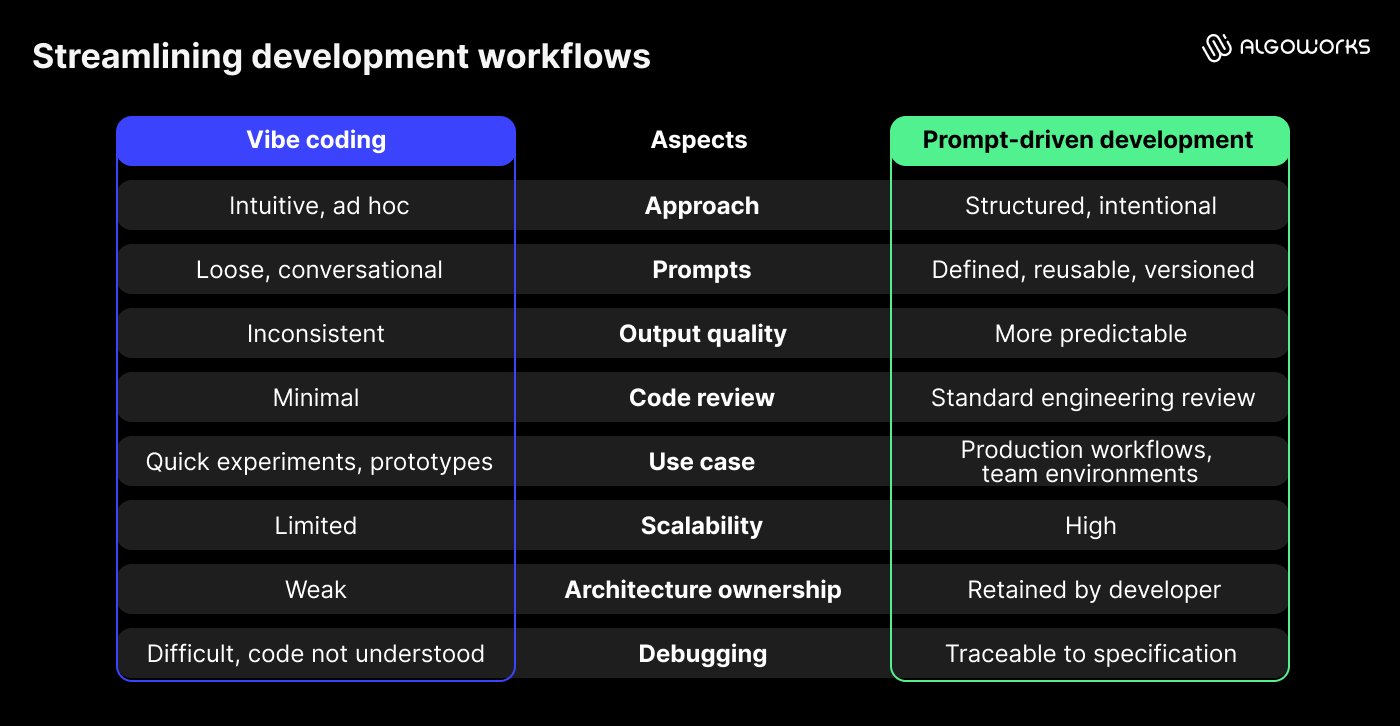 Both approaches use AI to generate code from natural language. That is where the similarity ends.
|
Aspect |
Vibe coding |
Prompt-driven development |
| Approach | Intuitive, ad hoc | Structured, intentional |
| Prompts | Loose, conversational | Defined, reusable and versioned |
| Output quality | Inconsistent | More predictable |
| Code review | Minimal | Standard engineering review |
| Use case | Quick experiments, prototypes | Production workflows, team environments |
| Scalability | Limited | High |
| Architecture ownership | Weak | Retained by the developer |
| Debugging | Difficult, code often not understood | Traceable back to a defined specification |
The practical difference: vibe coding is a personal productivity tool. Prompt-driven development is an organizational capability. So, the real question is not which one is better; it’s where each one fits.
When to use vibe coding and when to use prompt-driven development
The answer here is context-dependent, not ideological. In practice, teams align this choice with where AI delivers the fastest business value, especially in areas focused on AI-driven operational efficiency.
Use vibe coding for:
- Internal prototypes and proof-of-concepts
- Exploratory spikes where you are testing whether something is technically possible
- Hackathons and time-boxed experiments
- Non-critical internal tools with a short shelf life
Use prompt-driven development for:
- Any code going to production
- Features built by more than one developer
- Systems with security, compliance or performance requirements
- Long-lived codebases that need to be maintained and extended
- Client-facing products
Financial institutions by late 2025 were applying this split deliberately. Vibe coding for rapid internal tooling. Traditional prompt-driven workflows with human oversight for anything touching compliance-critical systems. Healthcare companies followed the same pattern: AI-assisted speed for administrative applications, deliberate engineering discipline for anything near patient data.
The split is not about being conservative or progressive. It is about matching the tool to the risk profile of the work and that leads to a bigger realization for most teams.
What this means for your organization
The instinct most teams have is to pick one approach and apply it uniformly. That is the wrong framing.
The right framing is: start with vibe coding, evolve into prompt-driven systems.
Vibe coding is how most teams discover what AI-assisted development can do for them. It is fast, low-friction and motivating. The problem comes when teams skip the evolution step and continuing operating in an ad hoc way even after moving into production. This is a common challenge in AI adoption in existing enterprise systems, where structure often lags behind implementation.
Here is what the evolution looks like in practice.
- Build internal prompt standards: Start documenting what makes a good prompt for your stack, your architecture and your common use cases. It starts with developers sharing prompts that worked well and patterns that consistently failed.
- Add review and testing layers: AI-generated code should go through the same code review process as human-written code. Given that AI-generated code shows measurably higher vulnerability rates, security review is not optional.
- Invest in prompt versioning: Once your team is producing prompts that work well, put them in version control. Track changes, evaluate the impact of updates and this becomes the foundation of repeatable AI-assisted delivery.
This is the kind of engineering infrastructure that separates teams shipping AI-assisted features reliably from teams constantly firefighting regressions they do not fully understand. Zooming out, both approaches are part of a larger move in how software is being built.
How this connects to AI-driven software development
Vibe coding and prompt-driven development are both part of a larger change in how software is being. The role of the developer is changing, not disappearing.
The DORA 2025 report found that developers use AI tools at work and more than 80% say AI improves productivity. At the same time, only 29% of developers trust AI-generated code, down from 40% the year before. Gartner predicts 90% of enterprise software engineers will use AI code assistants by 2028, up from less than 14% in early 2024.
Those numbers tell a clear story. Adoption is near-universal, but trust is not. The gap between the two is where engineering judgment lives.
Developers are becoming reviewers, orchestrators and specification writers. Less time goes into writing boilerplate. More goes into defining constraints clearly enough that the AI produces what you actually need. The skill is not prompting, it is knowing what you want in enough detail to specify it.
The human-in-the-loop is not a concession to AI limitations. It is the design. AI accelerates execution, while engineering judgment determines what to execute and whether the output is trustworthy; especially as we move toward agentic AI in the software development lifecycle.
Tools powering this shift 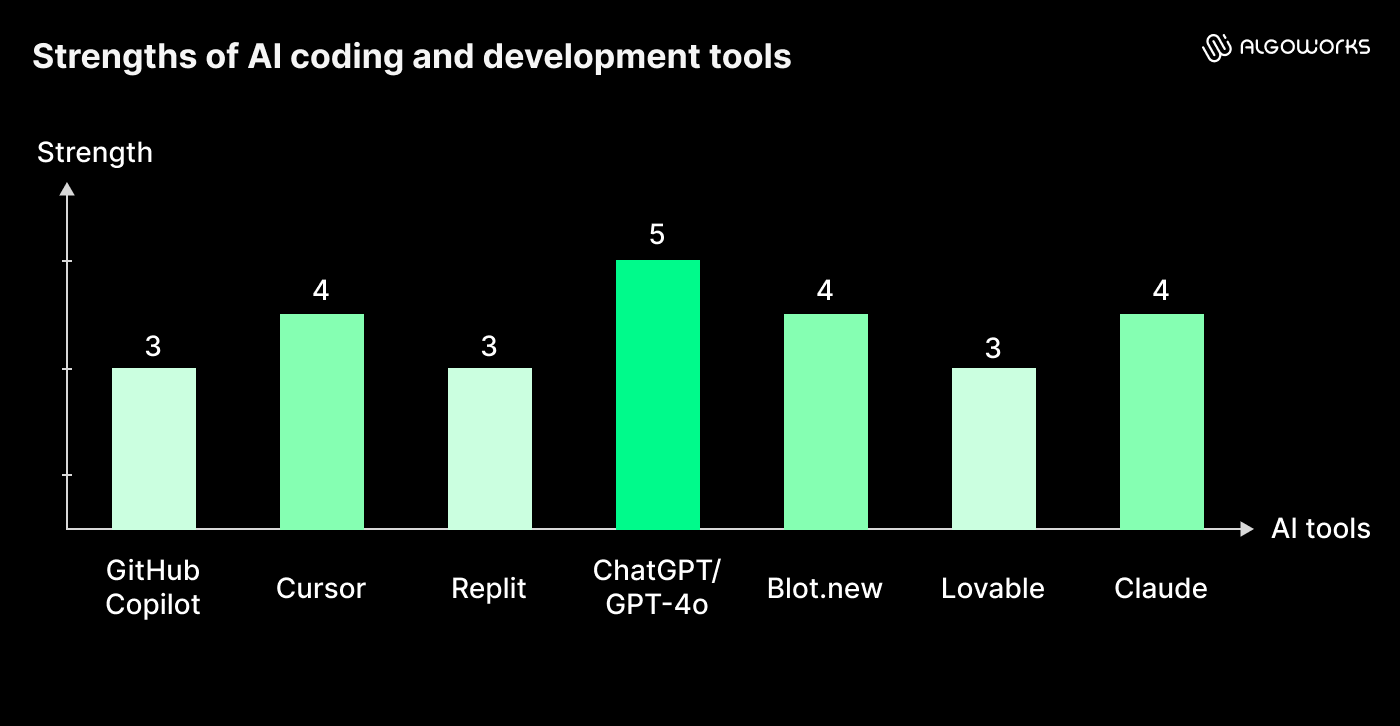 The tools matter, but they are not the strategy. Here are the platforms most engineering teams are working with right now.
|
Tool |
Best for |
Key strength |
| GitHub Copilot | IDE-integrated code completion | Deep integration, enterprise security |
| Cursor | Full-file and project-level editing | Context-aware across codebase |
| Replit | Browser-based prototyping | Fast setup, no local environment |
| ChatGPT / GPT-4o | Exploratory prompting, problem-solving | Broad capability, flexible |
| Bolt.new | Full-stack app scaffolding | Speed from zero to working app |
| Lovable | UI-focused app building | Non-engineers, product prototyping |
| Claude | Structured prompting, long-form reasoning | Strong context handling, better for complex workflows |
For vibe coding use cases, Replit, Bolt.new and Lovable are built around low-friction speed. For prompt-driven development workflows, Cursor and GitHub Copilot integrate more cleanly into existing engineering processes.
The choice of tools matters less than whether your team has a defined and disciplined workflow around them.
Turning prompt-driven development into a real engineering practice
This is the section most blogs skip. Getting from “we use AI tools” to “we have a reliable AI-assisted delivery process” requires four things.
Prompt versioning
Prompts are not temporary inputs. They are part of the system. They should live in your repository, carry commit history and be reviewed before they are changed. When output diverges from intent, the fix starts at the prompt level, not just the generated code. That discipline prevents the drift that makes AI-generated systems difficult to maintain over time.
Reusable templates
High-value prompts should be documented and shared across the team. A prompt that consistently generates reliable unit tests or structured APIs is more valuable as a shared asset than something used in isolation. Over time, this builds a prompt library that reduces variability and speeds up development without sacrificing consistency.
CI/CD integration
Prompt regression testing should be part of your pipeline. Before a prompt change is deployed, it should be tested against a defined evaluation dataset. This is not complex to implement, but it prevents a common issue where small prompt changes silently degrade output quality across the system.
Testing and governance
AI-generated code must go through the same security scanning, code review and quality gates as human-written code. Given that AI-assisted development introduces higher variability, treating generated code as pre-approved is not a calculated risk. It is an unexamined one. All of this points to a broader direction the industry is moving toward.
The future of AI-driven development
- What stays: Complex systems, enterprise infrastructure, regulated applications and anything where security and maintainability matter will continue to require deliberate engineering judgment. Karpathy himself updated his original framing in February 2026, noting that his early description of vibe coding was suitable mainly for throwaway projects and that the concept had been superseded by more structured approaches as models improved. Fundamentals still matter because AI does not replace the need to understand what you are building. It removes the friction of writing it down.
- What fades: Boilerplate writing, repetitive scaffolding, syntax lookup and the mechanical parts of coding are already largely automated. Developers who spend most of their time on those tasks will find their role changing whether they adapt deliberately or not.
- What this means for your team: The developers and organizations that move fastest are not the ones who use AI the most. They are the ones who have built the discipline to direct it well. Speed without judgment produces debt faster than humans ever could.
Which brings us back to where most teams actually start.
Final step: moving from vibe coding to structured AI development
Vibe coding is the entry point. Almost every team that now runs a mature prompt-driven workflow started by vibe coding their way through a prototype. The speed is real, the learning is genuine, but the problem is staying there.
Prompt-driven development is the system. It is what happens when a team takes the productivity gains from vibe coding and puts engineering discipline around them. Structured prompts. Version control. Code review. Testing. Governance. These are not bureaucratic additions. They are the difference between AI-assisted speed that compounds and AI-assisted speed that creates problems faster than you can fix them.
Real value comes from speed plus discipline. Not either one alone.
If your team is already using AI but without a defined workflow, this is where it starts to matter. Algoworks helps teams turn that into production-ready systems. Explore our extensive product engineering services to see how this works in practice.
Talk to our team about building the right structure for where your engineering practice is today.
FAQs
Vibe coding is an informal way of using AI to generate code by describing what you want in natural language and iterating until it works, without deeply reviewing or structuring the output.
Prompt-driven development is a structured approach where prompts are treated as engineering assets. They are designed with clear constraints, versioned, reviewed and reused to produce consistent, production-ready code.
Not typically. Vibe coding works well for prototypes and experimentation, but it lacks the consistency, traceability and control needed for production environments.
Neither is universally better. Vibe coding is useful for speed and exploration, while prompt-driven development is better for scalable, reliable and team-based engineering workflows.