When AI can accelerate delivery, what makes a digital experience partner valuable?

AI is changing how quickly digital experiences can be created, and what businesses should expect from digital experience services. Research can be synthesized faster. Ideas can move into prototypes sooner. Content, design, development and testing are all getting an AI-assisted speed boost.
A 2025 systematic review of 83 studies on AI-enabled UX design tools found AI already supporting evaluation, ideation, prototyping and user simulation across the design process. But faster delivery does not answer the harder questions.
- What is worth building?
- Where should AI improve the experience?
- What should remain human?
- How should the solution fit your business?
- What evidence will tell you it worked?
These questions are changing what you should expect from a digital experience partner.
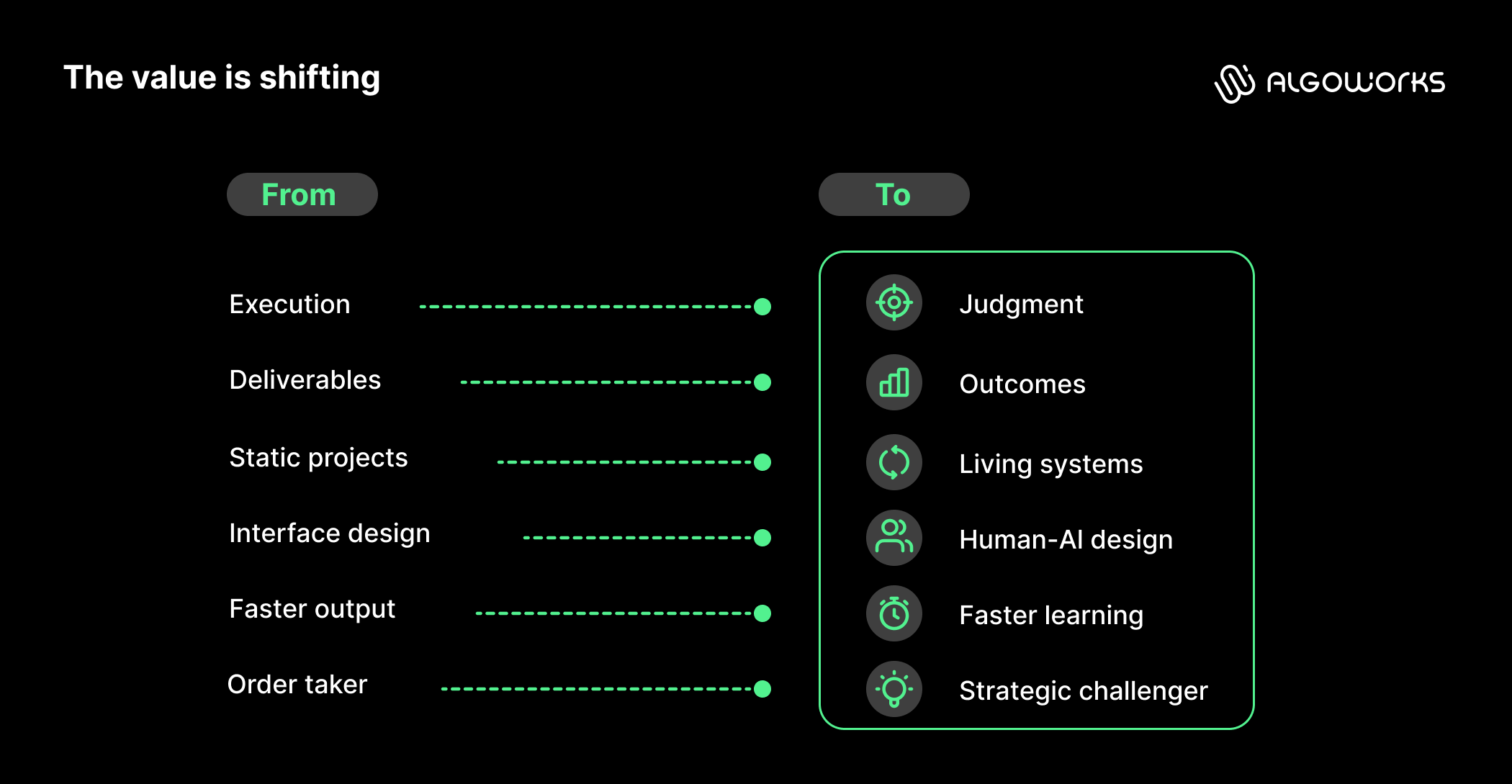
The bottom line: DX is shifting from execution to judgment
As AI accelerates execution, the value of a digital experience partner shifts toward strategic judgment. That means helping you choose the right problem, connect the work to a business outcome and prove whether it created value.
The shift looks like this:
- Execution → Judgment: Build less on assumption and make better decisions about what deserves investment.
- Deliverables → Outcomes: Measure success through conversion, adoption, productivity or another business result.
- Static projects → Living systems: Keep improving experiences after launch.
- Interface design → Human-AI design: Define how people and intelligent systems work together.
- Faster output → Faster learning: Use AI to reach evidence-based decisions sooner.
- Order taker → Strategic challenger: Question the brief when it does not address the real problem.
So, what does that look like in practice?
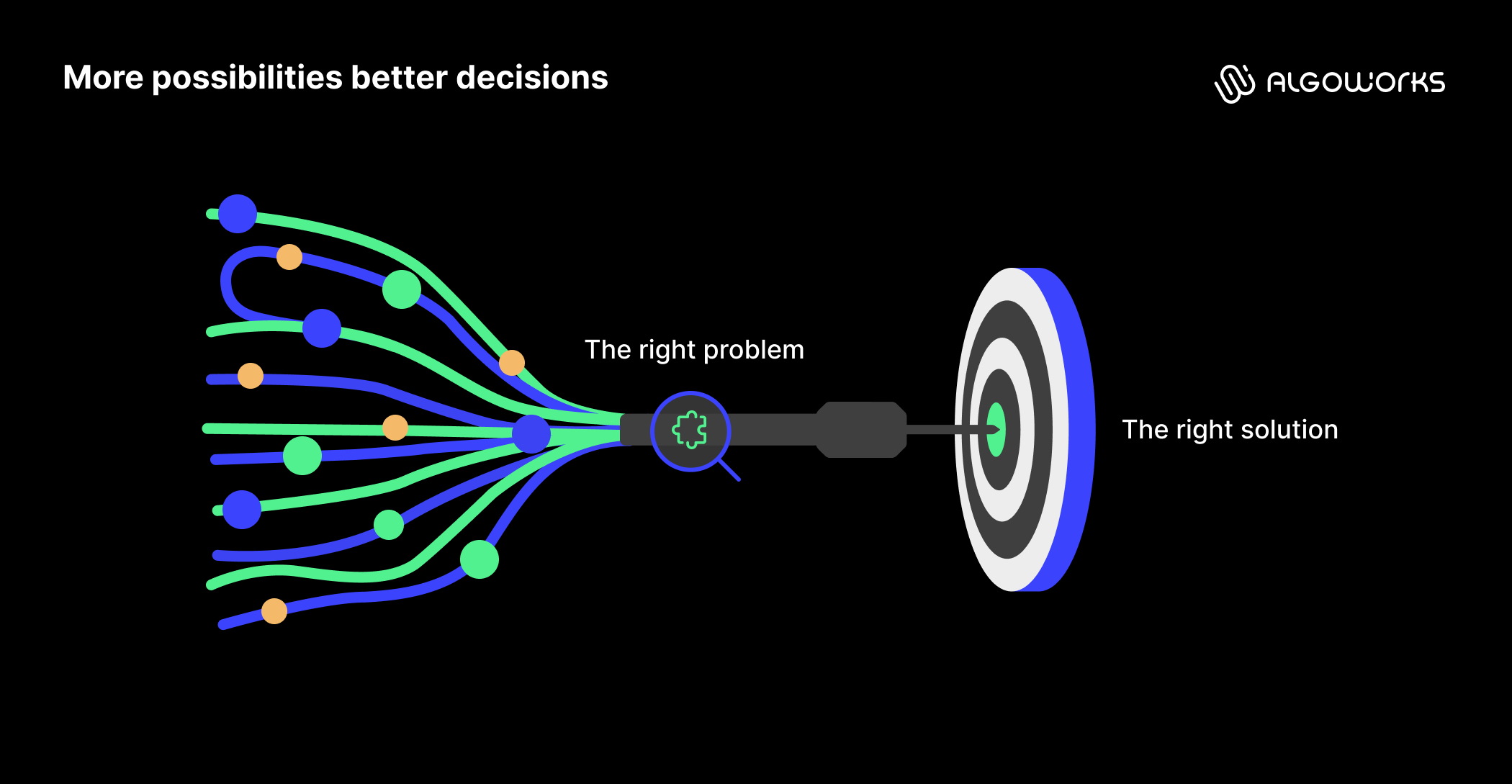
Start by solving the right problem
AI can give you more options. It cannot decide which one matters most to your business. If your team can produce ten concepts instead of three, you still have to choose which one solves the right problem. Hypothetically, if you can prototype in an afternoon, you still need to know what is worth testing.
This is where your partner should bring judgment. Say you ask for a website redesign. An execution partner can start designing. A strategic partner first asks why.
- Are customers struggling to find information?
- Has conversion dropped?
- Has the buying journey changed?
- Are visitors arriving from AI search with different expectations?
The problem isn’t Salesforce itself. It’s who implements it. The number one reason PE CRM implementations fail is data entry friction; a challenge many firms face during why transformations stall. You need to understand that before choosing the solution. Solve the right problem before you build the solution.
The 10/20/70 framework: Start with the outcome, not the technology
Once you know which problem is worth solving, the next question is what success should look like. That sounds obvious, but it is where many digital initiatives lose their way. The conversation moves too quickly from the problem to the solution.
- You identify friction in the customer journey and decide you need a website redesign.
- You see an opportunity to improve support and start planning an AI assistant.
But launching the solution does not mean you solved the problem. This is why an outcome-first AI strategy starts by defining the business result you need to change before deciding which technology to build or implement.
A redesigned website only matters if it makes the journey better. An AI assistant only matters if it helps customers get what they need faster. A new employee experience only matters if it removes friction from the way people work. This difference between what you build and what actually changes is becoming especially clear with enterprise AI.
AI adoption is not the same as AI value
McKinsey’s 2025 research shows that AI adoption is widespread, but enterprise-level impact remains harder to achieve. Workflow redesign is one of the factors associated with organizations generating greater value. That makes sense. If you add AI to a process that already creates friction, you may simply make the same process move faster.
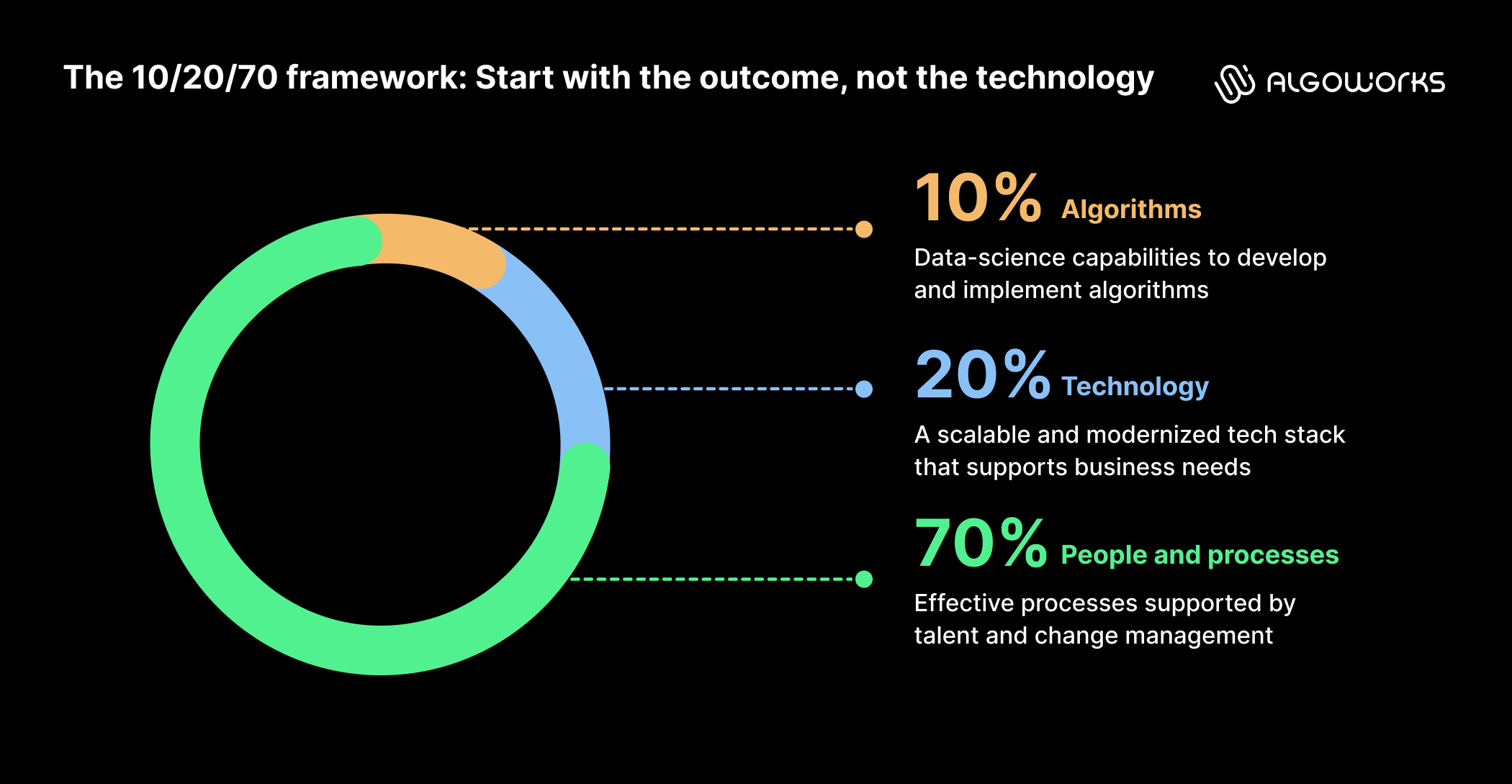
BCG’s 10/20/70 framework puts the challenge into perspective. It suggests organizations focus roughly:
- 10% on algorithms
- 20% on technology and data
- 70% on people and processes
The model is only one part of the transformation. Much of the work sits around it: how people use AI, how workflows change and how the technology fits into the way your business operates. Your partner should therefore start with the outcome.
- Do customers need to complete a task with fewer steps?
- Do employees need to spend less time searching for information?
- Does the buying journey need to convert more visitors?
- Does AI need to remove a manual handoff?
Once you know what needs to change, you can decide what needs to be built.
Agentic AI is turning digital experiences into living systems
Defining an outcome gives you a target. But in an AI-enabled experience, reaching it once is not enough. Traditional digital projects followed a linear lifecycle:
Research → Design → Build → Launch
That model assumes the experience remains relatively stable after launch. Agentic AI changes that assumption. Content can adapt to context. Recommendations can respond to behavior. AI can guide the next step or take action for the user. As agentic AI moves deeper into enterprise workflows, these experiences also need to account for context, oversight and what happens when AI acts rather than simply recommends.
Gartner predicts that by 2028, 60% of brands will use agentic AI to enable streamlined one-to-one interactions. Imagine a customer who begins by researching a product, continues through an AI-guided experience, asks an agent to complete part of a task and later moves to a human.
The journey has to work across all of those moments. Context needs to persist and the experience needs to adapt. That changes the lifecycle:
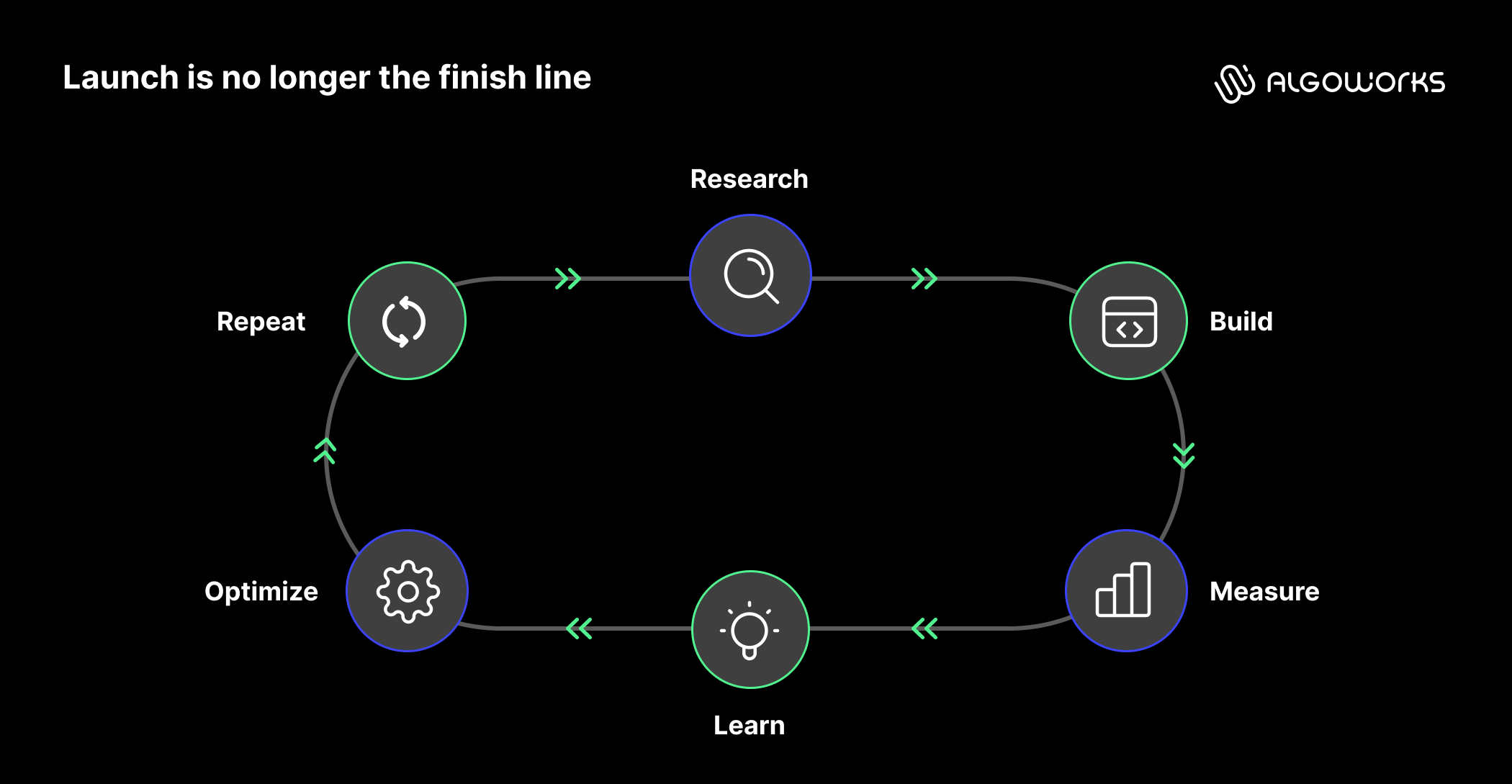
Research → Build → Measure → Learn → Optimize → Repeat
Launch becomes the start of the learning cycle. You watch what happens.
- Do customers trust the recommendation?
- Do they complete the task?
- Where does AI remove friction?
- Where do people still need help?
Then you improve the experience based on what you learn. That is what makes it a living system.
What is an intelligent digital experience?
As experiences become more dynamic, the interface has to change too. An intelligent digital experience uses AI within a customer or employee journey to understand context, guide decisions, adapt what the user sees or take an appropriate action. It does not mean putting every interaction inside a chatbot.
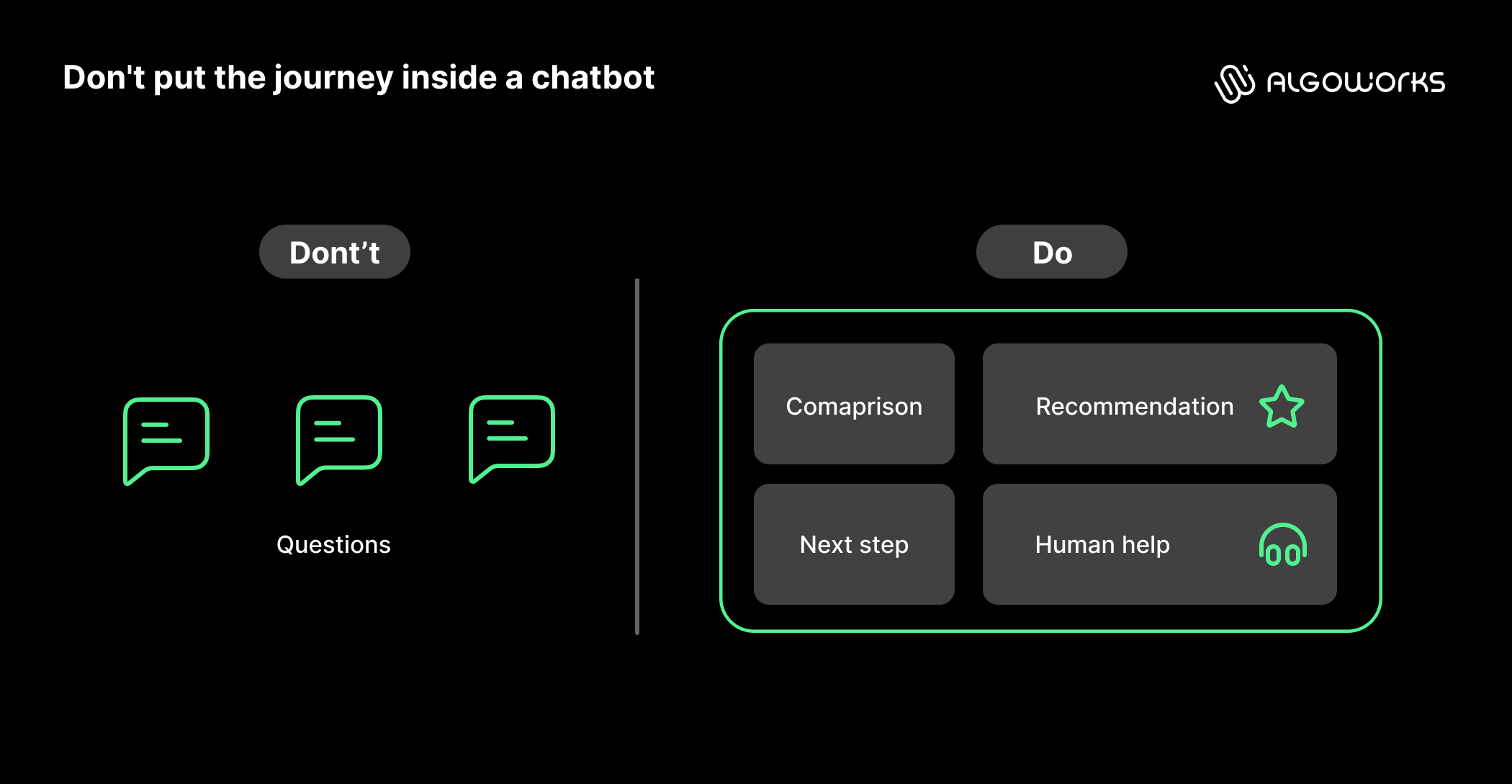
Imagine you are choosing a university program. You want to compare programs, understand the cost, explore learning options and eventually speak with an enrollment specialist. A chatbot can answer those questions. But if the entire journey happens in one long conversation, useful information quickly gets buried.
A better experience can combine conversation with interface. Your questions can change what appears on the page. Important information can become a persistent education plan. The system can surface relevant next steps and move you to a human when needed.
The AI does not need to dominate the interface. It needs to make the journey easier. The next generation of digital experiences will not necessarily look like AI. They will behave intelligently.
Human-AI design comes down to agency, control and escalation
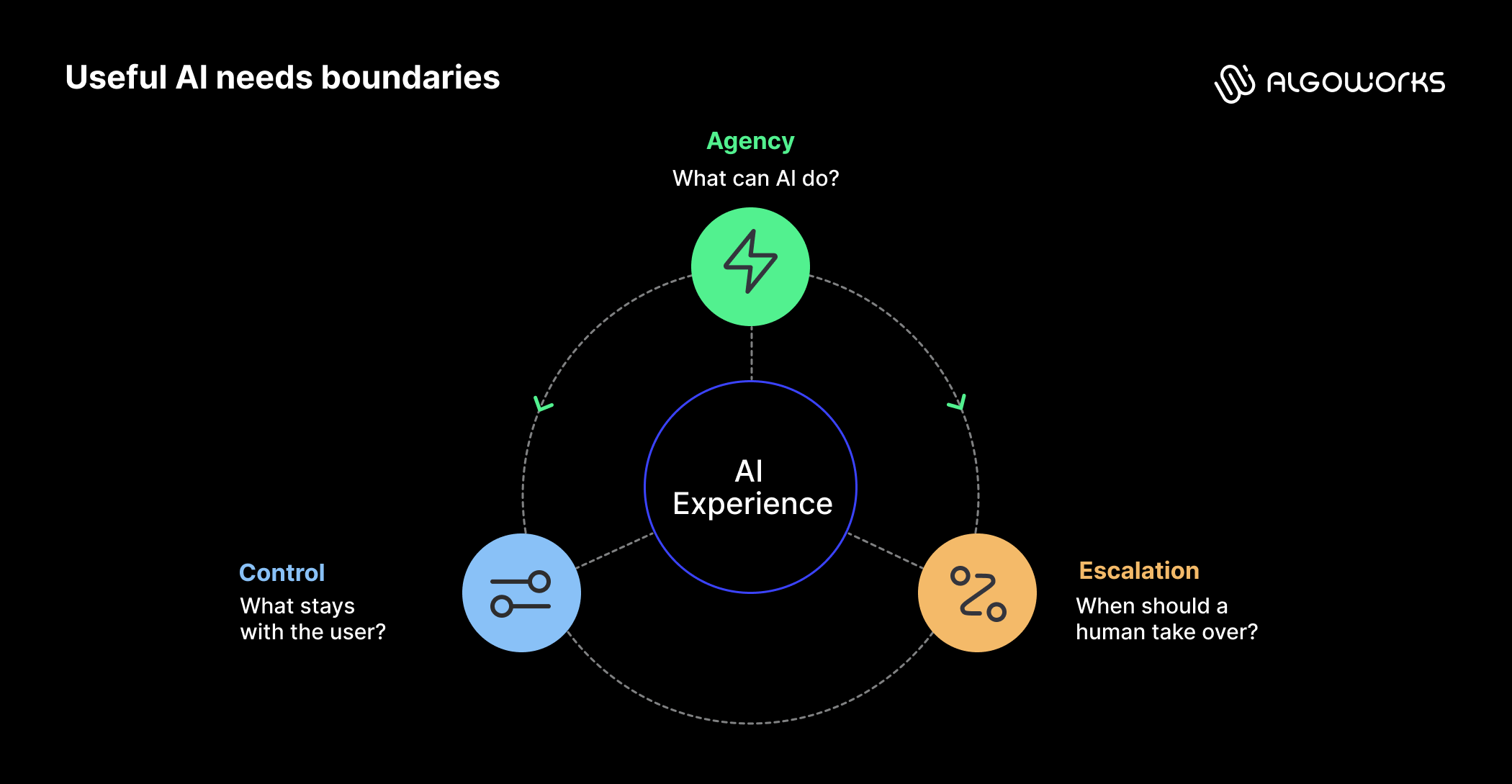
Once AI can act inside the journey, you have another design decision to make: how much should it be allowed to do? Three questions help define that relationship.
Agency: What can AI do?
Should AI recommend an action, prepare it or complete it? The answer depends on the task and its risk. An agent booking a routine appointment is different from one making a financial or healthcare decision.
Control: What stays with the user?
Users should understand what AI is doing and retain control where the decision matters. That includes being able to verify important outputs, change direction or stop an action when necessary.
Escalation: When does a human take over?
Some interactions need human judgment. The handoff should happen without forcing the user to start again. Relevant context should move with the interaction so the human understands what has already happened. This becomes especially important as conversational AI evolves to support better human interactions, rather than simply automate them. Together, agency, control and escalation determine whether AI feels genuinely useful or simply adds another layer of friction.
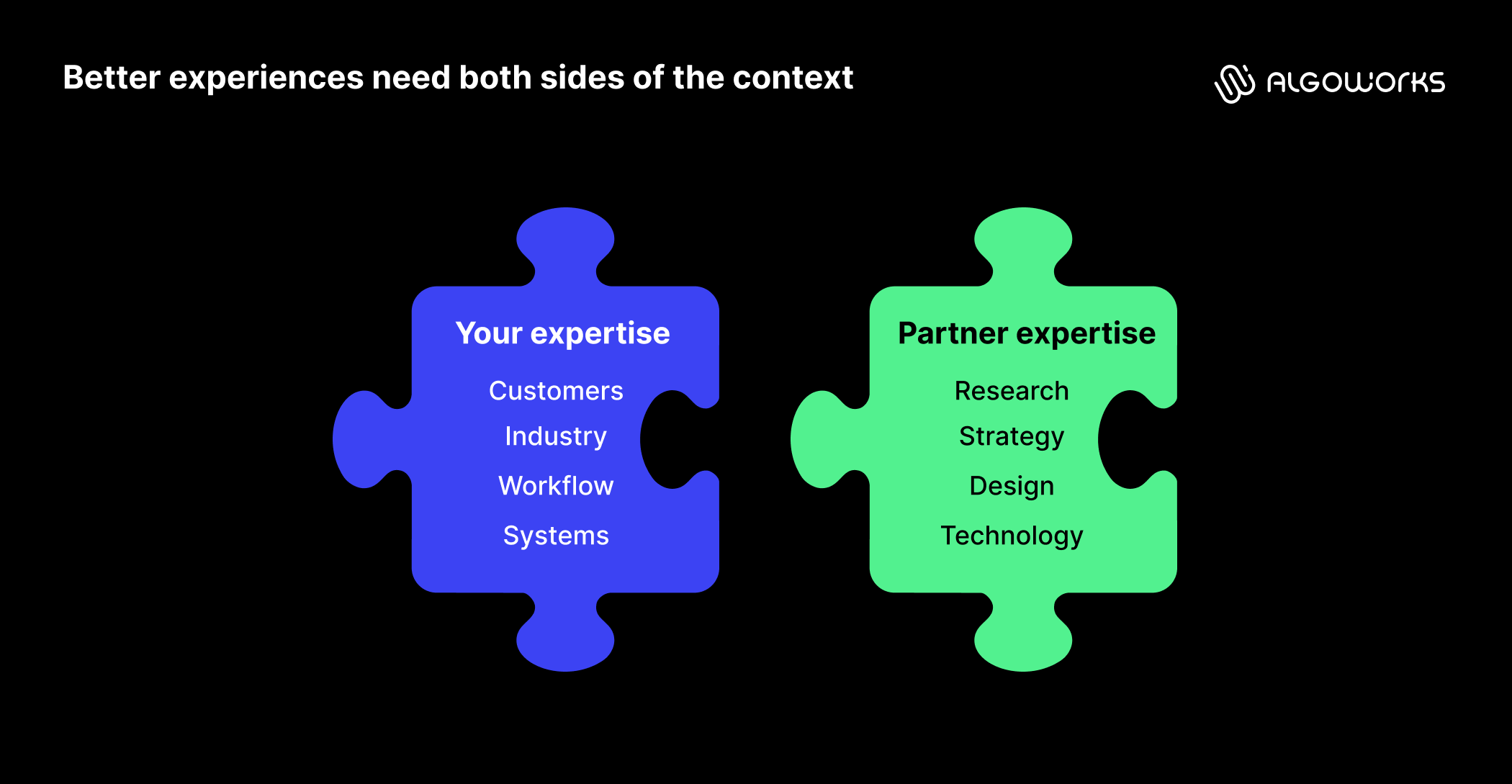
Better experiences combine your expertise with your partner’s
Making those decisions requires context that an external partner cannot bring alone. You understand your customers, industry, systems, workflows and constraints. Your partner brings research, experience strategy, design, technology expertise and patterns learned across other organizations. You need both.
Consider an AI-enabled system that helps engineers investigate equipment failures. The engineers know how failures are diagnosed, which signals matter and where uncertainty enters the process. An experience team can observe where that process becomes difficult. They can simplify interactions, reorganize information and determine how AI recommendations should appear without getting in the engineer’s way.
Neither side has the complete answer alone. Collaboration is therefore not just a relationship benefit. It directly affects the quality of the experience. A strong partner does not replace your expertise. They know how to build on it.
Context should compound over time
When that collaboration continues, each engagement leaves behind knowledge. Your partner learns where customers struggle, which assumptions proved wrong, which internal constraints matter and which experiments worked. The next project should begin with that knowledge.
Imagine the first engagement starts with a homepage. Your partner learns why visitors arrive, what information they need and what stops them from converting. The next project adds research. Another adds behavioral evidence. Work on an internal product reveals how employees support the same customer journey behind the scenes.
By the tenth engagement, you should not be starting from zero. This matters even more as AI tools become widely available. Your competitors can access many of the same models and platforms you can. Knowing how to use AI is becoming common. Knowing where AI belongs in your customer journey, employee workflows and business is much harder to replicate.
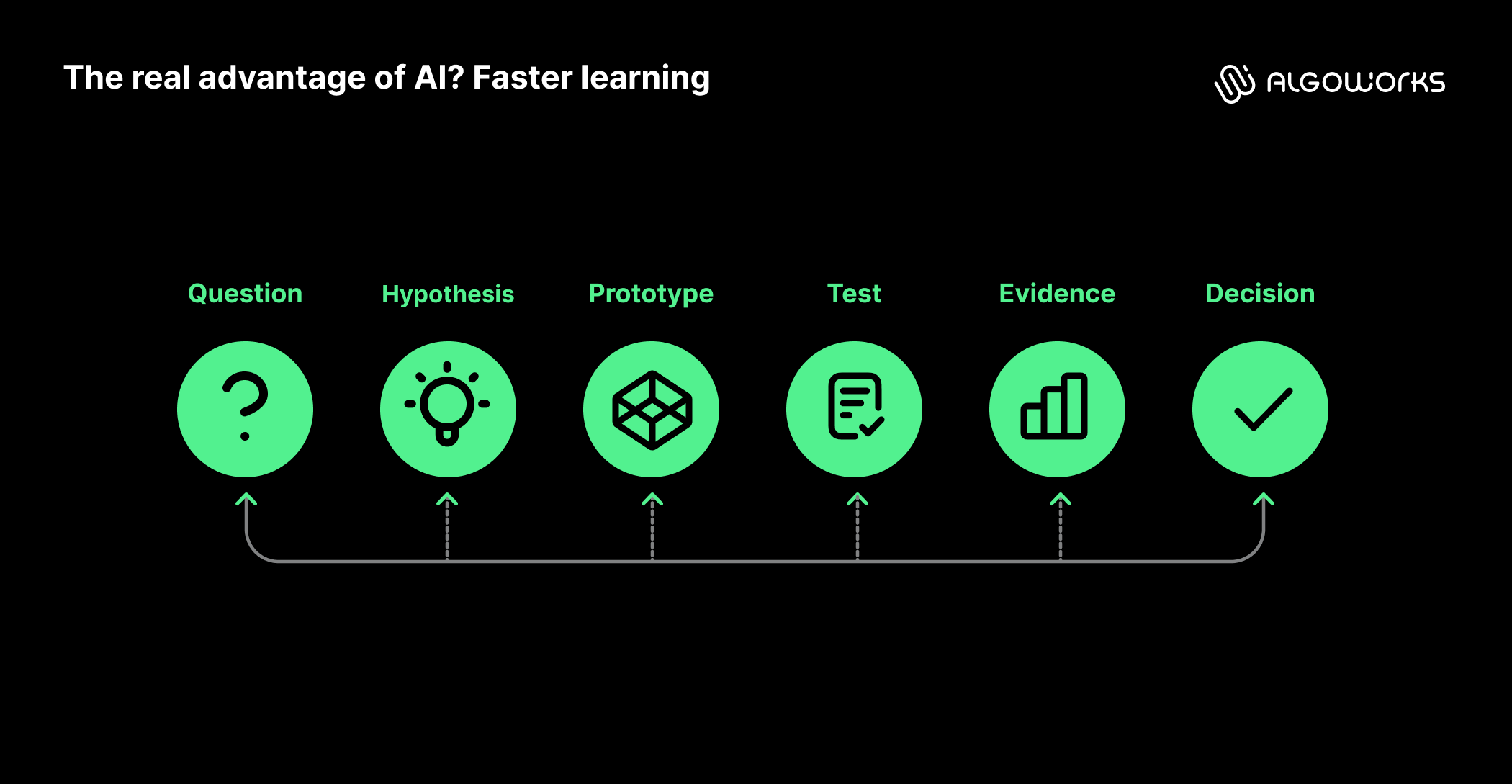
Use AI to learn faster, not just deliver faster
Accumulated context gives you better starting assumptions. AI can help you test them faster. That is where AI-enabled speed becomes more interesting than simple productivity. The traditional productivity question is: How quickly did you produce the prototype? A more useful question is: How quickly did that prototype help you make a better decision?
Think of the process as:
Business question → Hypothesis → Prototype → Test → Evidence → Decision
AI can shorten several steps in that cycle. You can analyze research sooner, turn a hypothesis into something testable faster and explore more variations before making a major investment. That means weak ideas can fail earlier and stronger ideas can move forward with evidence behind them.
So when you evaluate a partner, asking whether they use AI tells you very little. Ask what AI changes about the way they solve problems.
- Can they test assumptions sooner?
- Can they bring evidence into decisions faster?
- Can they help you avoid investing heavily in the wrong idea?
The real value of speed is not more output. It is faster learning.
Measurement tells you whether the experience created value
At the beginning, you defined what needed to change. Now you need to know whether it did. A successful launch only tells you that something shipped. Measurement tells you whether customers behaved differently or the business outcome improved.
Real-world experience work shows what that can look like:
- An initial homepage engagement produced a 23% uplift.
- A separate paid-site experience generated a 48% uplift.
- A later homepage iteration delivered another 15% uplift.
- Urgency messaging increased traffic to Apply Now by 32%.
- A Build Your Education Plan experience saw abandonment of around 1%.
These are different experiences and different measures, but the discipline is the same:
Define the outcome → Change the experience → Measure the result → Decide what comes next
That closes the loop. The work does not end with “we shipped it.” It ends with evidence you can use to make the next decision.
What should you expect from a digital experience partner in the AI era?
AI is making parts of digital delivery faster. That raises the bar for what you should expect from a partner. Execution still matters. But the greater value lies in knowing which problems deserve investment, how AI should fit into the experience and how to connect that work to measurable outcomes.
That value should also grow over time. A partner that works closely with your teams builds context about your customers, employees, workflows and business. Each engagement should make the next one smarter. A valuable partner does not earn your trust so they can take more orders.
They earn it so they can ask harder questions, challenge the brief when needed and help direct your investment toward what is most likely to create value. AI can make digital experience work move faster. The right partner helps you make sure it is moving in the right direction.
Ready to make AI work harder for your digital experience?
Algoworks helps you turn AI, customer insight and digital strategy into experiences that deliver measurable business value.