AI won’t replace human conversations. It will create better ones.

For years, conversational AI has been built around a simple question: How many human interactions can we avoid? Chatbots deflect support tickets, self-service tools reduce calls and AI assistants automate responses. These are useful outcomes. But they frame human interaction as a cost to remove, instead of focusing on the business outcomes AI should ultimately improve.
A different pattern is emerging. AI is helping people prepare for difficult conversations, giving experts more attention to the person in front of them, bringing knowledge into live interactions and helping people communicate with more empathy.
The opportunity is no longer limited to replacing conversations. AI can improve the conversations we still want humans to have.
What is communication intelligence?
Communication intelligence is the use of AI to improve how humans prepare for, conduct and learn from conversations with other humans. The distinction from traditional conversational AI is important. Conversational AI primarily communicates with the user. Human ↔ AI
Communication intelligence helps people communicate with each other.
Human ← AI support → Human
An AI assistant might write an empathetic response for a manager. Communication Intelligence could help that manager understand why their own response does not communicate the empathy they intended. One communicates for the human. The other helps the human communicate better, reinforcing the idea that UX is more than screens.
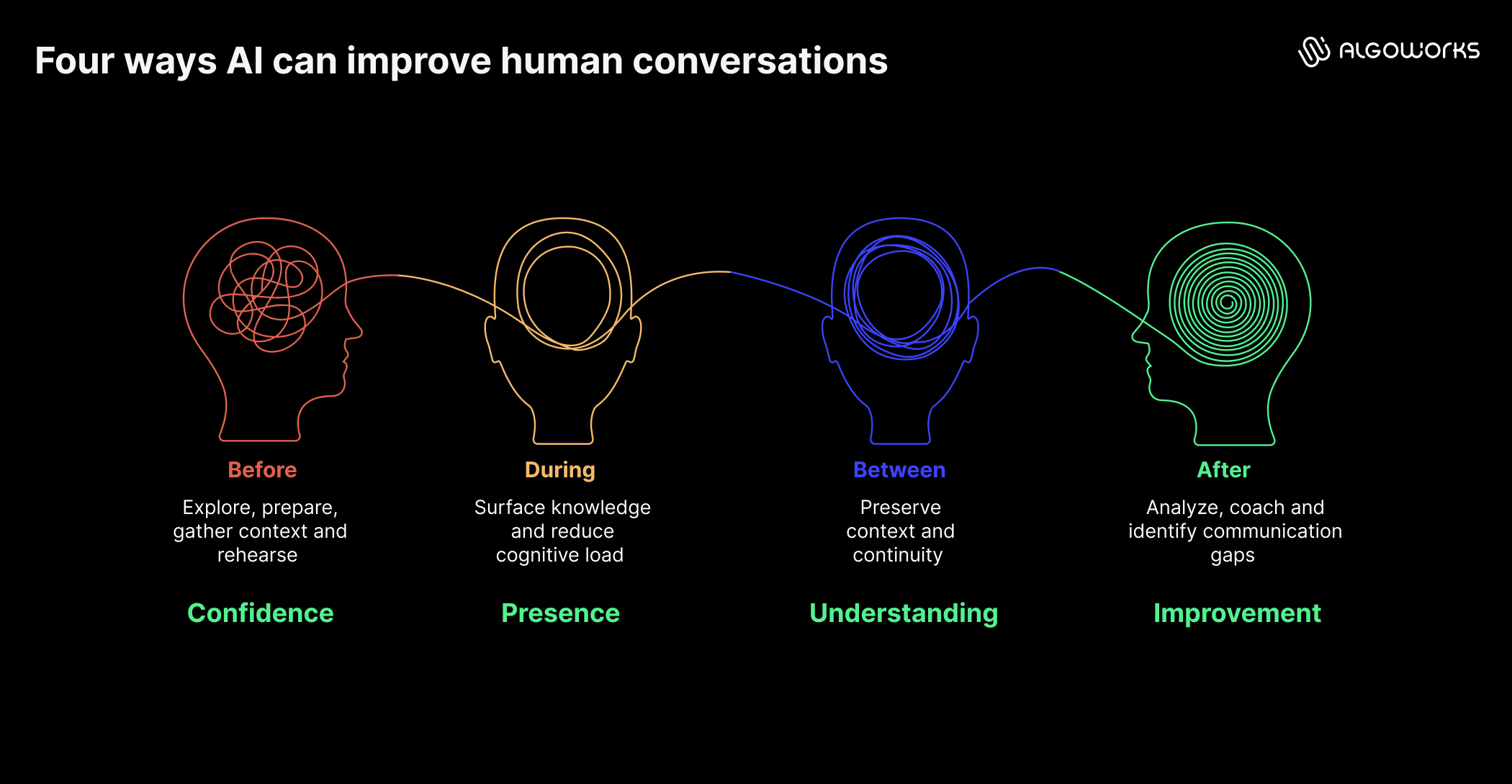
Four ways AI can improve human conversations
AI can support a human conversation at four moments:
| Moment | AI’s role | Human outcome |
| Before | Explore, prepare, gather context and rehearse | Confidence |
| During | Surface knowledge and reduce cognitive load | Presence |
| Between | Preserve context and continuity | Understanding |
| After | Analyze, coach and identify communication gaps | Improvement |
This changes the design question from What part of this conversation can AI automate? to: What can AI do around this interaction to make the human conversation better?
What does the research already show?
Evidence across industries is starting to answer that question.
- Healthcare: A 2025 study of ambient AI scribes found clinician burnout fell from 51.9% to 38.8% after 30 days of use. Researchers also found improvements in cognitive task load and after-hours documentation.
- Customer service: Research involving 5,179 support agents found generative AI increased productivity by about 14% overall, with gains of roughly 34% among novice and lower-skilled workers.
- Human empathy: A March 2026 experiment involving 968 participants, 2,904 conversations and 33,938 messages found personalized AI coaching improved people’s ability to communicate empathy.
- Human preference: A 2025 Nature Human Behaviour paper found people continued to prefer humans for emotional engagement, even when AI could generate highly empathetic responses.
Together, these findings point to something more interesting than AI becoming a better conversationalist. They show how AI can make people better prepared, more present and more capable when they talk to one another.
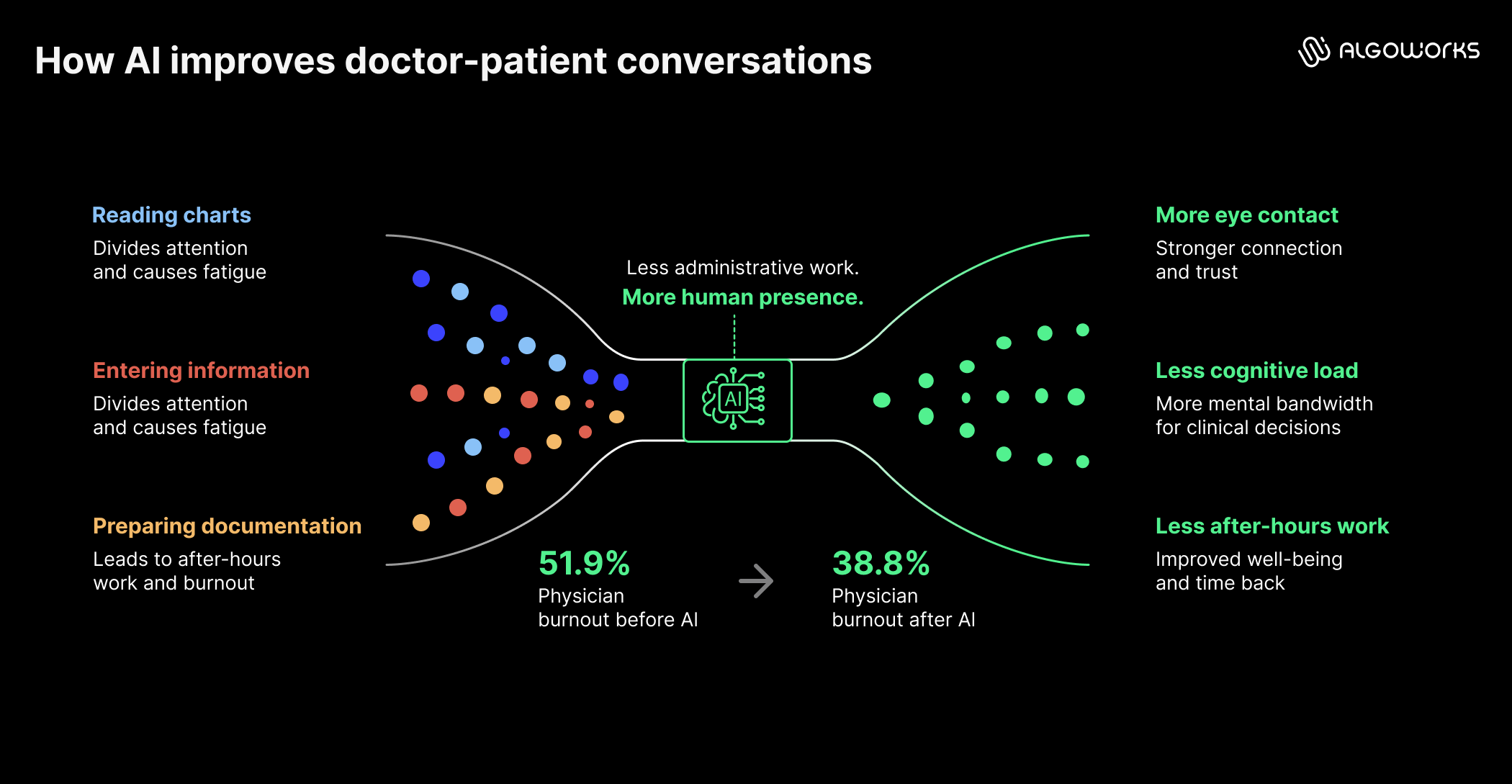
How is AI improving doctor-patient conversations?
A doctor can be talking to a patient while simultaneously reading a chart, entering information and preparing clinical documentation. While the conversation is occurring, the clinician’s full attention is frequently divided by these administrative demands, leading to a loss of eye contact and mental exhaustion
Ambient AI changes that dynamic by handling parts of the documentation process in the background, a direction that’s reshaping conversational AI in healthcare. A 2025 multi-site study examined ambient AI scribe use among 263 physicians and advanced practice practitioners.
Among the 186 participants included in its burnout models, burnout declined from 51.9% before the intervention to 38.8% afterward. The study also reported improvements in cognitive task load and time spent documenting outside working hours.
Randomized evidence is emerging too. A 2025 NEJM AI trial assigned 238 outpatient physicians across 14 specialties to ambient AI scribe applications or usual care to study their effect on documentation burden and burnout.
The important innovation is not that AI can write a clinical note. It is that the clinician has less administrative work competing for attention while talking to the patient. For healthcare, better AI can mean more human presence, not less.
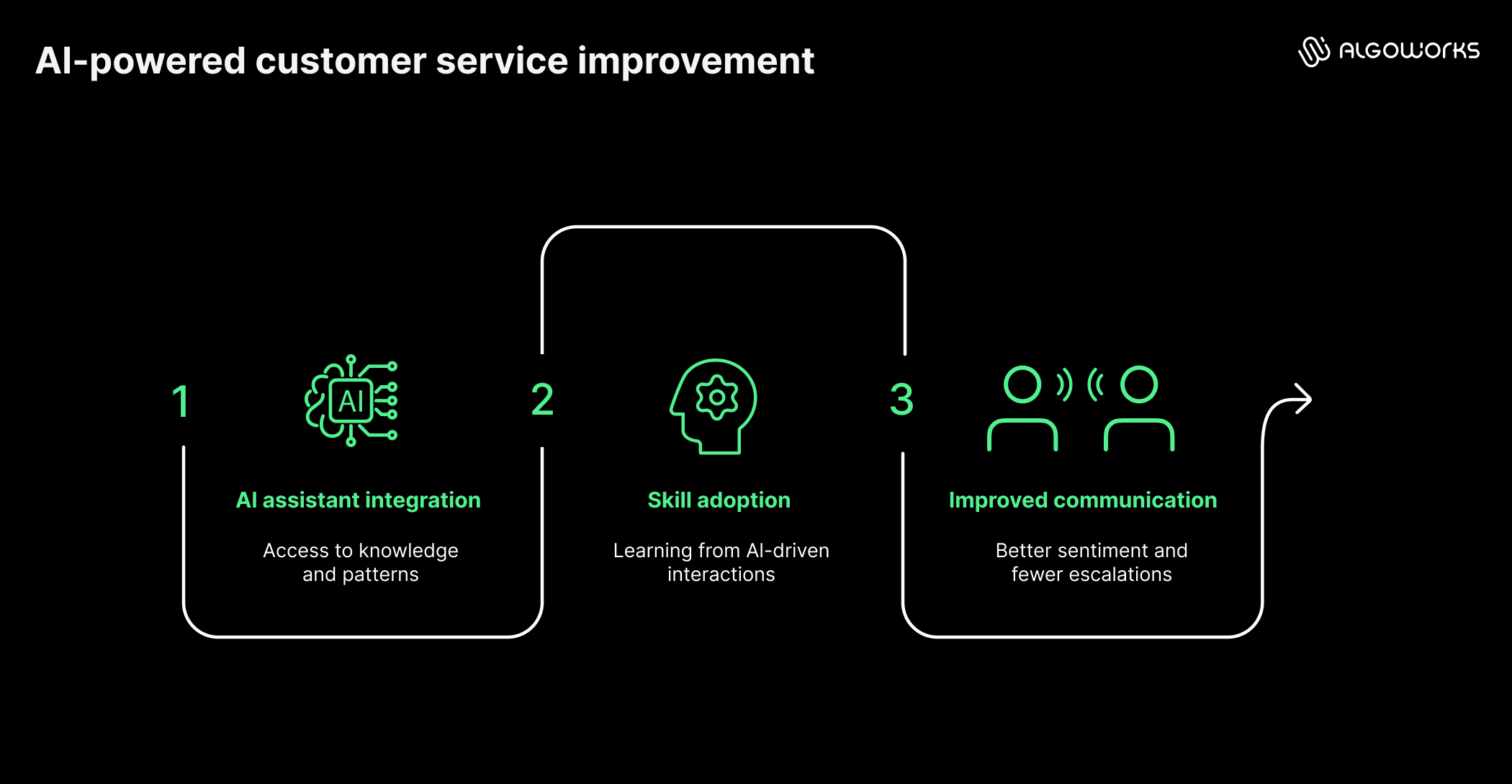
Can AI teach people to communicate with more empathy?
Some conversations are difficult because we do not know what to say. Others are difficult because we know what we want to communicate but struggle to express it. A March 2026 study explored whether AI could help close that gap.
Researchers analyzed 33,938 messages across 2,904 conversations involving 968 participants. Participants practiced responding to an LLM role-playing people experiencing personal and workplace problems. Some received personalized AI feedback on their responses.
Personalized coaching significantly improved empathic communication compared with a control group and participants who received non-personalized video instruction. The researchers also identified what they called the silent empathy effect: people can feel empathy without successfully expressing it.
That creates a more valuable role for AI than simply generating an empathetic message. Instead of write the response for me. AI can help someone ask: Why isn’t the empathy I feel coming through in what I’m saying?
A manager could rehearse difficult feedback or a salesperson could practice responding to a sensitive objection. The real conversation remains human. AI becomes the rehearsal room.
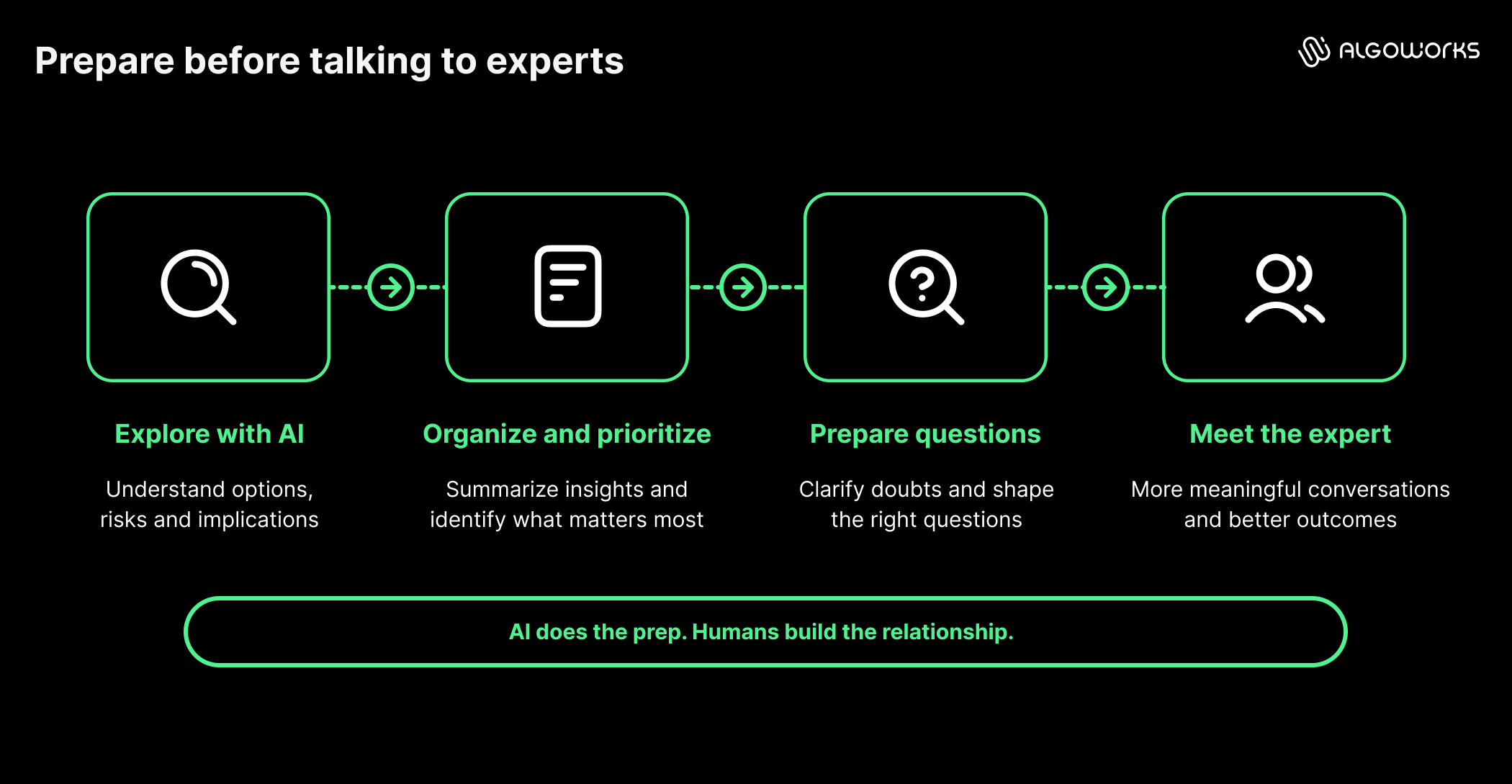
Can AI make people more confident before talking to an expert?
Not every human conversation is avoided because people prefer self-service. Sometimes they simply are not ready to talk yet. Someone evaluating a university program may still be wondering which program fits their career, whether they can afford it or how studying could fit around work.
A customer considering a financial product may want to understand their options before meeting an advisor. A B2B buyer may need to clarify requirements before talking to sales. A patient may want to organize questions before an appointment.
AI can provide a lower-pressure exploration layer before these interactions, much like organizations are now designing websites for an AI-first user journey. The traditional goal of self-service is to answer enough questions that the human conversation becomes unnecessary.
There is another possibility: Answer enough questions that the human conversation becomes worthwhile. People can explore options, clarify their needs and gather relevant information before speaking to an expert. The conversation does not disappear. It starts later, but it starts further ahead.
That advantage becomes much more valuable when the context gathered by AI survives the handoff. The questions someone has asked, the options they have explored and the needs they have revealed should not disappear simply because a human enters the conversation.
When that context moves with the person, the expert does not have to restart from zero. They can understand what has already been explored and move faster toward the decisions that require judgment, experience or trust. The person does not have to repeat information they have already provided. The AI interaction becomes preparation for the human interaction, not a separate journey.
If AI can communicate empathy, do people actually want it to?
AI can generate language that sounds remarkably empathetic. But sounding empathetic and being the person someone wants empathy from are not the same thing. A 2025 Nature Human Behavior paper examined this across nine studies involving 6,282 participants.
Participants evaluated empathetic responses attributed either to humans or AI. Responses believed to come from humans were generally perceived as more empathetic and supportive. Participants also consistently preferred humans when seeking emotional engagement.
Even believing AI had helped produce a human response could reduce perceived empathy and support. Put that beside the 2026 coaching research and an interesting tension appears. AI can help humans communicate empathy more effectively. Humans still place greater emotional value on empathy from other humans.
That suggests an important boundary for AI experience design. The goal does not have to be building machines that are better at impersonating human connection. It can be building machines that help humans connect better.
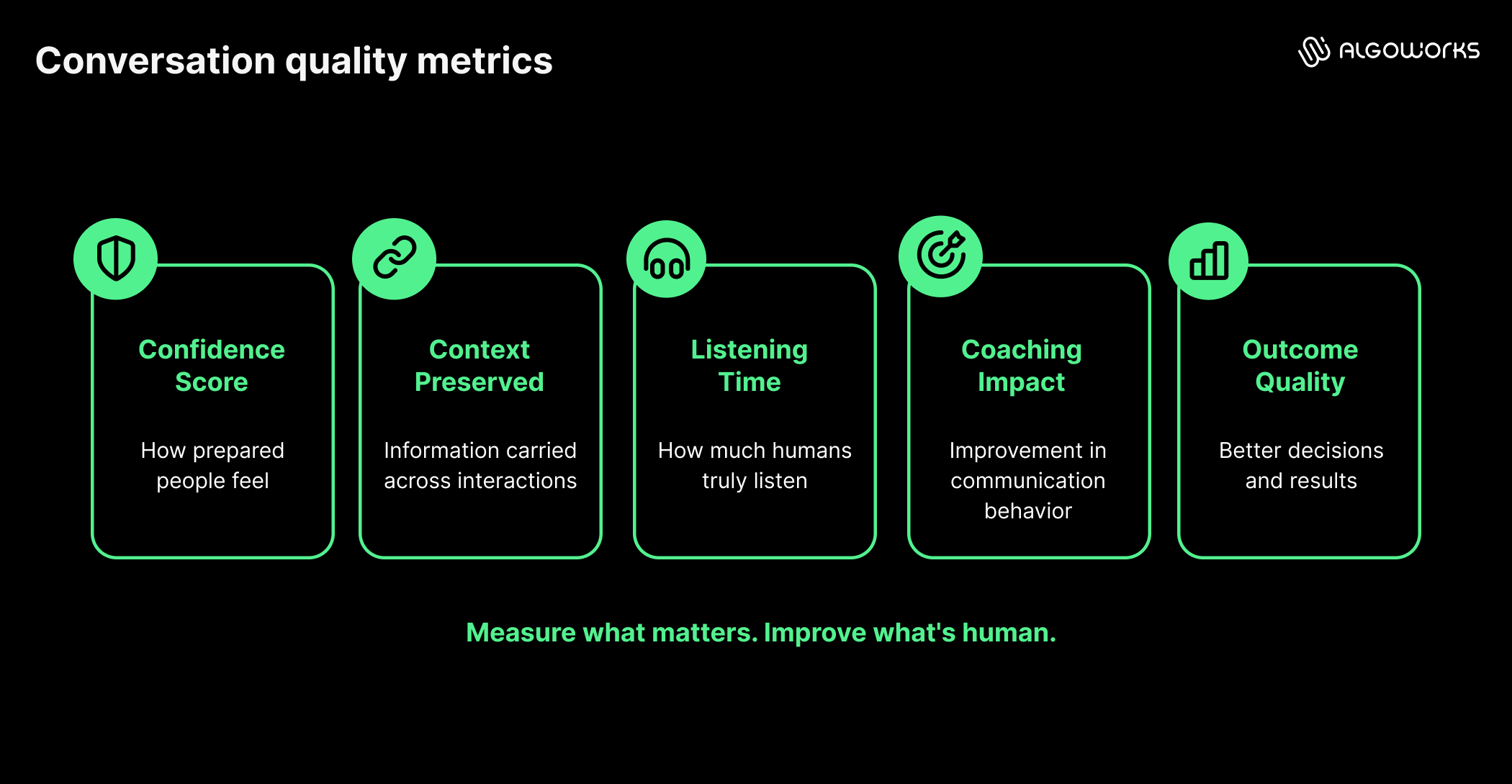
The next AI metric is conversation quality.
Most conversational AI metrics come from an automation mindset:
- Containment rate.
- Deflection rate.
- Automation rate.
- Average handling time.
- Cost per interaction.
They answer one question: How much human involvement did AI eliminate? That still matters. But it is no longer enough. If AI is being designed to improve human interaction, organizations also need to ask different questions:
- Did the person enter the conversation more confident and informed?
- Was useful context preserved when AI handed the interaction to a human?
- Did the employee spend more time listening and less time searching or documenting?
- Did both people reach the meaningful part of the conversation faster?
- Did coaching improve the next interaction?
- Did the human conversation produce a better outcome?
These metrics are harder to measure than containment. But they capture something automation metrics miss. A system can successfully avoid a human conversation without necessarily creating a better experience. The next generation of AI experiences should measure both.
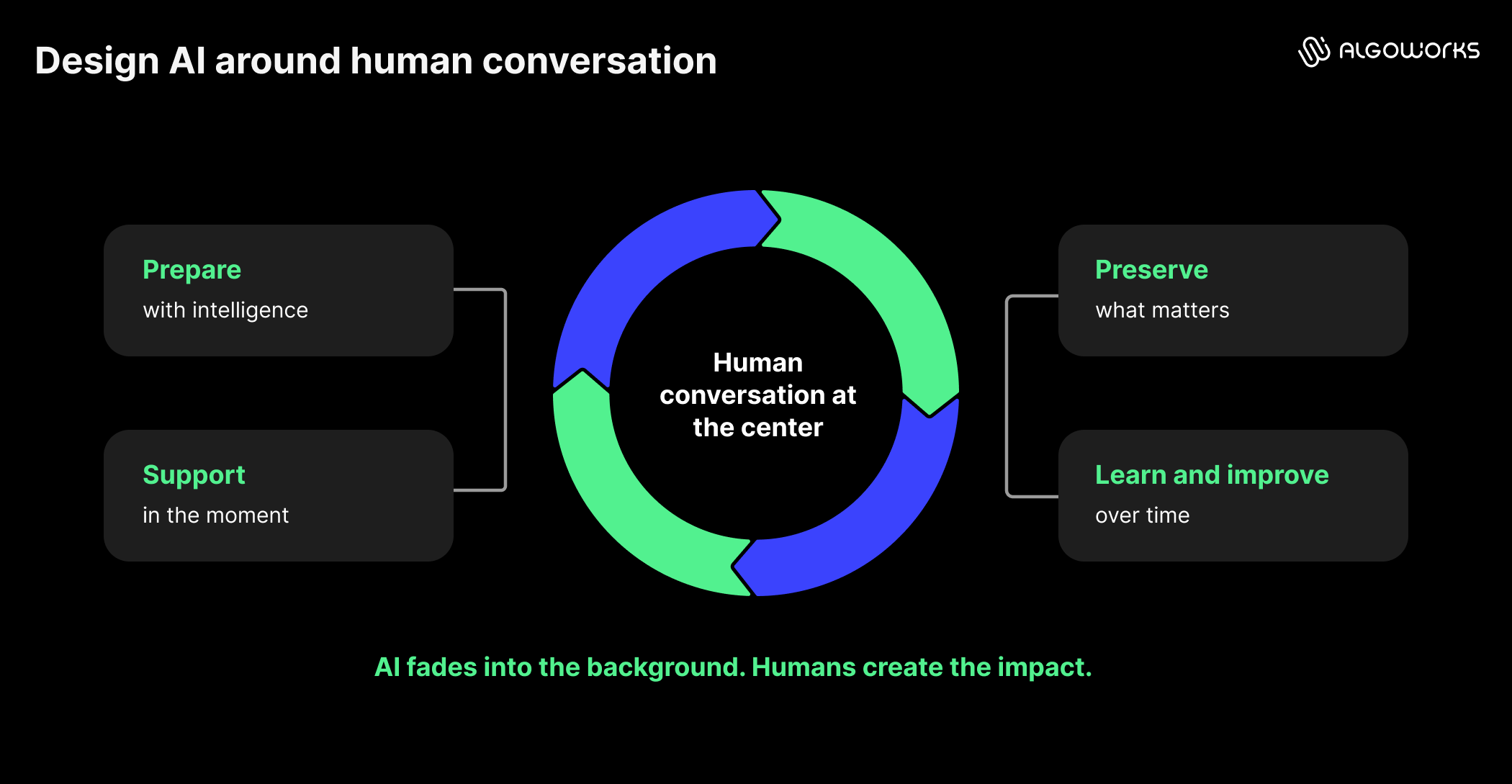
Design AI around the human conversation
The future of conversational AI does not have to be a choice between humans and machines.
- Use AI before a conversation when people need confidence, context or practice.
- Use it during a conversation when administrative work or information retrieval competes with attention.
- Use it between conversations when valuable context would otherwise disappear.
- Use it after conversations when feedback can improve the next interaction.
And know when AI should move out of the way. Because the best AI experience may not be the one that keeps a person talking to AI for the longest time. It may be the one that knows when the technology has done enough. The answer AI provides is not always the end of the experience. Sometimes, its real value is the human interaction it makes possible.
As organizations rethink conversational AI, one question deserves to sit alongside containment, automation and productivity: When a human conversation finally happens, is it better because AI was there?
The organizations that answer “yes” won’t get there by adding another chatbot. They’ll get there by redesigning how AI supports people before, during, between and after every meaningful interaction.
At Algoworks, we help enterprises build those experiences. If you’re exploring how AI can strengthen customer relationships, empower employees and create more meaningful human conversations, let’s start the conversation.