Salesforce migration and integration services
Turn Salesforce into a reliable foundation for reporting, automation and future AI capabilities through clean, connected data and stable integrations.

Clean, connected data forms the foundation for accurate reporting, reliable workflows and the AI capabilities modern Salesforce environments increasingly depend on.
Why enterprises struggle with migration and integration


Clarity, structured planning and engineering discipline

- Map systems, data flows and dependencies
- Identify risks early and plan for stability
- Align teams on how information must move
- Design migration and integration paths grounded in real usage
- Protect data integrity at every step
A disciplined approach to complex Salesforce migrations

By grounding every phase in clarity, communication and engineering discipline, we ensure your Salesforce environment remains stable, reliable and ready to support future growth.
Capabilities for Salesforce migration and integration

Migrate legacy CRM platforms, consolidate multiple Salesforce orgs and execute Hyperforce transitions with structured validation and governance.

Design integration architectures that connect Salesforce to ERP, billing, commerce platforms, contact centers and data systems with reliability and observability.

Clean, map and deduplicate data while establishing governance practices that keep information accurate and ready for reporting, analytics and AI.

Engineer phased testing cycles, reconciliation reporting and structured rollout plans that minimize downtime and reduce migration risk.

Diagnose failing integrations, resolve systemic issues and establish monitoring practices that maintain long-term platform stability.

Stabilize operations after launch, resolve issues quickly and refine processes so new systems remain effective and widely adopted.
From system assessment to a stable Salesforce environment
- Begin by mapping systems, analyzing data behavior and aligning stakeholders on what success must look like.
- Migrations and integrations are then engineered using structured, repeatable practices that reduce risk and prevent regressions.
- After go-live, the environment is stabilized, issues are resolved quickly and teams adapt confidently to new workflows.
- Success is measured when Salesforce becomes a dependable system that teams rely on every day.
Addressing migration and integration scenarios
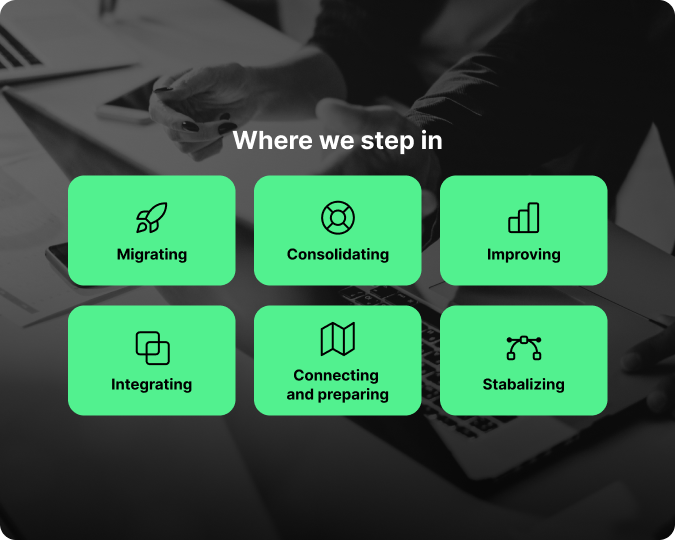
- Migrating from legacy CRM systems
- Consolidating multiple Salesforce orgs
- Moving to Hyperforce
- Integrating ERP, billing or warehouse systems
- Connecting contact center and CTI platforms
- Stabilizing broken or slow integrations
- Improving data quality for reporting
- Preparing for analytics or future AI capabilities
Precision across every Salesforce migration

Define the right path for your Salesforce
Share your constraints and objectives, and we will outline a structured path forward grounded in architecture, data readiness and operational priorities.
FAQs
Timelines depend on complexity, systems and data quality. We define a realistic plan after a short assessment.
Validation, reconciliation and structured testing are built into each migration phase to protect data integrity and prevent loss or duplication.
Yes. We analyze root causes, resolve systemic issues and establish monitoring to ensure reliable long-term integration performance.
Yes. Architecture, security and data residency requirements are aligned with Salesforce best practices to support Hyperforce transitions.
Yes. Governance frameworks, structured data models and quality controls ensure Salesforce data becomes reliable for analytics and AI use cases.