Salesforce is moving beyond AppExchange. Here’s what AgentExchange changes
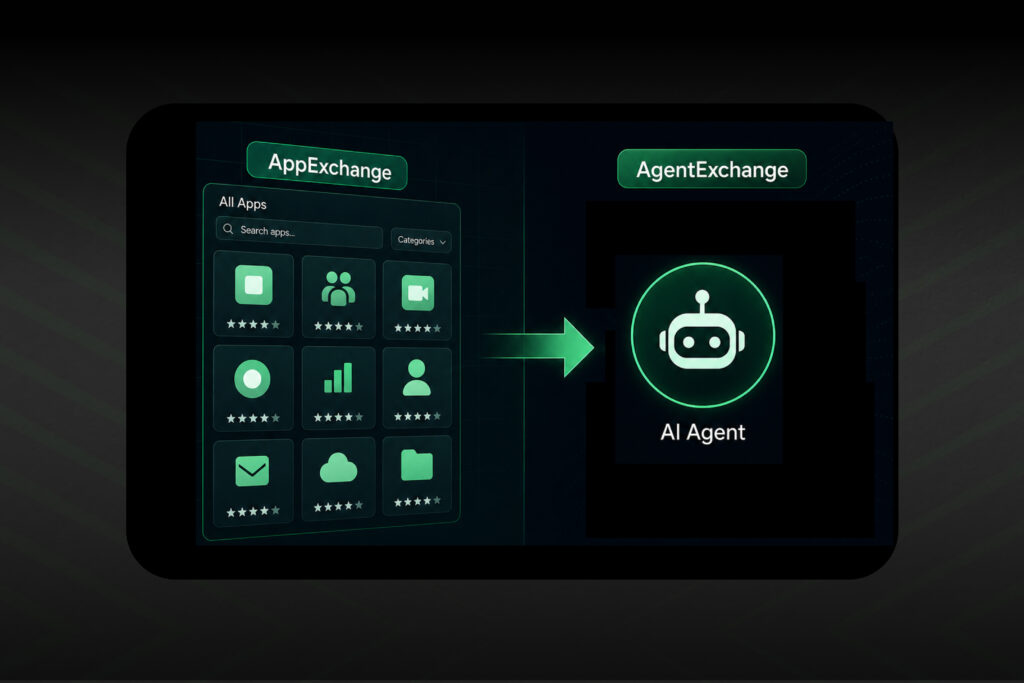
For over two decades, the Salesforce AppExchange has served as the bedrock of enterprise customization. With more than 5,000 ready-to-install applications, 80,000 peer evaluations and over 6 million installs, it became the primary marketplace where technology leaders extended Salesforce and addressed specific functional gaps.
The model worked because it made Salesforce adaptable. Teams could add capabilities, connect workflows and address specific needs without rebuilding systems. For instance, if a team needed better analytics or document generation, they could select the right application and deploy it directly into their environment.
However, the nature of the challenge has changed. The goal is no longer just adding features. It is reducing dependence on manual execution. This is why Salesforce has introduced a shift from AppExchange to Salesforce AgentExchange.
The shift from Salesforce AppExchange to AgentExchange
Even with the right applications in place, teams still spend time entering data, managing handoffs and moving between systems. As environments grow more complex, this slows execution and limits scale.
The shift from AppExchange to AgentExchange is not a branding update. It reflects a broader change in how value is created and scaled within the Salesforce ecosystem, moving from extending workflows to executing them. For instance, AppExchange was built on applications that support work, providing the functionality users need to complete tasks. In contrast, AgentExchange introduces a different model, where agents take on the responsibility of executing those tasks. 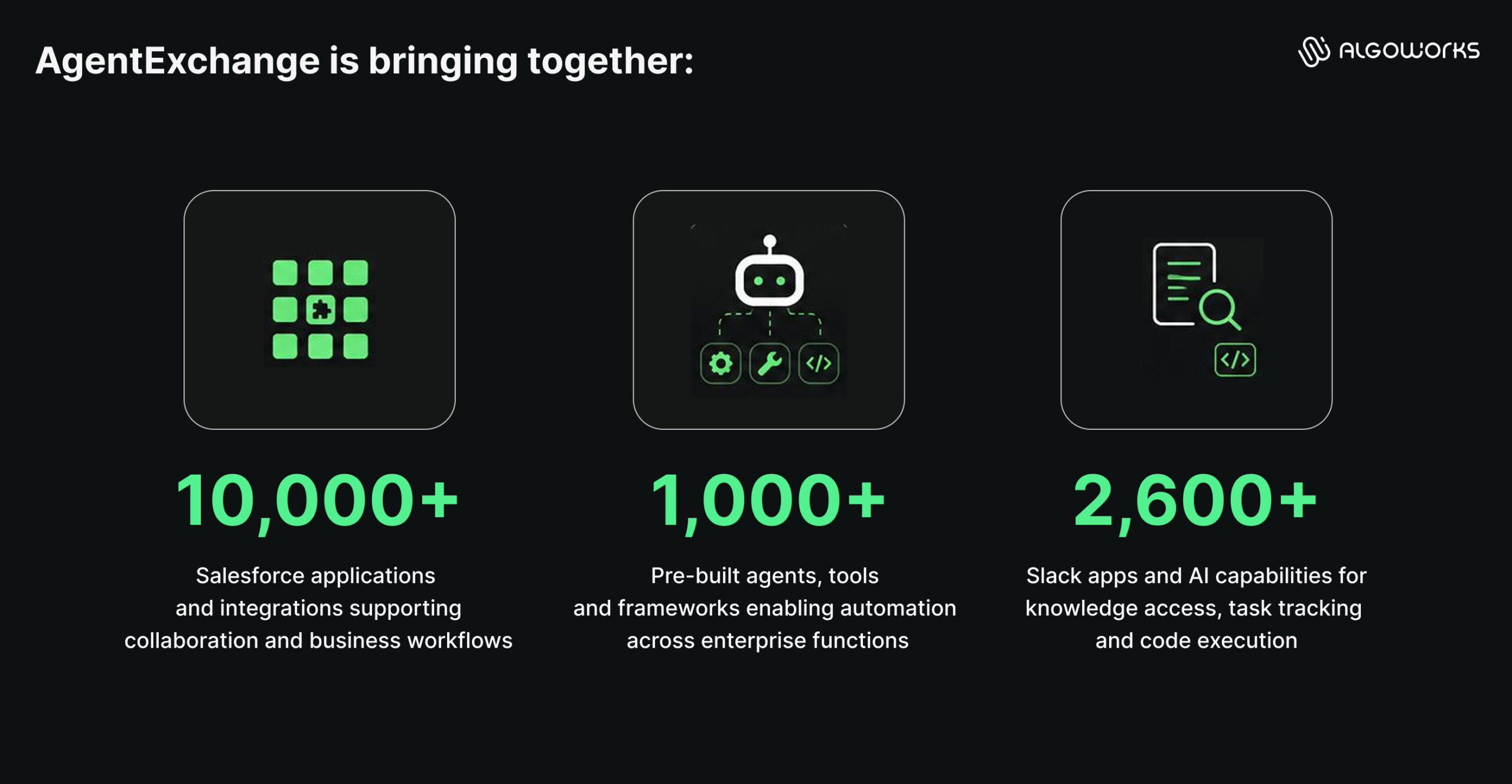 For technology leaders, this shift represents a move from a set of tools to a system that can execute work. It marks a transition from technology that supports users to technology that carries out tasks alongside them.
What is driving this shift?
While AppExchange was built as a marketplace of tools designed for human use, AgentExchange introduces a marketplace of capabilities designed to execute work across systems. This reflects a growing need for enterprises to operate with greater speed and consistency without increasing manual effort.
AgentExchange brings together AppExchange, Slack Marketplace and the Agentforce ecosystem into a unified environment. Instead of navigating multiple systems, teams can discover, activate and manage agents and applications within the flow of work. Discovery is intent-driven, using semantic search powered by Data 360 to surface relevant agents and applications based on business needs. Activation happens directly within environments like Agentforce Builder and Slack, allowing teams to deploy capabilities without breaking workflow. Procurement is also streamlined, with unified billing and provisioning reducing friction between selection and deployment.
Agents operate with context and can take action within defined boundaries, coordinating tasks across systems, evaluating next steps and continuing execution without constant user intervention. As operations grow more complex, this ability becomes critical. Scaling output through manual effort is inefficient, and AgentExchange addresses this by enabling execution across end-to-end processes rather than automating isolated steps.
What changes in this shift?
The transition from AppExchange to AgentExchange marks the end of the extension era and the beginning of the intelligence era. This shift is not about replacing one marketplace with another. It changes how work gets done inside Salesforce. To understand its impact, leaders need to look at how the underlying operating model is evolving from apps to agents.
1. Feature support to task execution
AppExchange was built on tools that add features to workflows. For instance, if a team needs to send SMS messages, they install an application that enables that function. AgentExchange is built on capabilities. An agent can manage an entire customer interaction from start to finish, understanding intent, generating responses and completing the task without manual input.
2. Workflow triggers vs decision-driven execution
Applications rely on predefined logic paths, often structured as fixed “if this, then that” workflows. When conditions fall outside those rules, processes stop and require human intervention. Agents operate differently. Powered by the Atlas Reasoning Engine, they evaluate context, determine next steps and continue execution as conditions change.
3. Decisions adapt to context
Applications operate on fixed logic and behave the same way every time. Agents use real-time data and context to determine the appropriate action. Their decisions are informed by current information across systems, allowing them to adapt as conditions change rather than waiting for workflows to be updated.
4. Execution capacity scales without headcount
In an application-led model, output is tied to headcount. Processing more tickets or qualifying more leads requires more people or more tool licenses. In an agent-led model, execution capacity scales across systems, allowing organizations to handle higher volumes without increasing manual effort.
Implications for the Salesforce customer
For technology leaders, this shift changes how systems are built and managed. It requires moving from an implementation mindset to an orchestration mindset, with success depending on three foundational areas:
- Data readiness: Agents are only as effective as the data they can access. Clean, connected data is a prerequisite for reliable execution. Without a unified data layer, agents cannot operate with accuracy or consistency.
- Workflow redesign: Adding agents to existing processes is not enough. Workflows need to be rethought with execution in mind. Leaders should design processes assuming agents can manage repeatable logic, coordination and data-driven decisions.
- Governance as guardrails: In the agent model, governance shifts from access control to defining operating boundaries. Organizations need clear rules for how agents interact with data, systems and users. This includes setting permissions, data scopes and controls that ensure secure and consistent execution.
Supporting the shift to execution
Moving toward an agent-based Salesforce environment requires more than adopting new capabilities. Most enterprises operate with fragmented data, disconnected tools and complex workflows. In this environment, adding agents alone does not deliver value. Without clean data, clear processes and aligned systems, agents cannot operate reliably.
It is time we focus on operationalizing AI within Salesforce by aligning data, streamlining workflows and defining clear operating boundaries for agents. By bringing these elements together, we can enable Salesforce Agentforce to function as an execution layer across the enterprise, not just an additional capability.
The focus is not on adding more tools, but on enabling Salesforce to execute work with greater speed, consistency and control, tied directly to measurable business outcomes. This is where Salesforce AI automation moves from isolated use cases to system-level execution.
This shift requires a structured path to define priorities, build aligned workflows and run systems with discipline. A Define, Build and Run approach enables organizations to establish the right foundations, implement automation within Salesforce workflows and operate within governed environments where agents can execute reliably across systems.
With this structure in place, Salesforce becomes a system of execution, not just a system of record, driving consistent outcomes at scale.