Intelligent enterprise integration: 7 transformative Salesforce + MuleSoft use cases for modern enterprises
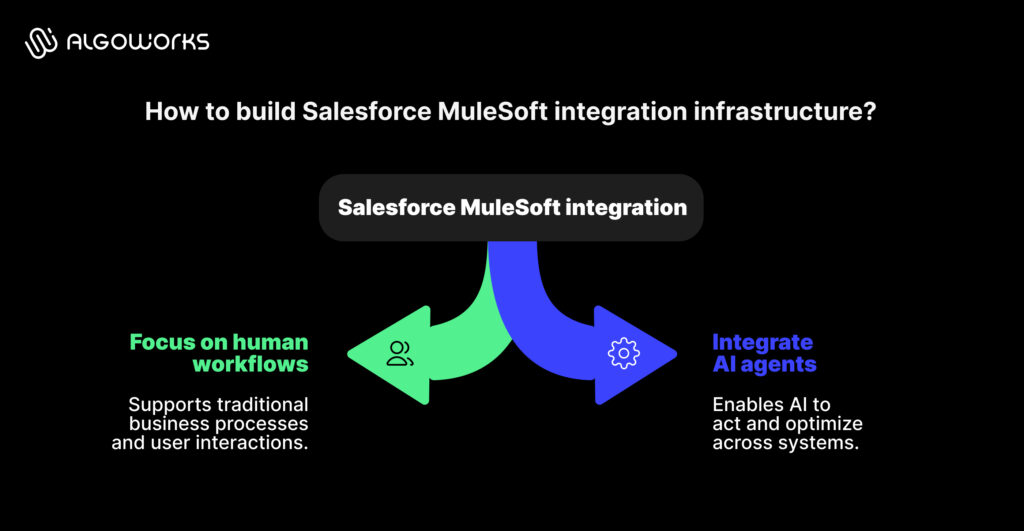
The integration landscape has fundamentally transformed. What once meant connecting systems through APIs has evolved into something strategic: empowering autonomous AI agents to orchestrate intelligent workflows across entire enterprises.
Salesforce MuleSoft integration solutions are now essential for organizations seeking to modernize operations. Yet the real question remains: How do we build integration infrastructure that supports AI agents that can act, decide, and optimize across all systems simultaneously?
This article explores seven real-world use cases demonstrating how enterprises are leveraging Salesforce MuleSoft integration to unlock transformation. Understanding these patterns is critical; whether architecting next-generation CRM experiences or modernizing legacy systems.
AI agent-enabled customer 360 view in healthcare
Historically, healthcare providers relied on Salesforce integration services to connect EHRs, lab results, and billing systems. These integrations created unified patient views. However, today’s healthcare deployments go much further.
With advanced MuleSoft integration services, AI agents now do more than display data; they act on it in real time. Using Salesforce MuleSoft integration, autonomous agents intelligently route patient queries and access unified profiles across systems.
Consider a typical hospital scenario. An AI agent powered by enterprise integration solutions now:
- Monitor incoming patient calls in real time
- Access patient history instantly
- Identify required appointments automatically
- Notify care teams and create tickets in backend systems like SAP
All of this happens without human intervention.
Real-time data aggregation for autonomous decision making
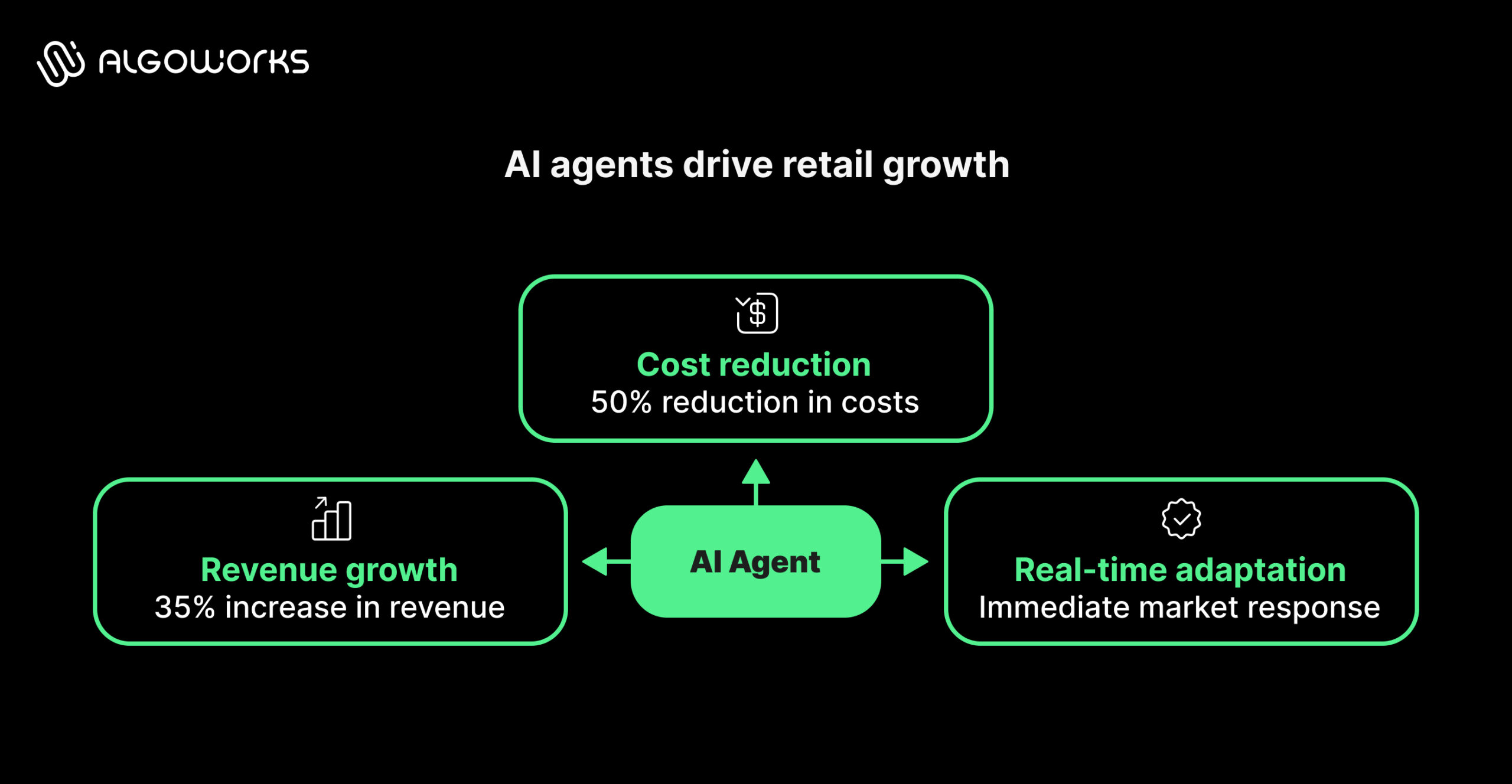
The shift toward intelligent automation changes how organizations approach data. Previously, companies built dashboards for analysts. Now, forward-thinking retailers feed real-time data directly to AI agents that execute decisions autonomously.
A global retailer implemented Salesforce integration services to aggregate real-time data through MuleSoft, including POS transactions, inventory levels, competitor pricing, and customer demand signals.
What happens next is transformative. Rather than analysts interpreting dashboards, an AI agent processes this data continuously and automatically:
- Adjusts prices for thousands of products
- Executes promotional strategies
- Generates reorder recommendations
All without human bottlenecks. Consequently, the competitive advantage through Salesforce MuleSoft integration is both immediate and measurable.
Agentic order-to-cash orchestration
Finance teams are embracing a new approach to complex workflows. Rather than managing order-to-cash processes manually, they’re deploying Salesforce MuleSoft integration solutions with multi-agent workflows that orchestrate entire business processes autonomously.
When a customer order arrives in Salesforce, an intelligent agent network springs into action:
- Verification Agent checks stock availability
- Execution Agent processes the order in ERP systems
- Operations Agent triggers manufacturing workflows
- Finance Agent initiates invoicing and collections
These agents use standardized protocols (MCP and A2A) to coordinate seamlessly through Salesforce MuleSoft integration. Importantly, human review is required only for exceptions; not routine transactions.
Using APIs as agent tools through Model Context Protocol, agents can verify credit, check inventory, execute billing, and reconcile transactions across Salesforce, NetSuite, and QuickBooks simultaneously.
Intelligent document processing at scale
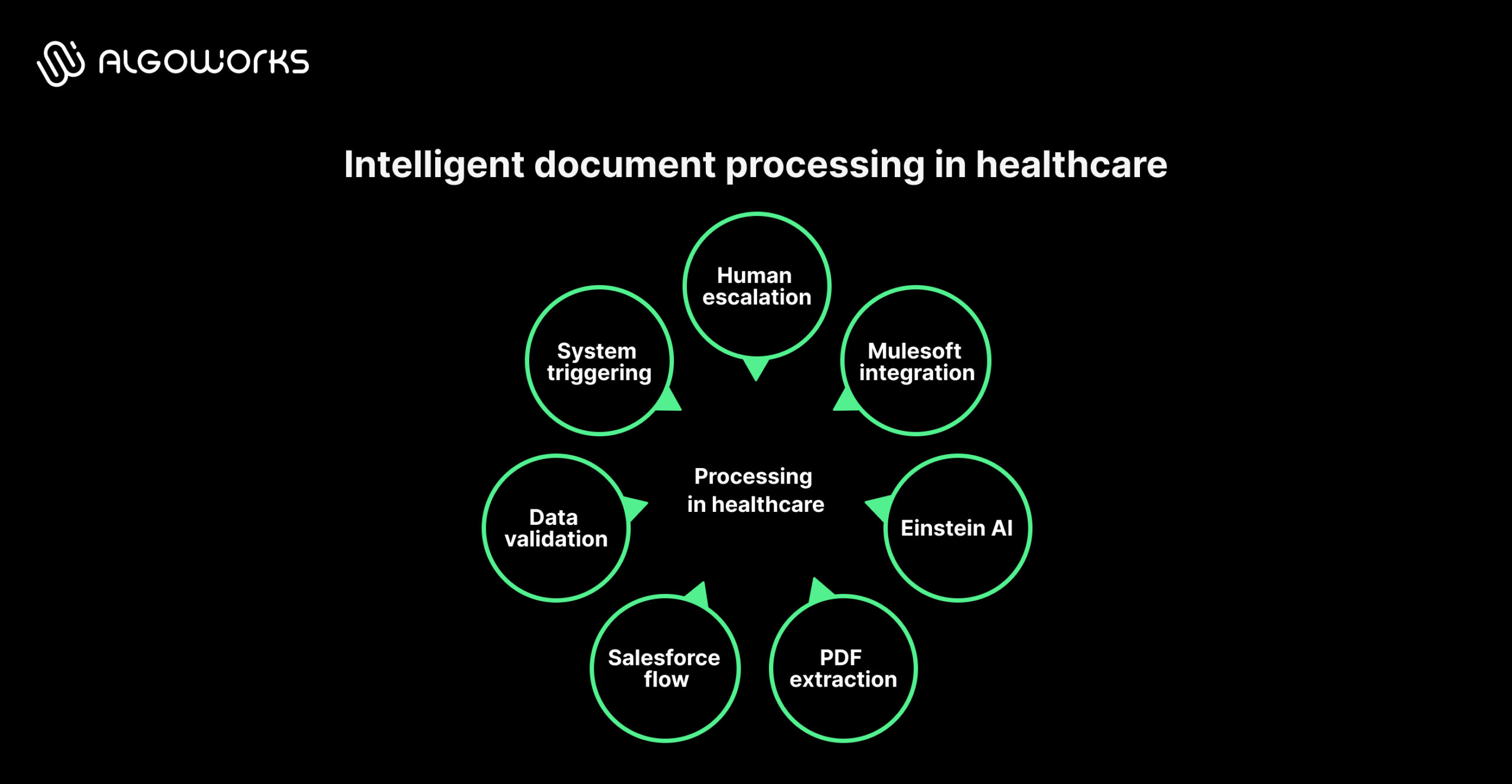
Organizations are discovering new ways to handle document-heavy workflows. Instead of relying on RPA bots, they’re deploying intelligent document processing powered by Einstein; embedded directly into MuleSoft workflows.
Natural language AI now extracts data from unstructured sources with remarkable accuracy. A healthcare organization receiving hundreds of insurance claims daily uses MuleSoft integration services with Salesforce Flow to:
- Extracts claim details from PDFs automatically
- Validates data against Salesforce records
- Routes claims to appropriate processors
- Triggers downstream systems with validated data
- Escalates complex cases to human reviewers when needed
This approach eliminates document processing bottlenecks while maintaining accuracy and compliance. Organizations see faster processing, reduced errors, and measurable ROI; all direct advantages of Salesforce MuleSoft integration.
Check out: MuleSoft API integration – Transform enterprise connectivity
Legacy system modernization through intelligent wrapping
Not all enterprises can afford rip-and-replace migrations immediately. Many contain decades of business logic handling mission-critical operations. Fortunately, forward-thinking organizations have found a better solution.
Instead of wholesale replacement, they utilize MuleSoft integration architecture to wrap legacy systems with intelligent APIs. This approach makes legacy systems accessible to AI agents while extending system lifespan and unlocking modern capabilities.
A telecommunications company operates 20-year-old provisioning systems containing critical business logic. Rather than migrating, they exposed provisioning capabilities as REST APIs and MCP servers. Now Agentforce agents can:
- Provision services automatically
- Check customer records in real time
- Validate orders against legacy systems
- Execute workflows without touching the legacy UI
This approach through Salesforce MuleSoft integration dramatically reduces implementation time. The key insight? Modernization doesn’t always mean replacement. Sometimes it means intelligent wrapping supported by Salesforce services.
Multi-agent collaboration for complex workflows
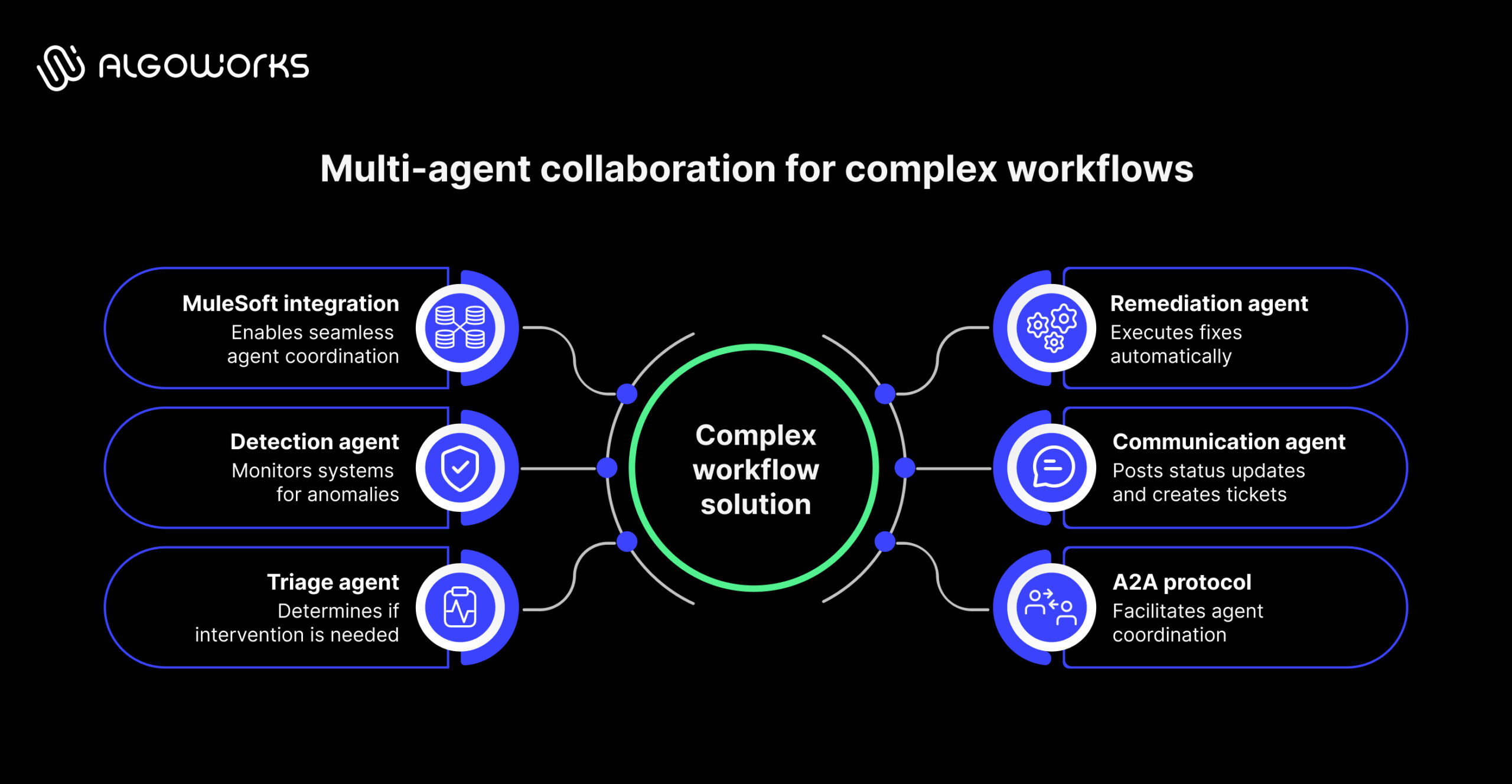
The most advanced use case involves orchestrating multiple AI agents to solve complex problems. When a single agent reaches its limits, specialized agents collaborate using standardized protocols.
Specialized agents work together intelligently:
- Detection Agent monitors systems for anomalies
- Triage Agent determines if intervention is needed
- Remediation Agent executes fixes automatically
- Communication Agent posts status updates and creates tickets
Using Agent-to-Agent (A2A) protocol for coordination, these workflows appear orchestrated yet are actually autonomous; all enabled through MuleSoft integration architecture. Organizations implementing agent networks achieve reduced duplication, accelerated delivery cycles, 24/7 autonomous operations, and human teams focused on strategy.
Also check: Salesforce AI Strategy Unveiled – The Power of Agentforce and Beyond
Composable enterprise architecture
The most strategically important use case involves building entire enterprise applications from composable, agent-ready building blocks. Rather than developing monolithic applications over months, enterprises now assemble pre-built components in days.
A consumer goods company built a supply chain application using pre-built APIs for order management, inventory, and logistics; AI-powered connectors to supplier systems; and templates for common integration patterns.
Because these components are inherently agent-ready, autonomous agents can participate in decisions without requiring infrastructure re-architecture. This composable architecture delivers rapid innovation, easier agent adoption, future flexibility, and lower development costs.
The technical foundation: APIs, agents and standards
Success requires understanding three critical elements:
First, the API-to-Agent Continuum: System APIs expose data and actions; Process APIs apply business logic; Experience APIs deliver to users; and Agent APIs (MCP/A2A) make everything accessible to autonomous agents. This layered approach enables flexibility and reusability through Salesforce MuleSoft integration capabilities.
Second, Model Context Protocol (MCP): Rapidly gaining momentum as a standardized framework for seamless communication between AI agents and enterprise systems, MCP enables Agentforce to understand and interact with modern and legacy applications consistently through MuleSoft integration services.
Third, Agent Infrastructure: MuleSoft Agent Fabric and related platforms move agents from experimental projects to enterprise infrastructure with governance, testing and DevOps integration. This legitimizes agents as first-class enterprise components through comprehensive Salesforce services.
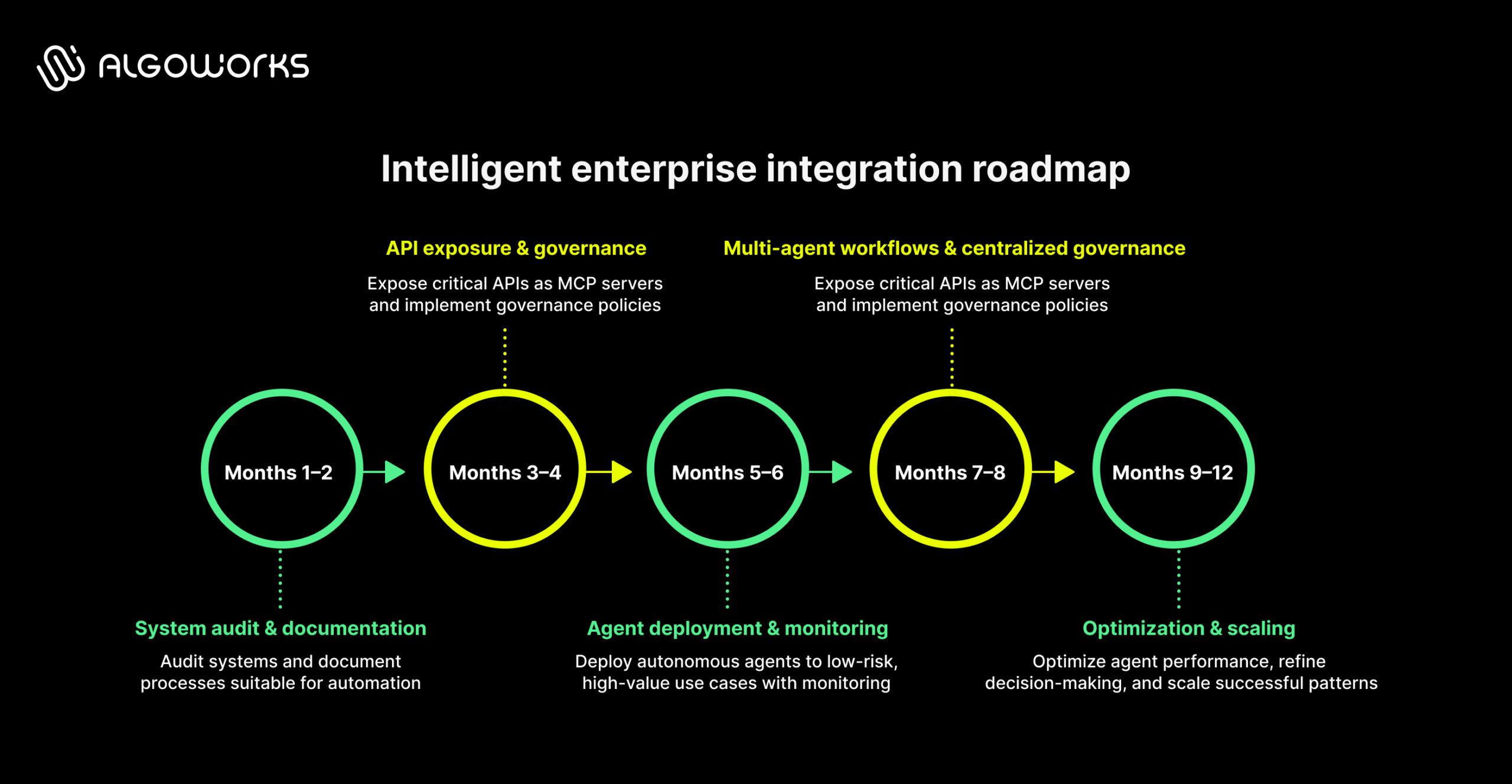
Implementation roadmap
- Phase 1 (Months 1-2): Audit systems and document processes suitable for automation with integration and migration services.
- Phase 2 (Months 3-4): Expose critical APIs as MCP servers and implement governance policies for agent interactions through Salesforce integration services and MuleSoft integration services.
- Phase 3 (Months 5-6): Deploy autonomous agents to low-risk, high-value use cases with monitoring and observability using MuleSoft integration best practices.
- Phase 4 (Months 7-8): Expand to multi-agent workflows and implement centralized governance with enterprise integration solutions.
- Phase 5 (Months 9-12): Optimize agent performance, refine decision-making and scale successful patterns through benefits of Salesforce MuleSoft integration.
Conclusion: The intelligent enterprise awaits
The real challenge isn’t connecting systems anymore. It’s building an integration foundation that lets autonomous agents act with context, precision, and speed. Salesforce and MuleSoft now sit at the center of that shift.
Teams that understand how to expose the right APIs, establish clear governance, and design processes with agents in mind will move faster than those still thinking in traditional integration terms. The seven use cases above aren’t future scenarios; they’re already reshaping how modern enterprises run.
If organizations want to compete at this level, the next step is simple: build infrastructure that agents can trust, learn from, and execute on. MuleSoft and Salesforce provide the building blocks; the advantage goes to the enterprises ready to use them.