How agentic AI is transforming the software development lifecycle (SDLC) ?
The Software Development Lifecycle (SDLC) has adapted to every major shift in engineering. Agile improved speed, DevOps connected development and operations and cloud expanded scale and flexibility. Each transition refined execution. None fundamentally changed where decisions were made. However, Agentic AI does.
The role of AI in software development is shifting from assistance to controlled execution. Systems are no longer limited to suggesting actions. They can interpret intent, execute workflows and adjust outputs within defined boundaries. That shift changes how software is built, validated and governed.
This article talks in detail about how agentic AI is rewriting the software development lifecycle.
AI in software development is shifting to execution
For years, teams improved productivity through code suggestions, automated testing and documentation support. These capabilities reduced effort but kept humans at the center of execution. Agentic systems introduce a different model.
They plan tasks, execute across systems, evaluate results and iterate. Instead of waiting for instructions, systems act within defined constraints. This shift marks a transition from assistance to execution in AI in software development, where systems begin to influence outcomes directly.
Why traditional SDLC models struggle with agentic AI
Traditional SDLC models assume predictable behavior. Systems are designed to produce consistent outputs for the same inputs. Agentic systems operate differently.
Outputs depend on prompts, models, context and integrations. The same input may produce different outcomes over time. This probabilistic behavior introduces variability that traditional validation methods cannot fully capture. This is where AI in SDLC creates friction, as deterministic processes are applied to adaptive systems.
According to Gartner’s report, over 40% of agentic AI projects will be canceled by the end of 2027 due to escalating costs, unclear business value or inadequate risk controls. That is not a technology problem. It is a governance and structure problem; one that begins at the lifecycle level.
 How agentic AI is changing the software development lifecycle
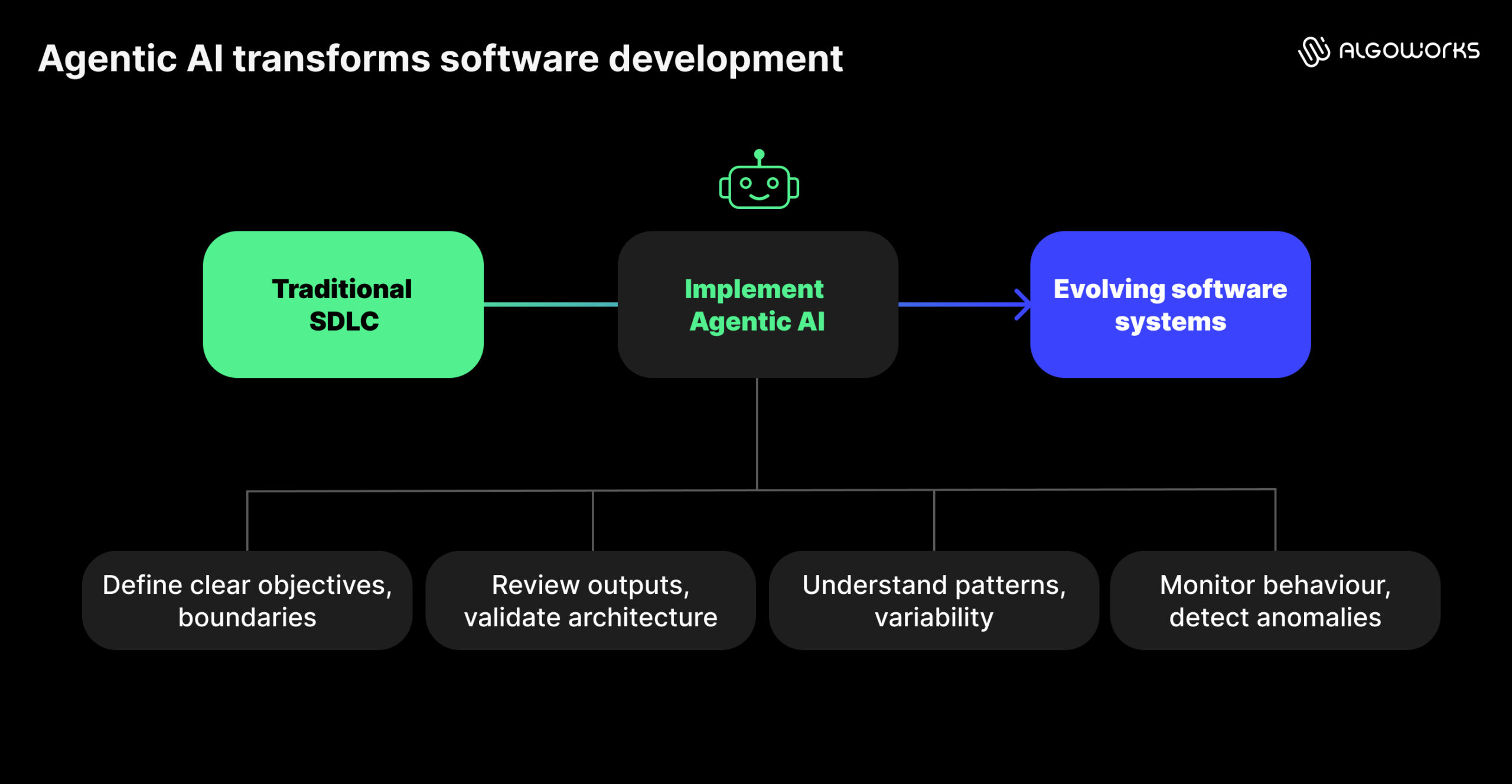
The impact of AI in software development varies across lifecycle stages. Some phases accelerate, while others become more critical in maintaining control.
Planning becomes a control layer
Agentic systems can simulate trade-offs and assess feasibility quickly. However, defining intent remains a human responsibility. Clear objectives, autonomy boundaries and failure conditions must be explicitly defined. In agentic environments, unclear intent leads to misaligned execution rather than delay.
Developer role shifts to orchestration
Development is no longer limited to writing code. Agentic systems generate code, scaffold features and execute workflows. Engineers focus on reviewing outputs, validating architecture and ensuring system consistency. The role shifts toward system design and orchestration, which defines how to use ai in software development effectively.
Testing focuses on system behavior
Testing expands from validating correctness to understanding behavior. Agentic systems generate test cases and improve coverage, but interpreting outcomes requires context. Evaluation moves beyond pass or fail into patterns and variability. This represents one of the most critical ai use cases in software development.
Deployment requires continuous supervision
Deployment is no longer a stable endpoint. Model updates, context drift and usage patterns influence system behavior over time. Monitoring must include behavioral tracking, anomaly detection and continuous validation. This shift defines the future of software development, where systems evolve continuously.
Real-world use cases of agentic AI in the SDLC
Agentic AI becomes clearer when you see how it operates inside real engineering workflows. These are not isolated tools. They function as systems that interpret intent, execute across stages and continuously adapt based on feedback.
Autonomous test generation and failure analysis
In modern QA workflows, agentic systems generate test cases directly from requirements and code changes. They do not stop at execution; instead, they analyze patterns, identify root causes and suggest fixes.
Testing shifts from validation to continuous quality intelligence, where systems actively improve coverage and reliability without waiting for manual intervention. Algoworks applied this principle for Bromcom, automating 6,000 test cases and reducing QA cycle time by 70% through a framework fully integrated with Azure DevOps pipelines.
Codebase-aware feature development
Agentic systems can understand existing repositories, architecture patterns and dependencies. Based on a feature requirement, they scaffold code aligned with the current system rather than generating isolated snippets.
Developers no longer start from scratch. They review, refine and guide execution. This is one of the most practical examples of how to use AI in software development without compromising consistency.
Intelligent incident triaging and resolution
In production environments, agentic systems monitor logs, traces and system behavior. When an issue occurs, they correlate signals, identify probable causes and initiate resolution workflows. Instead of reactive debugging, teams move toward context-aware incident management, where response time reduces and system understanding improves with each incident.
When multiple agents operate across enterprise systems, coordination becomes as critical as execution. MuleSoft Agent Fabric addresses this directly; providing a governance and orchestration layer that prevents agent sprawl and ensures agents communicate with the right context at every step.
Continuous optimization through feedback loops
Agentic systems learn from every execution cycle. They refine prompts, adjust workflows and improve outputs based on feedback and observed outcomes. This creates a system where deployment is not the end state. It becomes part of an ongoing loop of improvement, which directly reflects the future of software development.
 How to use AI in software development effectively
As systems become more autonomous, the challenge shifts from adoption to control. Agentic systems increase speed but introduce variability. Without structure, outputs become inconsistent and accountability becomes unclear.
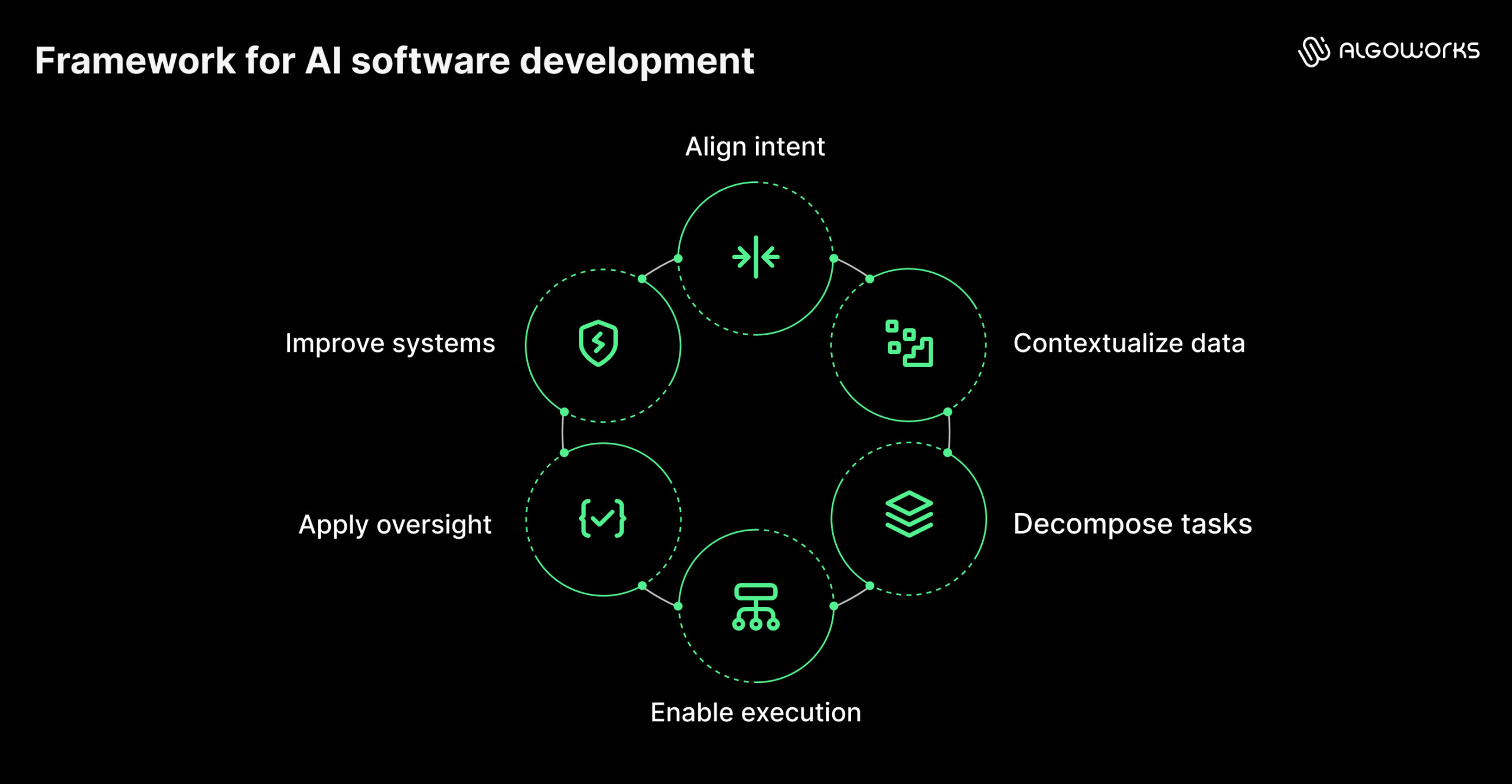
A structured approach ensures that autonomy operates within defined limits. The A.C.T.I.O.N framework provides this control.
Align intent at the design stage
Execution begins with clearly defined outcomes, success criteria and autonomy limits. Intent acts as the primary control mechanism in agentic systems.
Contextualize data for accurate execution
Agentic systems rely on context to generate relevant outputs. Codebases, historical data and domain knowledge shape system behavior.
Decompose tasks for consistent output
Breaking down objectives into structured tasks improves reliability and reduces variability. This stage directly impacts execution quality.
Enable execution within defined constraints
Agentic systems generate code, run tests and execute workflows within guardrails. Constraints ensure alignment with defined intent.
Apply human oversight and governance
Human oversight ensures validation, compliance and accountability. Monitoring must include system behavior and decision tracking, especially in agentic ai in software development environments.
Improve systems through continuous feedback
Each execution cycle generates insights that refine prompts, workflows and outputs. This creates a continuous improvement loop across the lifecycle.
 Why agentic AI requires a new lifecycle
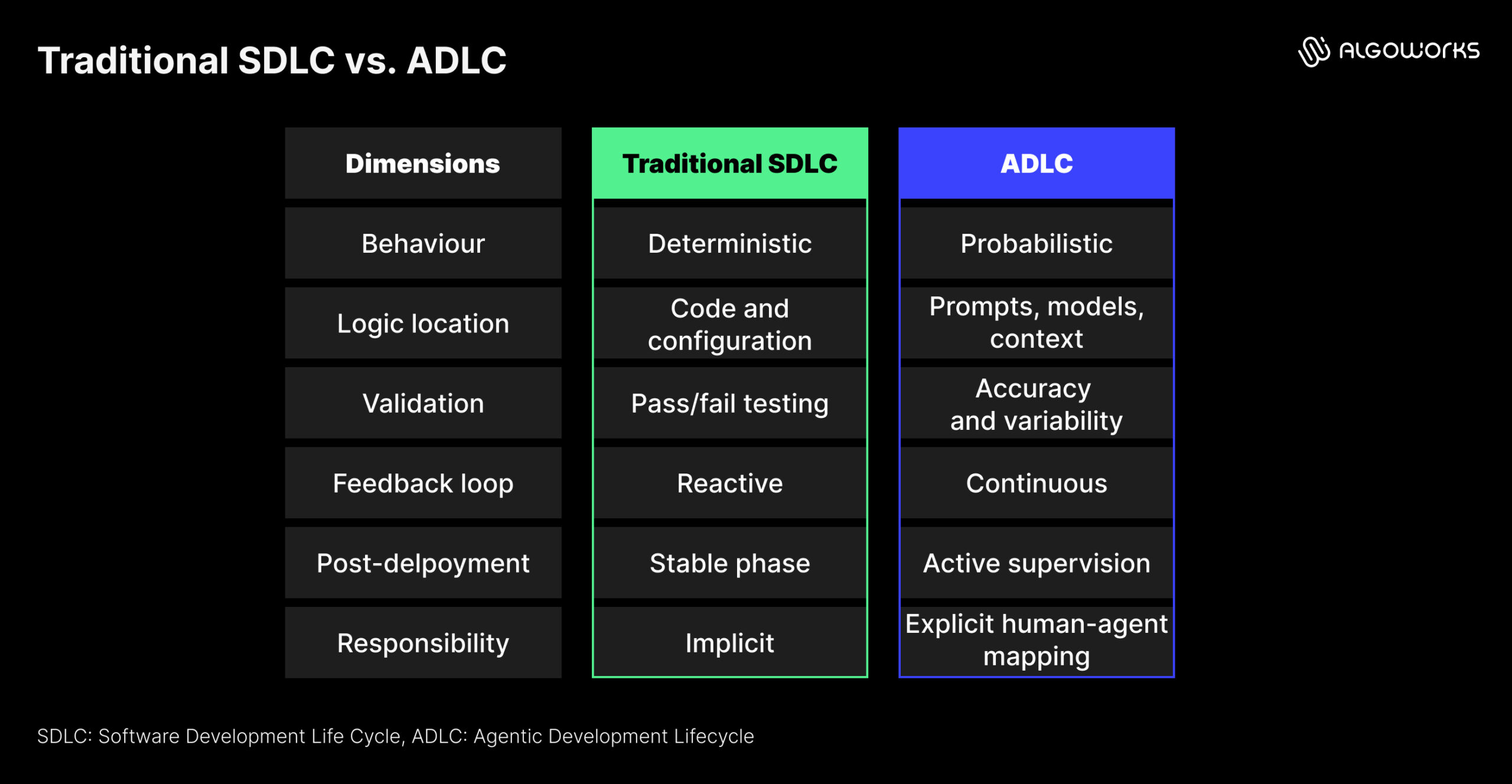
The Agentic Development Lifecycle (ADLC) is a lifecycle framework designed for systems whose behavior evolves after deployment. Traditional SDLC assumes behavior is fixed at build time. Agentic systems invalidate this assumption.
| Dimension | Traditional SDLC | ADLC |
|---|---|---|
| Behavior | Deterministic | Probabilistic |
| Logic location | Code and configuration | Prompts, models, context |
| Validation | Pass/fail testing | Accuracy and variability |
| Feedback loop | Reactive | Continuous |
| Post-deployment | Stable phase | Active supervision |
| Responsibility | Implicit | Explicit human-agent mapping |
The key shift is responsibility. ADLC defines where humans maintain control, where systems operate autonomously and how escalation is handled.
Benefits and risks of agentic AI in software development
The benefits of ai in software development become clear when systems are structured effectively.
- Development cycles accelerate.
- Repetitive effort reduces.
- Systems adapt more efficiently to change.
However, risks increase alongside autonomy. Non-deterministic behavior introduces unpredictability. Over-reliance on generated outputs increases complexity. Lack of governance creates accountability gaps. Balancing autonomy with human oversight is essential.
How AI is changing developer roles
Engineering roles are evolving with the rise of agentic systems. Less time is spent writing foundational code. More time is spent designing workflows, validating outputs and maintaining system alignment. The defining capability becomes systems thinking — understanding how systems interact and adapt determines long-term success, particularly in agentic AI in SDLC environments.
For a concrete example of this at scale, see how Algoworks built a centralized DevOps performance platform for a global automotive manufacturer; unifying visibility across 70+ scrum teams and turning fragmented pipeline data into real-time decisions.
What this means for the future of software development
Agentic AI is rewriting the software development lifecycle by challenging its core assumptions. The lifecycle was designed for predictability and controlled execution. Agentic systems introduce variability and bounded autonomy.
The shift is not only about speed. It is about redefining control, responsibility and system behavior. From Algoworks’ experience working with enterprise engineering teams, successful adoption of AI in software development depends on clear governance, defined responsibility boundaries and alignment between intent and execution.
The advantage lies in operating with control while scaling autonomy.
FAQs
Agentic AI refers to systems that can plan, execute and adapt tasks within defined boundaries instead of only assisting developers.
Traditional AI supports tasks like code suggestions. Agentic AI executes workflows, evaluates outcomes and improves over time.
It improves speed, reduces repetitive work and enables continuous optimization across the lifecycle.
Algoworks helps define intent, set autonomy boundaries, integrate agentic systems into workflows and ensure governance and monitoring for controlled execution.
AI is moving from assistance to execution, where systems operate autonomously within defined limits and continuously improve over time.