AI for operational efficiency: Where businesses see the fastest wins

The conversation around AI has grown quieter and more serious.
A year and a half ago, AI discussions were full of pilots and proofs of concept. Teams explored possibilities, tested tools and experimented with ideas. That phase was necessary, but it was also temporary. Today, leaders are asking a different question:
Where does AI actually deliver value and how quickly does that value show up?
For most organizations, the answer isn’t found in bold experiments or sweeping transformation programs. It shows up in operations. In everyday work that keeps the business running. This is where AI for operational efficiency begins to matter; not as a future bet, but as a practical lever for reducing friction in how work already happens. While AI impact varies across industries, operational functions show the most consistent early return.
This article focuses on those areas. It looks at where AI delivers fast, measurable gains by improving how work already gets done; using existing systems and data, without disrupting the organization.
Where AI delivers the fastest impact
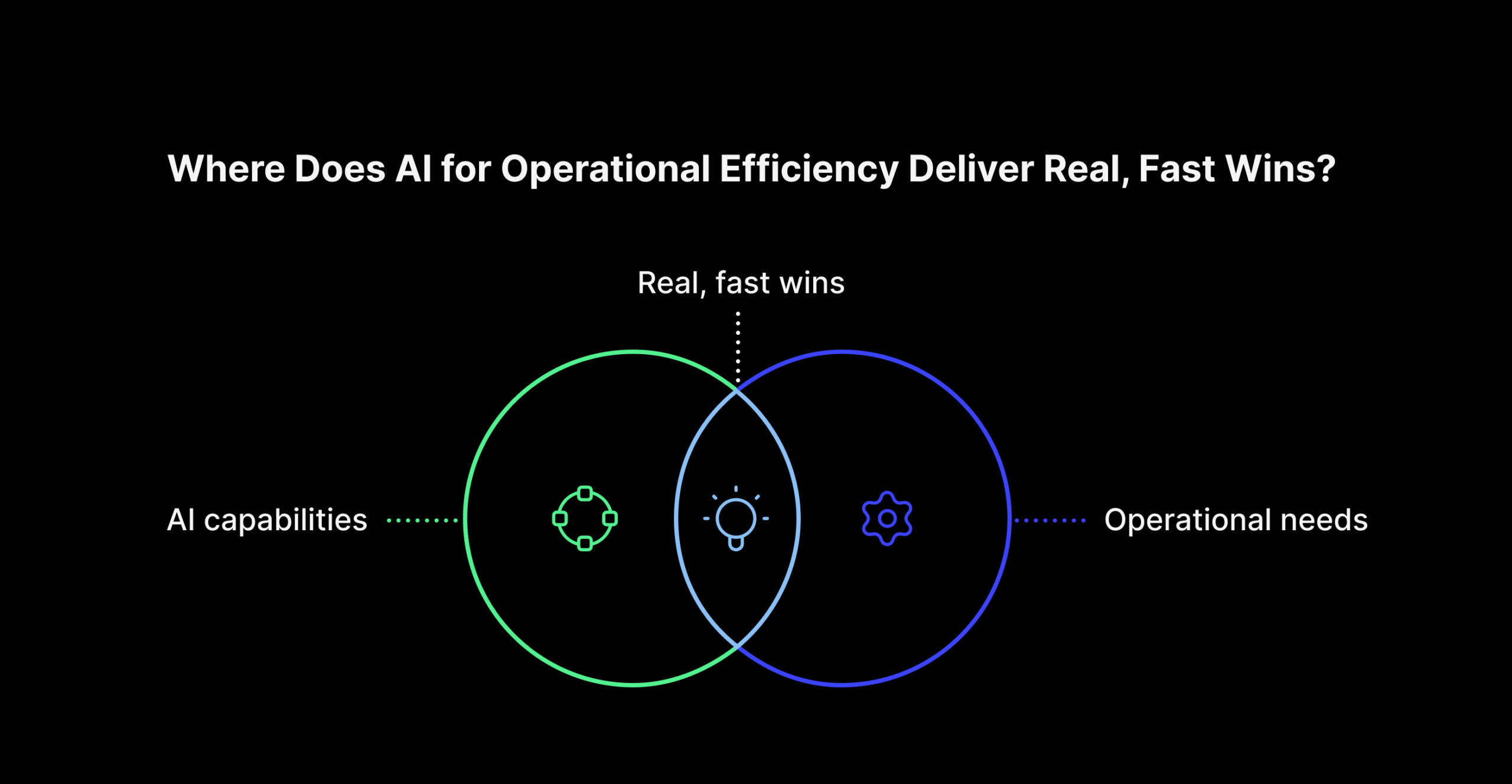
Operational efficiency isn’t a single problem; it’s a pattern. Across departments, teams face the same underlying challenge: skilled people spending too much time on repetitive, predictable work. AI for operational efficiency proves most effective where that pattern is strongest, especially in functions built around volume, consistency and historical data.
AI in IT operations: Moving from firefighting to foresight
IT operations teams generate massive amounts of data; system logs, performance metrics, alerts, incident reports and service tickets. Yet despite this, most teams still operate reactively. Problems surface only after users are impacted. Engineers diagnose issues under pressure, often revisiting the same root causes again and again.
The issue isn’t lack of expertise. It’s that the signals are buried in noise and humans aren’t built to detect subtle patterns across thousands of data points in real time. This is one of the earliest and clearest use cases for AI for operational efficiency. It also explains the rapid adoption of AI in IT operations.
How AI changes the dynamic
AI shifts IT operations from reaction to prediction. By learning from historical incident data, machine learning models begin to recognize combinations of signals that precede failures. This shift toward predictive and autonomous systems is also redefining agentic AI in software development, where intelligent systems are increasingly shaping how applications are built, tested, and deployed.
A CPU spike that once looked normal now triggers an alert. A sequence of authentication failures points to a potential security issue before escalation. Repetitive tickets are automatically categorized and matched with known resolutions, sometimes resolved without human involvement.
Instead of reacting to outages, teams gain early warning, which is the core promise of AI for operational efficiency in IT.
The measurable impact of AI in IT operations
The results appear quickly. Many organizations reduce mean time to detection by 40–60%. Fewer incidents reach production. Night-time firefighting declines. Engineers spend more time strengthening systems instead of stabilizing them.
Routine service requests drop as automation handles password resets, access provisioning and basic troubleshooting. Senior engineers focus on complex issues that actually require judgment and experience.
Over time, IT work becomes calmer, more predictable and more strategic. That shift is often where leaders first see tangible returns from AI for operational efficiency, prompting interest from other teams.
That same shift from reactive effort to proactive capacity is exactly what other operational teams are searching for as well.
AI in Customer service: absorbing volume without adding pressure
Customer support teams experience the cost of inefficiency more visibly than most. Volume rises, response times slip and burnout follows. What looks like a staffing problem is often a process problem and one that responds well to AI for operational efficiency.
The weight of repetition
A large share of support tickets are variations of the same questions; billing clarifications, feature explanations, basic technical issues. Each one still requires an agent to search documentation, confirm details and respond.
As ticket volumes grow, teams struggle to keep up, even though much of the work is predictable.
Where AI fits naturally
AI changes how demand is handled. Instead of routing every request to an agent, AI systems respond instantly to common queries and escalate only when context, nuance or judgment is required.
Customers receive answers in seconds. Agents see fewer repetitive tickets and more meaningful interactions. This is AI for operational efficiency applied to high-volume service workflows. It is increasingly delivered through everyday AI services embedded into support platforms.
Why the gains compound
The first improvements appear quickly, but the real value compounds over time. As the system learns from conversations, accuracy improves and escalations become more precise. Agents resolve complex issues faster because they are no longer juggling routine tasks.
Organizations often find they can handle two or three times their previous ticket volume without increasing team size. Customer satisfaction rises. Agent burnout declines. Support work becomes more human, not less.
At this point, AI for operational efficiency stops feeling like a tool and starts feeling like capacity.
AI in Finance operations: Turning operational data into financial control
Finance teams are responsible for accuracy, compliance and visibility, yet much of their time is consumed by manual work that offers little strategic value. This makes finance another natural beneficiary of AI for operational efficiency. It often sits within broader AI in digital transformational efforts focused on speed and control.
The cost of manual processing
Invoices, receipts, purchase orders and expense reports require verification, reconciliation and categorization. These processes are essential, but they are slow and prone to error when handled manually.
Delays here affect month-end close cycles, reporting confidence and cash flow visibility.
What AI automates effectively
AI excels at document-heavy workflows. It extracts data with high accuracy, matches invoices to purchase orders, flags anomalies and categorizes expenses automatically.
Instead of reviewing every transaction, finance teams focus on exceptions; the small percentage of cases that actually require human judgment. This selective attention is a defining advantage of AI for operational efficiency.
Tangible outcomes
Processing time often drops by 70–80%. Month-end closes accelerate as reconciliation happens continuously rather than in bursts. Duplicate payments, billing errors and suspicious transactions are surfaced early.
Finance teams regain time and confidence. The work shifts from checking data to using it.
This same principle, automating the predictable to protect human attention, applies just as clearly to HR.
AI in HR operations: Freeing time for work that matters
HR teams play a critical role in employee experience, yet much of their capacity is consumed by administrative repetition. As organizations scale, AI for operational efficiency becomes less optional and more necessary here.
The administrative load
Employees ask about benefits, policies, onboarding steps, leave balances and procedural details. Each interaction is small, but together they represent a significant time sink.
As organizations grow, this load increases without a corresponding increase in strategic impact.
How AI supports HR
AI systems handle routine inquiries instantly using policy-aware responses. Employees get accurate answers without waiting. New hires receive tailored onboarding guidance. Leave requests are validated against policy before reaching a human reviewer.
The result is smoother flow, fewer interruptions and clearer ownership; all hallmarks of AI for operational efficiency.
The strategic payoff
The real benefit isn’t just speed; it’s focus. HR teams reclaim time for engagement, development, retention and culture. The function moves closer to its strategic mandate without additional headcount.
Across IT, customer service, finance and HR, a clear pattern emerges. Which raises the obvious question: why does operational AI work so consistently?
Why operational AI delivers reliable results
Operational AI succeeds not because the technology is flashy, but because the conditions are right for AI for operational efficiency to compound value. Understanding what artificial intelligence can and cannot do well helps explain why these operational use cases deliver such reliable outcomes.
Existing data creates a head start
Operational systems generate structured data by default. Years of tickets, transactions, logs and records provide the historical context AI needs to learn patterns. Most organizations already have what they need; they just haven’t used it effectively.
Results are easy to measure
Operational improvements show up in clear metrics: time saved, tickets resolved, errors reduced, costs avoided. ROI is visible and defensible, which accelerates buy-in and expansion of AI for operational efficiency initiatives.
Change management Is minimal
AI augments existing workflows rather than replacing them. Teams don’t need to change how they work; only what they spend time on. Adoption feels supportive, not disruptive.
This combination is what allows early wins to turn into something larger.
How momentum builds across the organization
Operational AI initiatives rarely stay isolated.
An IT success prompts finance to explore automation. Improvements in customer service inspire HR to streamline workflows. Each win builds confidence and internal capability. Teams learn what works in their environment and skepticism fades as daily work improves. This mirrors broader AI trends where organizations move from experimentation to systematic adoption.
Financial savings from early projects often fund the next ones. What once felt like a long transformation becomes a sequence of practical improvements delivered in months, not years, driven by AI for operational efficiency.
The path forward
The companies seeing the most value from AI today aren’t chasing spectacle.
They’re asking practical questions:
- Where does repetitive work consume skilled time?
- Where does unused data delay decisions?
- Where do handoffs slow progress?
- Where do small errors quietly cost money?
- Where would freed capacity create real impact?
These aren’t broken processes. They’re overlooked opportunities.
The fastest wins from AI for operational efficiency come from making everyday work sustainable. Time saved. Costs reduced. Capacity unlocked. Quality improved.
The AI conversation has matured. The pilots are done. The results are clear. The real value isn’t in reinventing the business. It’s in improving how the business runs; one operational decision at a time.
FAQs
It’s the use of AI to reduce manual effort, errors and delays in day-to-day business operations.
IT operations, customer support, finance and HR typically see results within months.
No. Most use cases build on existing tools, data and workflows.
Through metrics like time saved, fewer errors, faster resolution and reduced operational costs.
Adoption is usually smooth because AI supports existing work instead of changing how teams operate.