Conversational AI in healthcare: A complete guide for modern apps
Healthcare systems aren’t overwhelmed because patients need more care; they’re overwhelmed because simple questions get stuck in phone queues and portals. Patients wait, staff gets buried in routine tasks and the gap between need and capacity keeps growing.
Creating healthcare apps today means understanding this friction. AI in healthcare apps steps in to clear that noise. It doesn’t replace clinical judgment; it removes the friction around it. When done well, it feels invisible. Patients get answers faster and teams focus on care instead of admin work. This is exactly why modern enterprise app development now prioritizes conversational layers inside clinical workflows.
This guide explains how that shift happens for anyone building in this space.
Key challenges in healthcare that conversational AI solves
Before you consider any new technology, you need to see where the system actually breaks down. It’s usually not where you think it is.
- Generic reminders fail – Patients miss appointments because notifications get lost in notification overload, not because they don’t care
- Repeated intake – Staff asks the same questions three times across different departments because data doesn’t flow between them
- Static workflows – Systems designed for predictable patient paths can’t handle chronic care, multiple touchpoints or care happening across clinic, home and pharmacy simultaneously
- Admin overhead – Clinicians spend 90 minutes daily on tasks that don’t require medical training but still need human attention
- Fragmented communication – Patients repeat themselves to different departments. No single system tracks the full conversation
This isn’t volume. It’s architecture. Your tools were built for yesterday’s workflow, not today’s reality. Teams focused on healthcare app development now see this gap as the central design challenge when building systems that serve both patients and staff in real time.
How conversational AI improves healthcare app development?
Conversational AI isn’t the chatbots from five years ago. The technology has fundamentally changed, which is reshaping how enterprise app development teams approach healthcare solutions.
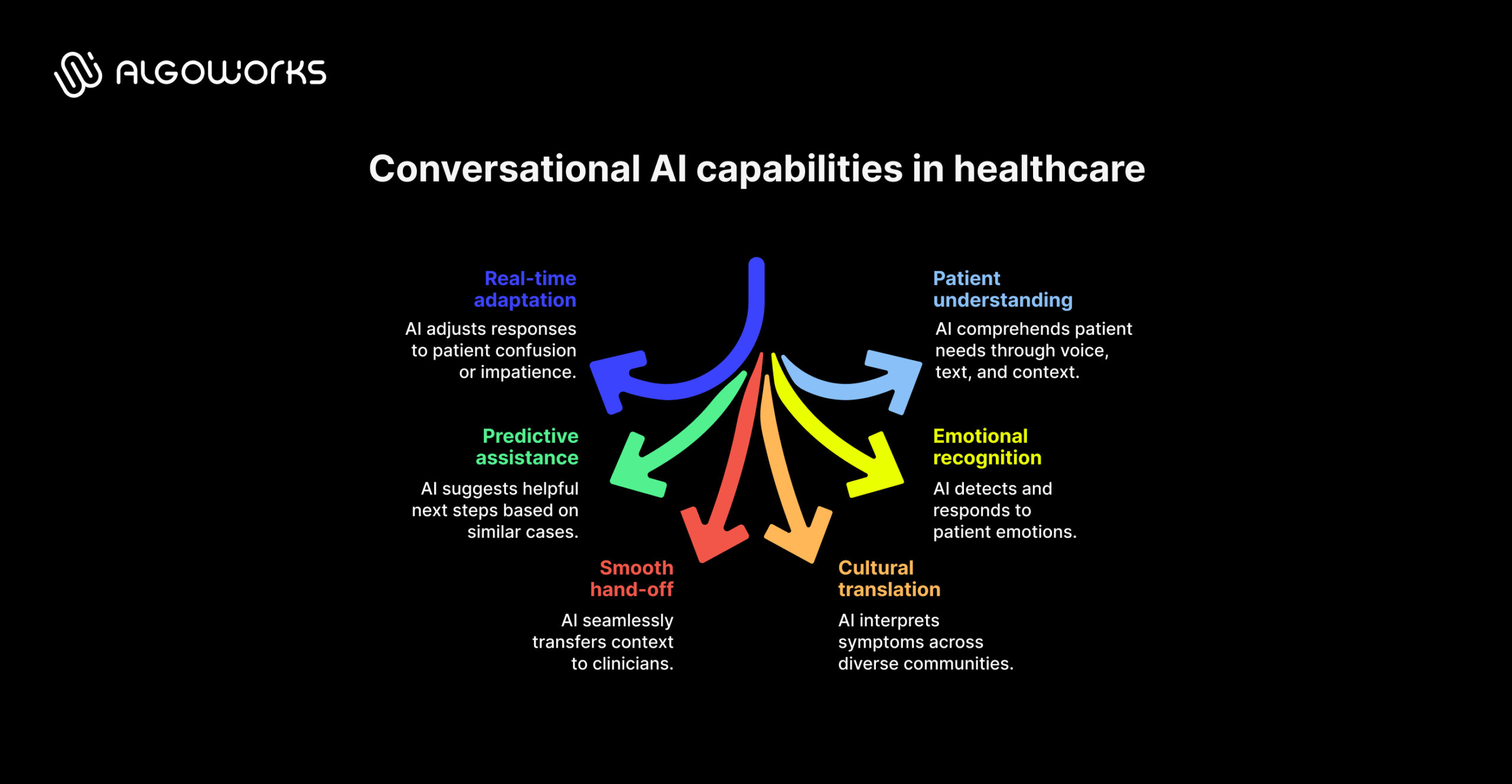
Modern systems now combine voice, text and contextual data to truly understand what patients need. They recognize emotional patterns in speech, learn from thousands of similar cases and know when to escalate before a patient asks.
Key capabilities that matter:
- Understands patients across voice, text and context. It picks up intent even when the question is vague.
- Recognizes emotional cues. Tone, pauses and pacing help the system sense worry or frustration and respond more gently or escalate faster.
- Translates with cultural context. It interprets how different communities describe symptoms.
- Hands off smoothly to clinicians. When a human needs to step in, the entire context carries over so patients don’t repeat everything from scratch.
- Predicts helpful next steps. It uses patterns from similar cases to suggest what the patient might need.
- Adapts responses in real time. If a patient seems confused or impatient, it simplifies explanations instead of sticking to a rigid script.
Key benefits of conversational AI in healthcare
The business case is straightforward. Conversational AI solves three specific problems that hit your bottom line directly.
No-show reduction
Generic reminders fail because they don’t address why patients skip appointments. Contextual AI reminders do. When systems include specific visit details and remove patient barriers, show rates improve dramatically; from 75% to 91% in implementing health systems. For a clinic running 100 daily appointments, that’s 16 extra slots daily. At $150 average revenue per appointment, that’s $2,400 extra per day or $600,000 annually just from better reminders.
This is why enterprise app development teams working on healthcare solutions prioritize reminder logic as a core feature rather than an afterthought.
Staff productivity
Administrative staff currently spend 90 minutes per shift managing phone queues for routine requests. Conversational AI cuts that to 30 minutes. That reclaimed 60 minutes per person per day gets redirected to prior authorizations, patient follow-ups and billing issues; work requiring actual judgment. Multiply that across a 50-person administrative team: that’s 50 hours weekly of high-value work that previously got lost in call volume.
Documentation speed
Physicians review clinical notes for an average of 8 minutes per encounter. AI-powered documentation that understands clinical context reduces this to 2 minutes while increasing completeness from 85% to 98%. A physician seeing 20 patients daily recovers 2 hours. They spend that time actually engaging with patients instead of reviewing screens. This measurable time recovery is becoming a key selling point for healthcare app development initiatives at enterprise level.
How conversational AI improve patient engagement and trust?
Patients don’t trust systems. They trust providers. Conversational AI either strengthens provider relationships or weakens them depending on design.
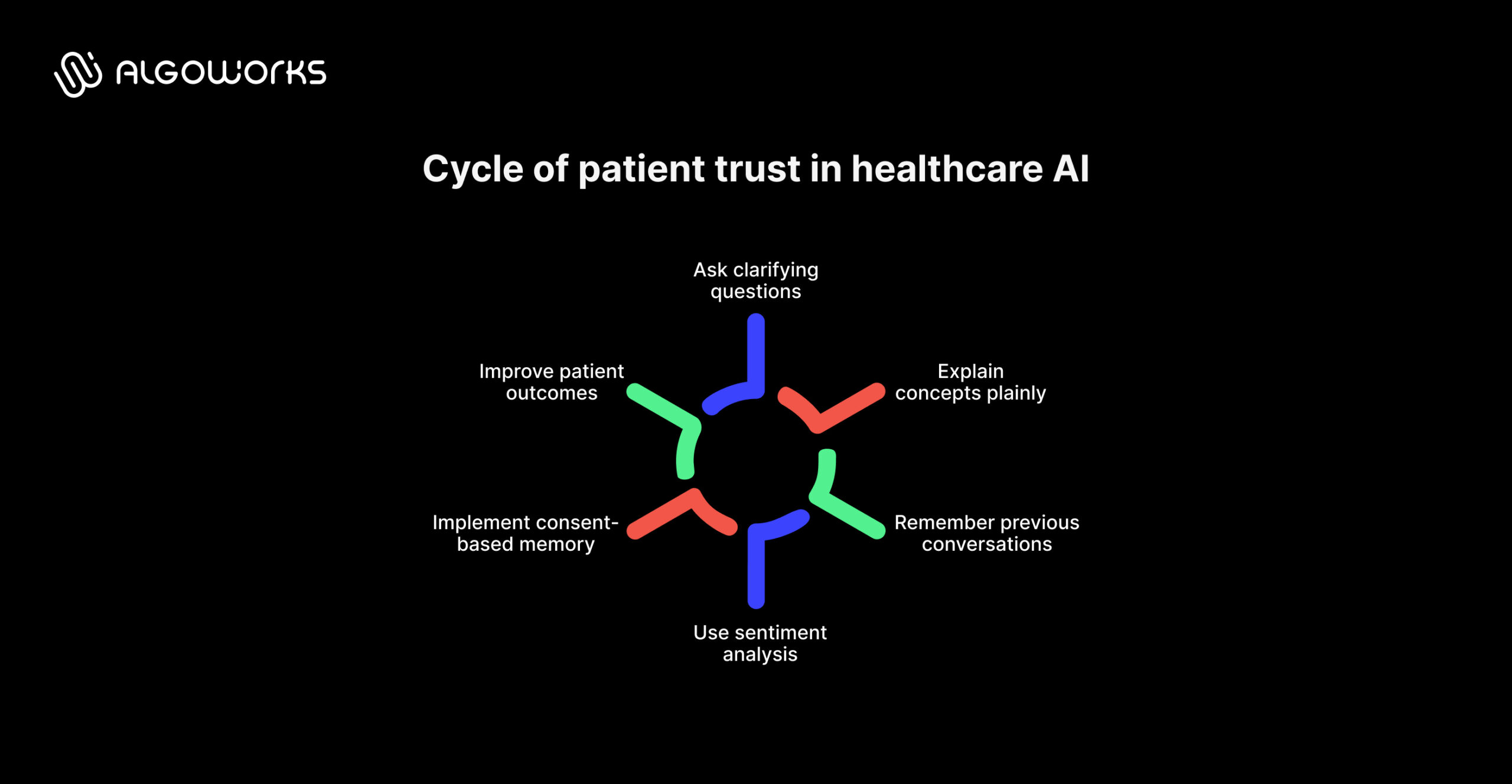
When AI asks clarifying questions before jumping to conclusions, patients feel heard. It explains complex concepts plainly with option choices, not directives, patients feel respected. Moreover, it remembers previous conversations and references, patients feel continuity. This might sound soft, but it’s measurable.
What’s changing now:
Forward-thinking health systems have started using sentiment analysis embedded in conversational AI. If patient satisfaction dips during interaction, detected through language patterns, response speed, question density; the system flags it and escalates earlier. Some are also implementing consent-based memory, where patients explicitly approve data retention between visits. This sounds like more bureaucracy, but it actually builds trust because patients control what’s remembered and why.
The outcome: patients who feel understood show up for appointments, follow treatment plans and recommend providers. That’s not theoretical; it’s how reputation and retention work in healthcare. When creating healthcare apps with trust as a foundational principle, these design choices separate solutions that create loyalty from those that just process transactions.
Conversational AI integration in healthcare apps: challenges & solutions
Installing conversational AI isn’t like adding software. It requires threading through existing workflows, connecting securely to patient records and maintaining compliance. Most implementations fail not because the AI is poor, but because integration gets rushed.
What makes implementation work
Start narrow. Choose one use case: appointment scheduling, post-visit follow-ups or insurance questions. Demonstrate ROI there before expanding. This approach lets staff adjust, lets security verify compliance and lets leadership see results before committing larger resources.
Each phase should validate:
- Does it integrate cleanly with your EHR?
- Do clinicians trust the workflow?
- Are patients actually using it?
- Is compliance verified?
The integration principle
Conversational AI only works when it talks to your existing systems. A brilliant chatbot that can’t access patient history is just an information booth. This is why many teams undertaking enterprise app development projects now start by mapping their entire technical ecosystem before designing conversational flows.
New consideration for 2026
Privacy-first integration is becoming table stakes. Systems now allow organizations to run AI locally on patient data rather than sending everything to cloud servers, addressing compliance concerns before they become problems. This approach costs more upfront but eliminates security debates later.
Start with clear goals. Partner with someone who understands healthcare and compliance, not just AI architecture. Involve clinicians early; they spot workflow issues before they become organizational problems.
Many successful implementations work with specialized app development services that combine healthcare expertise with technical depth, ensuring that the conversational layer actually integrates with how clinical teams work day-to-day.
Limitations of conversational AI in healthcare
Honesty matters. Conversational AI struggles with complex rare conditions, true emergencies and situations where tone and body language are critical. More importantly, it shouldn’t try. These moments require human judgment, not automation.
The design principle
Good conversational AI recognizes when it’s out of depth and escalates intelligently. A system that tries to handle everything fails at everything. One that knows its limits and passes patients forward confidently wins.
Where implementation derails
Leadership expects AI to replace clinical judgment—it won’t. Clinical staff resists because previous tech installations disappointed—valid concern worth addressing directly.
The reframing that works
Conversational AI protects clinical judgment by handling volume so clinicians do what they trained for. By removing administrative friction, it lets expertise actually be applied. That’s not reduction. That’s amplification.
Conversational AI implementation roadmap for healthcare apps
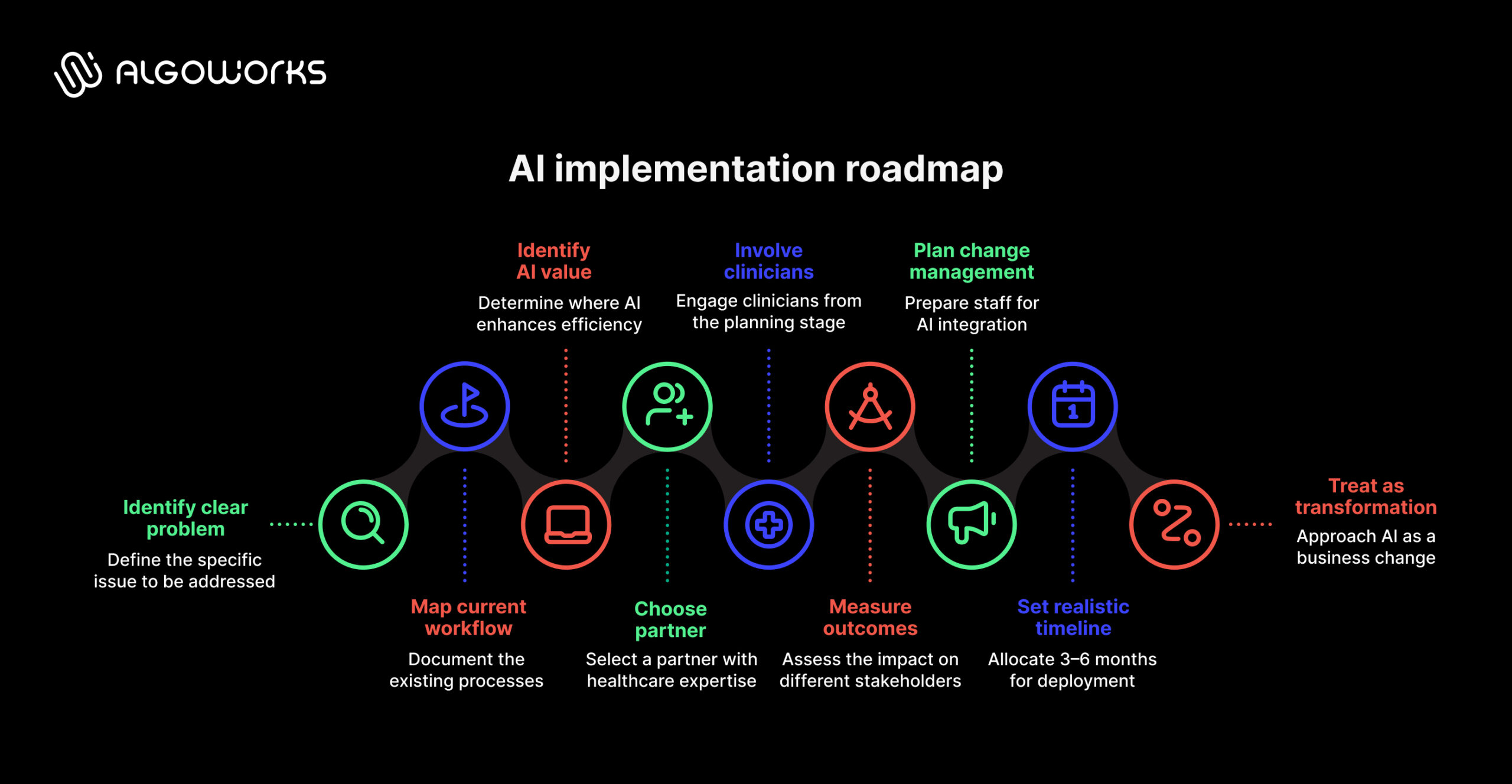
Implementation needs discipline. Start with one clear problem you’re solving. Map the current workflow. Identify where AI adds value versus where it creates friction.
The essential steps
Choose a partner who understands healthcare operations and compliance, not just AI code. Involve clinicians immediately; not in final approval, but from planning onward. They’ll spot integration issues, workflow conflicts and adoption barriers faster than anyone. This is particularly critical when creating healthcare apps because clinical workflows aren’t uniform; what works at one hospital might create friction at another.
Measure outcomes separately for different stakeholders. Clinicians care about time saved and care quality. Business leaders care about cost reduction and retention. Misalignment kills adoption.
Plan for change management upfront. Staff needs clarity that AI augments their work, not threatens it. Communication prevents resistance before it starts.
Timeline reality: Plan for 3-6 months from decision to live deployment if you’re starting narrow. Rushing this creates problems that waste months later.
Success comes from treating this as business transformation, not technology installation. When teams approach healthcare app development with this mindset, adoption accelerates and outcomes improve significantly.
Key takeaways on conversational AI in healthcare
Conversational AI works on healthcare app development because it solves real problems clinicians and administrators face daily; not because it’s innovative. When integrated thoughtfully in any enterprise app development with existing workflows and staff involved from the start, it becomes the infrastructure that lets healthcare providers actually practice medicine instead of managing logistics.
Algoworks can help you shape a solution that fits your workflows, your compliance needs and your long-term scalability. Ready to move from ideas to implementation? Reach out to us and let’s build it the right way.
FAQs
1. Does conversational AI replace clinicians?
No. It handles volume and routine queries so clinicians can focus on cases that genuinely need their expertise.
2. Is it safe to use AI with patient data?
Yes, when built with privacy-first architecture. Modern systems let organizations run AI locally, keeping PHI within secure environments.
3. Will patients actually use conversational interfaces?
They already are. Adoption spikes when the system reduces effort, remembers context and responds in plain language.
4. How long does implementation usually take?
A focused use case—like scheduling or follow-ups—typically goes live in 3–6 months, depending on your tech stack and integration depth.
5. What’s the biggest reason AI rollouts fail in healthcare?
Integrations get rushed. If the AI can’t talk to your EHR or doesn’t match real clinical workflows, adoption drops quickly.